

The shift from surviving to thriving is the move from daily endurance to living with purpose, resilience, and genuine fulfillment. For women over 40, this transition is not a luxury or a distant goal. It is a real, achievable change, grounded in science and supported by practical steps you can begin today. Research confirms that purpose and meaning account for 71% of the variance in mental well-being among midlife and older adults. That number tells you something important: this shift is not about willpower or positive thinking alone. It is about building the right conditions, inside and around you, for a life that feels like yours.
What mindset shifts help you overcome survival mode?
Survival mode is a recognizable state. You are managing, coping, getting through. But you are not fully present, and you are not moving toward anything that feels meaningful. The psychological term for the mental skill that breaks this pattern is psychological flexibility, defined as the ability to face difficult emotions without letting them control your behavior. Harvard Online teaches this skill as a practical, learnable set of responses to stress, avoidance, and uncertainty.
The most common trap in survival mode is avoidance coping. You sidestep the hard conversation, the unfulfilling routine, the question you are afraid to answer. Research from PLOS ONE shows that purpose in life directly supports active, problem-focused coping and reduces disengagement. Purpose does not just feel good. It changes how you respond when things get hard.
For women over 40, specific barriers make this shift harder. Years of showing up for others can leave your own preferences feeling unfamiliar, even suspicious. You may not know what you want because you have not been asked in a long time. The work here is not dramatic. It is quiet and iterative.
-
Recognize emotional reactivity as information, not instruction.
-
Replace avoidance with one small, direct action toward what matters.
-
Treat purpose as a behavior you practice, not a destination you find.
-
Notice which coping strategies restore you and which ones just delay the feeling.
Pro Tip: Try one small experiment this week. Choose one situation where you normally avoid or withdraw, and respond differently. Write down what you notice. This is how a thriving mindset gets built, one small test at a time.
How does your environment support or block thriving in midlife?
Your mindset does not operate in a vacuum. The process–ecological model of thriving shows that sustainable wellbeing emerges from the interaction between you and your environment. That means your relationships, your daily routines, and the physical spaces you inhabit either support your nervous system or keep it in a low-grade state of alert.
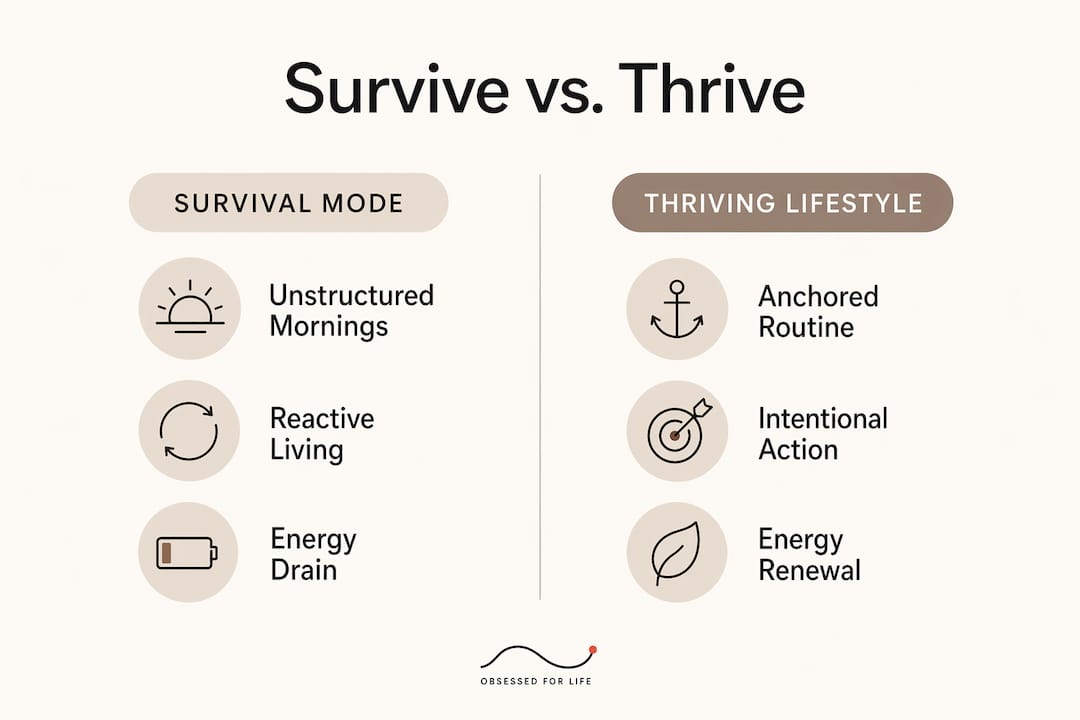
A system audit is the practical first step. You look at your calendar, your social circle, your home rhythms, and you ask: what drains me, and what restores me? This is not about eliminating all difficulty. It is about identifying the patterns that consistently pull you back into survival mode so you can make deliberate changes.
| Survival-mode trigger | Thriving-supportive alternative |
|---|---|
| Unstructured mornings with no anchor | A short, consistent morning rhythm (movement, quiet, intention) |
| Social obligations that leave you depleted | Relationships with reciprocity and genuine connection |
| Constant availability to others’ needs | Protected time that belongs entirely to you |
| Reactive scheduling driven by others | A weekly structure you design with your values in mind |
| Environments filled with noise and demand | Regular access to quiet, nature, or restorative spaces |
The table above is not a checklist of perfection. It is a mirror. You may recognize yourself in one column or several. The point is that ecological changes alongside inner work create sustainable wellbeing in a way that mindset shifts alone cannot.
Pro Tip: Spend 10 minutes this week reviewing your last seven days. Mark each activity as draining, neutral, or restorative. The pattern you see is your system audit. Use it to make one concrete change to your daily routines next week.
How do you build a personal vision of thriving after 40?
A thriving vision is not a five-year plan. It is a living picture of what a good life looks and feels like for you, right now, in this season. For women over 40, this picture has often been shaped by what others needed. Building one that is genuinely yours requires starting with values, not goals.
Values are the qualities that make life feel meaningful when you are living in alignment with them. Honesty, creativity, connection, freedom, contribution. When you know your values, you have a compass. Goals without values are just tasks. Values without goals stay abstract. The combination is what moves you forward.
The SPARC model, developed by Understood, frames thriving as personal and non-linear. Progress looks different in different areas of life, and it cycles rather than climbs steadily upward. This framing matters because it removes the all-or-nothing thinking that stops many women from starting.
Here is a practical sequence for building your vision:
-
Name your values. Write down five qualities that matter most to you right now, not the ones you think should matter.
-
Describe a thriving day. What does a day look and feel like when you are living well? Be specific about time, people, and activities.
-
Identify one area to focus on first. Relationships, health, creativity, work, or purpose. Pick one and go deeper rather than spreading thin.
-
Set a small, measurable goal. Instead of “be healthier,” use “walk for 20 minutes three mornings this week.” Specificity creates momentum.
-
Schedule a monthly check-in. Revisit your vision and ask: does this still fit? What has shifted? Adjust without judgment.
Writing a personal life vision after 40 is one of the most clarifying things you can do. It is not about having all the answers. It is about asking the right questions with enough honesty to hear your own response.
What challenges should you expect on the path to flourishing?
Thriving is not linear. The SPARC model is explicit about this: progress varies by life context, and setbacks are part of the process, not evidence of failure. Life transitions common in midlife, including retirement, children leaving home, health changes, or relationship shifts, can pull you back into survival patterns even after real progress.
The most useful thing you can do when this happens is name it without judgment. “I am back in survival mode right now” is information. It is not a verdict. Resilience in this context is not toughness. It is the ability to notice where you are and take one small step back toward what matters.
-
Practice self-compassion as a skill, not a sentiment. Treat yourself with the same patience you would offer a close friend.
-
Identify your early warning signs. What does it feel like in your body when you are slipping back? Tension, withdrawal, irritability?
-
Keep your vision visible. A written note, a photo, a single word on your mirror. Small anchors matter during hard seasons.
-
Know when to ask for support. A therapist, a coach, or a trusted community can hold the thread when you temporarily lose it.
Pro Tip: Set a quarterly progress checkpoint. Ask yourself three questions: What has improved? What has pulled me back? What one change would help most right now? This practice keeps your path to moving to prosperity honest and self-directed.
Key takeaways
The shift from surviving to thriving requires purpose, psychological flexibility, and deliberate changes to your environment, not just a better attitude.
| Point | Details |
|---|---|
| Purpose drives coping | Living with purpose supports active, problem-focused responses instead of avoidance. |
| Environment shapes wellbeing | Auditing your routines and relationships is as important as inner mindset work. |
| Thriving is non-linear | Expect setbacks and use the SPARC model’s cyclical view to stay compassionate with yourself. |
| Values anchor your vision | A thriving vision built on personal values creates lasting motivation and direction. |
| Small experiments build change | Testing new behaviors in low-stakes moments is how psychological flexibility grows over time. |
What I have learned about thriving that most articles miss
I have watched women over 40 arrive at this question with a particular kind of exhaustion. Not the tiredness that sleep fixes. The kind that comes from years of being excellent at what everyone else needed, while quietly setting themselves aside. What strikes me most is how often they assume the problem is motivation. They think they just need to want it more.
The research tells a different story. Action for Happiness frames the shift as beginning not with ambition but with stopping the hiding. Emotional exhaustion and disconnection keep women stuck far more than lack of drive. The wound is not laziness. It is the habit of making yourself invisible.
What I have seen work is not grand reinvention. It is the ecological audit. The woman who finally blocks Tuesday mornings for herself. The one who stops attending the social obligation that leaves her hollow every time. These are not dramatic moves. But they change the nervous system’s baseline, and that changes everything downstream.
The other thing I would say plainly: purpose is not a thing you find. It is a thing you practice. You try something. You notice how it feels. You adjust. The SPARC model’s non-linear framing is not just academically accurate. It is a relief. You do not have to get it right the first time. You just have to keep going with honesty and a little self-compassion.
The women I most admire in this season are not the ones who figured it all out. They are the ones who kept asking the question.
— Theresa Stairs
What Obsessedforlife offers women ready to move forward
You have spent years being the answer to everyone else’s questions. Now one question belongs entirely to you: what do I want with my life?
Obsessedforlife was built for exactly this moment. The Obsession Map is an original guided assessment that helps women 40 and beyond identify what brings them joy in this season, what values drive them, and what experiences are waiting in this chapter. It is not a quiz. It is a thoughtful process that listens to who you are and reflects back a picture of what lights you up. If you are ready to move from surviving to a life that feels genuinely yours, Obsessedforlife is where that begins.
FAQ
What does it mean to shift from surviving to thriving?
The shift from surviving to thriving means moving beyond daily coping to living with purpose, positive emotion, and resilience. Frontiers in Psychology defines thriving as optimal functioning, marked by positive emotionality and mental clarity, rather than merely the absence of distress.
How long does it take to move out of survival mode?
There is no fixed timeline. The SPARC model confirms that thriving is non-linear and varies across life contexts, so progress in one area may be faster than in another. Consistent small changes to mindset, routine, and environment produce measurable shifts over weeks and months.
Why is purpose so important for women over 40 who want to thrive?
Purpose accounts for a significant share of mental wellbeing in midlife adults and directly supports active coping strategies over avoidance. Without a sense of meaning, women are more likely to disengage from challenges rather than move through them.
What is the SPARC model and how does it apply to thriving?
The SPARC model, developed by Understood, frames thriving as personal, multi-dimensional, and non-linear. It helps women set realistic expectations, use check-in points to reassess progress, and respond to setbacks with adjustment rather than all-or-nothing judgment.
Can changing your environment really help you thrive?
Yes. The process–ecological model shows that thriving requires both inner work and environmental change. Adjusting your routines, social dynamics, and physical spaces directly affects your nervous system and your capacity for sustained wellbeing.