

You are standing at a threshold you did not plan for, and the question rising in you feels both terrifying and alive. What is a life pivot after 40? Simply put, it is a deliberate realignment of your life’s direction, not a dramatic wipeout of everything you have built. Psychologists call it an intentional life transition, and it is fundamentally different from a midlife crisis or a fresh start from zero. It is the moment you stop organizing your life around what others need and start asking what this next chapter is genuinely for.
Table of Contents
Key Takeaways
| Point | Details |
|---|---|
| A pivot is realignment, not starting over | Life pivots build on your existing experience and values rather than erasing what came before. |
| Biology is part of the picture | Hormonal shifts during perimenopause and menopause influence energy, priorities, and decision-making in ways worth understanding. |
| Transferable skills are your foundation | Your professional and personal history gives you leverage most younger career changers simply do not have. |
| Phased approaches reduce risk | Testing new directions before making dramatic leaps protects your finances and your confidence. |
| Joy is a legitimate compass | Choosing your next direction based on what genuinely lights you up is not indulgent. It is strategic. |
What a life pivot after 40 really means
The phrase “life pivot” gets thrown around a lot, but the meaning matters. A pivot, in psychological terms, is not a retreat from your past. It is a realignment with meaning, a process of bringing your outer life into closer alignment with the values, purposes, and desires that have been quietly clarifying themselves for years.
Midlife transitions ask us to prioritize personal values and meaning over achievement and performance. That shift is not a crisis. It is a maturation.” — British Psychological Society.
The culture loves the term “midlife crisis” because it makes a tidy narrative. But that framing puts you in a passive role, someone who is falling apart rather than waking up. Reframing midlife as opportunity changes everything: your motivation, your risk tolerance, and the quality of your planning. When you call it an opportunity, you start asking better questions.
A life pivot after 40 also looks different from a pivot at 25. At 25, you are building from scratch. At 42 or 55, you are carrying two decades of skills, relationships, professional credibility, and hard-won self-knowledge. Career pivots at midlife are most successful when they are treated as strategy-guided changes that leverage what you already know, not departures from it.
Pro Tip: Make a “skills inventory” before you plan a single next step. List every skill you use regularly, across every area of life, not just your job. Most women are carrying far more transferable capability than they realize.
The distinction between a job, a career, and a calling is worth sitting with here. A job pays the bills. A career builds over time. A calling pulls you toward work that feels like an expression of who you actually are. Many women over 40 discover they have spent years in a job or a career that was never quite a calling. The pivot is the moment they decide to find out what that calling might look like.
What catalysts typically trigger life changes after 40
No pivot happens in a vacuum. Something shifts first, sometimes loudly and sometimes so quietly you almost miss it.
The most common catalysts for life changes after 40 include:
-
Career dissatisfaction or burnout. Years of performing without feeling seen or fulfilled eventually create a kind of internal pressure that demands release. It is not weakness. It is information.
-
Biological changes. Perimenopause and postmenopause affect sleep, concentration, mood, and energy in ways that directly influence women’s decision-making and priorities. Many women describe this phase as the moment their tolerance for misalignment dropped to zero.
-
Shifts in family roles. Children leaving home, a marriage ending, aging parents requiring care, or a long relationship changing shape can all create a sudden, startling amount of space. That space is an invitation.
-
The legacy question. At 40 and beyond, many women begin asking not just “What do I want to do?” but “What do I want to have mattered?” That is a deeper, richer question, and it deserves a deeper answer.
Americans hold an average of 2.9 jobs between ages 35 and 44, and 2.2 between 45 and 54. Career mobility in midlife is not unusual. It is, increasingly, the norm. You are not breaking a pattern. You are part of one.
What makes women’s pivots at this stage distinct is the biological layer. Hormonal changes are not just a physical experience. They reshape what feels tolerable, what feels urgent, and what no longer seems worth the sacrifice. Ignoring that layer does not make you stronger. Acknowledging it makes you smarter.
How to approach a strategic pivot
A life pivot is not something you decide at 11 pm on a Tuesday and execute by Thursday. It is a process. And the women who navigate it most steadily are the ones who treat it as one.
Here is a practical approach worth considering:
-
Start with a self-assessment. Before you redesign your life, you need to understand what it is you actually want from it. Values mapping, journaling, and tools like the Ikigai framework (which asks where your passions, skills, the world’s needs, and earning potential intersect) offer structured ways to clarify direction without guesswork.
-
Audit your transferable skills. Strategically leveraging your existing network and skills is what separates a confident pivot from a panicked leap. Most women have far more to offer a new field than they think.
-
Use bridge roles. Career experts recommend treating early pivot roles as bridges, not final destinations. A role that builds relevant experience or supplements your income while you test a new direction helps protect your morale and finances during a vulnerable transition.
-
Plan your finances before you move. Talk with a financial literacy counselor who understands midlife transitions. Organizations like Storehouse Firm offer coaching specifically designed to support people rethinking their financial structures during major life changes.
-
Build emotional resilience practices. Setbacks during a pivot are not signs that you chose the wrong path. They are tuition. The women who sustain their pivots are the ones who expected some turbulence and built practices to steady themselves through it.
Pro Tip: Don’tt quit your current role before you have at least one bridge in place. Test your new direction on evenings and weekends first. Real-world data about what energizes you is worth far more than a theory.
Setting new goals after 40 is not about erasing what came before. It is about layering a new season of meaning onto everything you have already built.

Comparing types of life pivots
Not every life transformation at 40 looks the same. Understanding which type of pivot fits your season makes planning far more specific.
| Pivot type | What it involves | Key benefit | Primary challenge |
|---|---|---|---|
| Career rebrand | Shifting roles within or adjacent to your field | Minimal skill gap, faster income recovery | Identity shift if you are heavily tied to old title |
| Full industry change | Moving to an entirely new field | Potential for deep fulfillment | Longer runway, possible pay cut initially |
| Personal growth pivot | Refocusing on education, health, or relationships | Whole-life realignment | Harder to quantify progress |
| Entrepreneurship | Starting your own venture or practice | Autonomy and legacy-building | Financial risk and isolation |
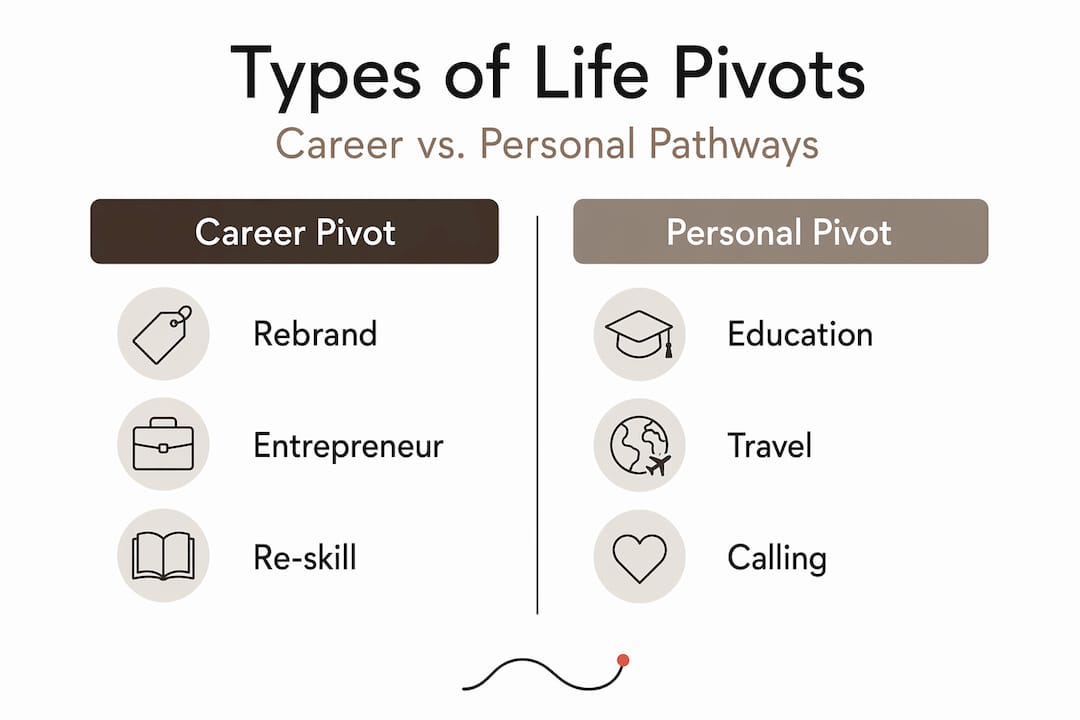
Some women pursue a single pivot type. Many pursue combinations. A woman who leaves corporate law to launch a wellness coaching practice is doing a career rebrand, an entrepreneurial pivot, and a personal growth pivot simultaneously.
Experiences worth exploring after 40 are not limited to careers, either. Personal pivots focused on education, travel, creative practice, or physical health are just as meaningful and often lay the groundwork for later career changes.
The biggest myth about entrepreneurship after 40 is that it requires starting completely fresh. In reality, most successful midlife entrepreneurs are monetizing expertise they already hold, just in a new structure. Midlife is increasingly treated as a career rebrand moment, not a crisis, and women who approach it that way tend to build with far more confidence.
Practical tools and support for your pivot
Knowing you want to pivot is one thing. Knowing where to begin is another. These resources and practices make the process more grounded:
-
Values mapping. Write down the five experiences in your life when you felt most like yourself. Look for the patterns. What values do they share? That pattern is your compass.
-
The Ikigai framework. This Japanese concept asks you to find the overlap between what you love, what you are good at, what the world needs, and what someone will pay for. It is a simple lens with real depth.
-
Medical and counseling support. If you are experiencing perimenopause or postmenopause symptoms, combining healthcare counseling with life planning creates a more stable foundation for decision-making. Mental clarity is not optional when you are redesigning your life.
-
Peer communities and coaching. Isolation is a pivot’s worst enemy. Seek out communities of women at similar life stages. Coaching accelerates the process by offering outside perspective when you are too close to see clearly.
-
Career tools built for midlife. Platforms like CareerMatch offer resources specifically designed for people later in their careers who are weighing education, skill development, and transition strategies.
Pro Tip: Do not wait until you have a plan to start moving. Choose one small experiment this week: one conversation, one course module, one afternoon doing the thing you have been curious about. Motion creates clarity in ways that thinking rarely does.
My perspective on pivoting with purpose
For me: the hardest part of a life pivot after 40 isn’t the practical logistics. It is the identity question.
For years, many of us built our sense of self around what we did and who we showed up for. Stepping out of that structure does not just feel uncertain. It can feel like losing yourself. I have seen that fear stop brilliant women cold, not because they lacked capability, but because they did not yet know who they were outside their roles.
What I have learned is this: the uncertainty is not the problem. It is the beginning. The moment you cannot default to your old identity is the moment you get to choose a truer one. That is not comfortable. But it is rare and worth protecting.
I also want to push back on the idea that patience during a pivot means passivity. Patience means trusting the process while still showing up for it every day. You do not get to coast through a reinvention. You engage with it. Slowly, thoughtfully, and without apology.
Finally, I want to say this directly. You are not starting over. You are starting from. From everything you know, everyone you have loved, every hard season that clarified your values. The pivot is not an erasure of your past. It is the most sophisticated use of it.
— Theresa Stairs
Ready to find your next direction?
If something in this article stirred a recognition in you- that quiet knowing that this season is yours to define- Obsessedforlife was built for exactly this moment. The Obsession Map is an original guided assessment that helps women over 40 identify what genuinely brings them joy, what values are driving them now, and what experiences belong to this chapter of their lives. It does not tell you what your pivot should be. It reflects who you already are, so the path forward feels yours unmistakably. Whether you are 42 or 62, this is not too late. This is, in fact, exactly the right time to begin.
FAQ
What exactly is a life pivot after 40?
A life pivot after 40 is a deliberate, values-driven shift in your life’s direction that builds on your existing experience rather than abandoning it. Psychologists describe it as an intentional life transition focused on aligning your outer life with deeper personal meaning.
How is a life pivot different from a midlife crisis?
A midlife crisis is typically reactive and driven by fear or loss. A life pivot is proactive, shaped by values and purpose, and involves structured planning rather than impulsive change.
Can I pivot careers at 40 without starting from scratch?
Yes. Most successful midlife career changes leverage transferable skills and networks you already have. A phased approach, using bridge roles and targeted upskilling, reduces risk significantly.
How do hormonal changes affect a life pivot after 40?
Perimenopause and postmenopause can affect sleep, mood, and mental clarity, all of which influence major decisions. Aligning medical counseling with life planning creates a stronger foundation during this transition.
How long does a life pivot after 40 typically take?
There is no fixed timeline, but most experts treat midlife pivots as transformational processes that unfold over months to years rather than weeks. Building in patience while staying in motion is the balance that sustains progress.