

A personal life vision is a clear, present-tense statement that defines who you are, what you value, and how you intend to live — not someday, but now. For women over 40, this kind of clarity is less a luxury and more a compass. The years of showing up for everyone else have a way of quietly erasing your own direction. Writing your life plan from scratch, grounded in your current identity rather than an old resume of roles, is one of the most honest and freeing things you can do at this stage. This article walks you through every step: from the foundational questions to the practical tools that keep your personal vision statement alive and evolving.
What does it mean to write a personal life vision?
A personal life vision is not a bucket list, a career goal, or a five-year plan. It is a living declaration of who you are becoming, written as if it is already true. The standard industry term for this is a personal vision statement, and it serves a specific function: it acts as a filter for every decision, large or small, that shapes how you spend your time and energy.
A clear, written vision transforms wishfulness into a practical guiding direction. That distinction matters enormously. Wishfulness is passive. A written vision is a commitment you return to when life gets noisy or uncertain.

For women at midlife, the importance of a personal vision is amplified by a specific kind of transition. Many arrive at 40, 50, or 60 having been extraordinarily good at what others needed. The question that rises now, sometimes quietly and sometimes with real urgency, is: What do I actually want? Writing a personal life vision is how you begin to answer that question with intention rather than accident.
Pro Tip: Keep your vision statement between 30 and 40 words, structured in two sentences. The first sentence names your focus or way of being. The second explains the impact or reason it matters to you.
What foundational elements belong in your vision?
Before you write a single word of your vision, you need raw material. That material comes from three sources: your values, your current strengths, and your genuine interests. Not the interests you think you should have. The ones that actually light you up when no one is watching.
Start with values. At midlife, values tend to sharpen. The things you tolerated in your thirties may feel genuinely wrong now. Identifying your core values, words like freedom, depth, creativity, service, or presence, gives your vision its backbone. Without them, a vision statement is just pretty language.
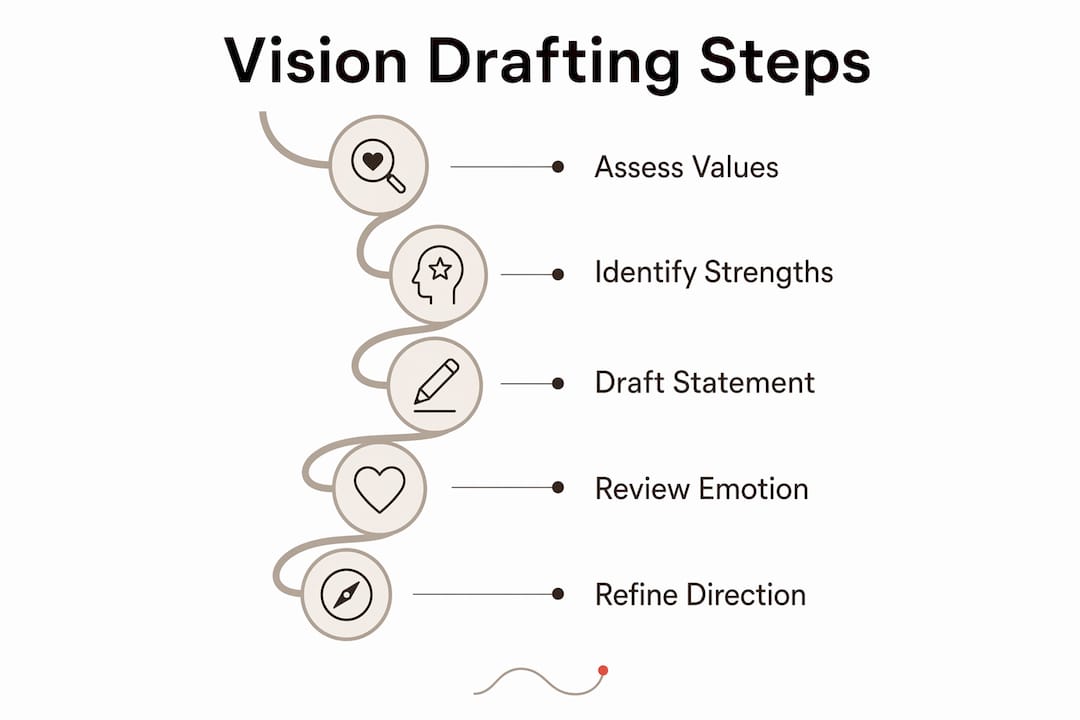
Recognize your present strengths. One of the most common mistakes in vision writing is confusing identity with aspiration. Focusing on present identity rather than aspirational roles releases outdated obligations and opens genuine possibilities. You are not writing a job description for a future self. You are naming who you already are, more fully.
Clarify your interests. Ask yourself where time disappears for you. What conversations leave you energized? What topics do you read about without being asked? These are not trivial clues. They are the architecture of a life that feels like yours.
One of the most powerful exercises for this stage is to write your own obituary. It sounds confronting, but it is clarifying in a way few other exercises match. When you summarize your life from the end looking back, what you valued and what you want to be remembered for becomes surprisingly clear. That clarity belongs in your vision.
-
Write down 5 to 7 values that feel non-negotiable right now, not inherited, not performed.
-
List 3 strengths you are already living, not ones you hope to develop.
-
Name 2 to 3 areas of life where you feel most alive or most curious.
-
Draft a single paragraph of your obituary, focusing on how you want to have lived, not what you want to have achieved.
How to draft your personal vision statement effectively
The drafting process is where most people stall. They wait for the perfect words, the perfect moment, the perfect level of certainty. None of those arrive on schedule. The most effective method bypasses that waiting entirely.
-
Set a timer for 20 minutes and write without stopping. Non-stop writing for 20 minutes is specifically recommended to bypass your inner critic. Do not edit. Do not reread. Just write everything that comes when you ask yourself: Who am I, and how do I want to live?
-
Revise 6 to 7 times. A single draft is never the vision. Experts recommend iterating through six to seven revisions to arrive at a statement that feels directionally true. Each pass strips away what is borrowed and sharpens what is genuinely yours.
-
Write in the present tense. Present-tense framing programs your subconscious toward immediate realization rather than perpetual future-chasing. “I am a woman who…” lands differently than “I want to become…” The first is an identity claim. The second is a wish.
-
Aim for 30 to 40 words in two sentences. A concise vision statement has a first sentence that names your field or way of being, and a second that explains the reason or impact. Brevity forces honesty.
-
Read it aloud. If it sounds like someone else wrote it, it needs another pass. Your vision should feel like your own voice, not a LinkedIn summary.
Pro Tip: If you feel resistance or emotion while writing, stay with it. Resistance usually means you are getting close to something true. Emotion is confirmation, not a sign to stop.
The goal at this stage is not perfection. It is direction. A vision that is 80% right and written is infinitely more useful than a perfect one still living in your head.
Tools and practices to keep your vision alive
Writing the vision is the beginning, not the destination. A personal vision statement left in a notebook drawer does very little. What keeps it alive is a set of simple, repeatable practices.
Build a living vision book. Rather than a static document, a vision book is a journal you return to regularly, adding reflections, revisions, and evidence that your vision is taking shape. Handwriting your vision entries anchors intentions more deeply than typing. The physical act of writing encodes your intentions in a way that a screen simply does not replicate.
Schedule quarterly reviews. Your vision at 42 will not be identical to your vision at 47. Life changes, and your vision should be allowed to change with it. A quarterly review, even 30 minutes with your journal and a cup of tea, lets you check whether your current life is moving toward your stated vision or quietly drifting away from it.
Use a vision board as reinforcement, not a starting point. Vision boards work best after you have a clearly defined written vision. They are visual reinforcement, not a substitute for the harder work of articulating what you actually want. Once your vision is written, images and words that reflect it can serve as daily reminders.
| Practice | How it supports your vision |
|---|---|
| Living vision book | Captures revisions and reflections as your vision evolves over time. |
| Quarterly review | Keeps your vision current and aligned with your changing priorities. |
| Handwritten entries | Deepens subconscious assimilation of your intentions. |
| Vision board | Provides daily visual reinforcement after your written vision is clear. |
| Monthly action steps | Translates vision into concrete behavior, one small step at a time. |
Common challenges women 40+ face when defining their vision
The path to a clear personal vision is rarely straight. Several specific obstacles tend to surface for women at midlife, and naming them is the first step to moving through them.
“Clarity on life vision at midlife often demands clearing past limiting beliefs. It is a staged process, not an instant revelation.” — Life Vision Coaching Insights
The weight of “shoulds.” Many women arrive at this work carrying a long list of what they should want: security, stability, a tidy narrative of progress. These inherited expectations crowd out genuine desire. The practice here is simple but not easy: every time you write a “should,” replace it with a question. What do I actually want here?
Confusing roles with identity. A woman who has spent 20 years as a mother, a caregiver, or a professional can find her identity so fused with those roles that she struggles to see herself apart from them. Shifting from role to present identity is the pivot that makes an authentic vision possible. You are not your job title. You are not your relationship status. You are a person with a specific way of seeing the world, and that is what belongs in your vision.
Impatience with the process. Vision clarity rarely arrives in one sitting. It emerges in stages, after clearing the noise of obligation and expectation. Give yourself permission to be in the middle of the process. A partial vision is still a compass.
-
Notice when you are writing what sounds good versus what feels true.
-
Share your draft with one trusted person who knows you well, not to get approval, but to hear it reflected back.
-
Read about new goals after 40 to understand why this season genuinely calls for a different kind of direction.
-
If you feel stuck, return to the obituary exercise. It cuts through noise faster than almost anything else.
A documented personal vision also serves as a stabilizing force during sudden life changes like divorce, loss, or career disruption. It prevents the negative spiraling that comes from having no internal reference point when external structures fall away.
Key takeaways
Writing a personal life vision works because it transforms a vague sense of wanting more into a clear, present-tense identity claim that guides every decision.
| Point | Details |
|---|---|
| Start with values and present strengths | Ground your vision in who you already are, not who you think you should become. |
| Write non-stop, then revise repeatedly | Twenty minutes of unfiltered writing followed by six to seven revisions produces a genuine statement. |
| Use present tense throughout | Present-tense framing reduces mental friction and anchors your vision as current reality. |
| Build a living vision book | A journal you return to quarterly keeps your vision evolving alongside your life. |
| Clear limiting beliefs first | Vision clarity at midlife is a staged process; patience with that process is part of the work. |
What I’ve learned from living with a written vision
I resisted writing a personal vision statement for longer than I care to admit. It felt like homework. It felt like the kind of thing people did in corporate retreats and then forgot about by Tuesday. I was wrong about that.
The first time I wrote mine, it was messy and too long and borrowed language from books I had read rather than from my own life. But even that imperfect draft did something unexpected: it made certain decisions easier. When an opportunity came up that felt exciting but hollow, I read my vision and knew immediately it was not mine to take. That clarity was worth every awkward revision.
What I did not expect was how much the vision would change. The version I wrote at 44 is almost unrecognizable compared to what I carry now. And that is not failure. That is the point. A vision that never changes is a vision that stopped listening to you. The practice of returning to it, questioning it, and rewriting it is itself a form of intentional living that most people never experience.
The one thing I would tell anyone starting this process: do not wait until you feel ready. Write the imperfect version. Read it out loud. Cringe a little. Then revise. The woman who shows up in the fifth draft is someone worth knowing.
— Theresa
Start your vision with Obsessedforlife
If you have read this far, something in you is already ready to begin. Obsessedforlife is a self-discovery platform built specifically for women 40 and beyond who are asking, perhaps for the first time in years, what they actually want with their lives. The Obsession Map is an original guided assessment that helps you identify what brings you joy in this season, what values drive you, and what experiences are genuinely waiting for you in this chapter. It is not a quiz. It is a mirror. Visit Obsessedforlife and let the path forward feel like yours, because it is.
FAQ
What is a personal vision statement?
A personal vision statement is a concise, present-tense declaration of who you are and how you intend to live, typically 30 to 40 words across two sentences. It serves as a personal compass for decision-making and intentional growth.
How long does it take to write a personal life vision?
The initial draft takes about 20 minutes of non-stop writing, but a genuinely useful vision emerges after six to seven revisions over days or weeks. Clarity is a process, not a single sitting.
Should my vision change over time?
Yes. A living vision book with quarterly reviews allows your statement to evolve as your priorities and identity shift. A vision that never changes has likely stopped reflecting who you actually are.
What if I don’t know what I want?
Start with the obituary exercise: write a paragraph about how you want to have lived, not what you want to have achieved. That emotional clarity is the raw material your vision needs.
Is a vision board the same as a personal vision?
A vision board is a visual reinforcement tool, not a substitute for a written vision statement. Vision boards are most effective after you have already articulated your vision in words.