
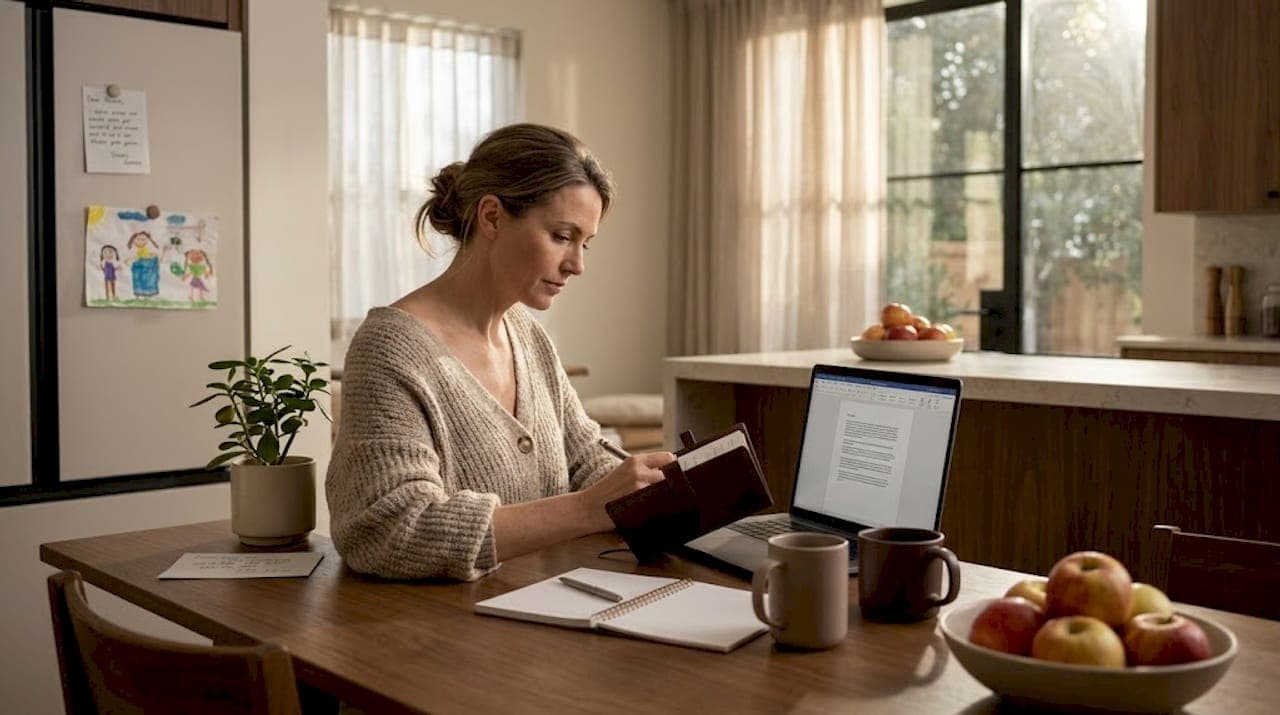
There is a quiet assumption many of us have carried for years: that the house, the meals, the emotional labor, the school pickups — all of it was the opposite of growth. A detour. Something you managed while your real life waited. But the role of domestic life in personal growth is far more layered than that story suggests. For women moving through their 40s and beyond, home is often where the deepest identity work happens. Not despite the dishes and the family dynamics, but through them.
Table of Contents
Key takeaways
| Point | Details |
|---|---|
| Home shapes who you become | Supportive domestic environments are key predictors of well-being, self-efficacy, and moral development across a lifetime. |
| Role shifts create growth space | When caregiving roles evolve from managing to supporting, you gain room to reconnect with your own identity. |
| Small habits compound quietly | Improving just 1% daily compounds into 37x growth over a year, making incremental home-based habits genuinely powerful. |
| Identity anchors habits | Seeing yourself as “someone who does X” sustains growth far longer than motivation alone. |
| Fair space prevents resentment | Unbalanced domestic labor quietly erodes personal growth. Shared responsibility creates the conditions for everyone to flourish. |
The role of domestic life in personal growth
The research is more detailed than most of us were taught. Healthy domestic environments are among the strongest predictors of individual well-being and personal development across a lifetime. The home is not a backdrop. It is a primary context where psychological development, emotional intelligence, and self-concept take shape.
Think about what domestic life actually asks of you. Conflict resolution. Emotional regulation under pressure. Long-term thinking. Patience that gets tested daily. These are not soft skills. They are exactly the capacities that define mature psychological development.
A supportive home environment builds self-efficacy, the belief that you are capable of meeting challenges. It strengthens your sense of moral identity. It gives you a living laboratory for practicing what matters most: empathy, consistency, and repair after rupture.
The contrast matters too. Dysfunctional home dynamics can have real costs on personal growth, including anxiety, diminished self-worth, and a harder road to trusting your own instincts. This is not about blame. It is about recognizing that the conditions inside your home either support or strain the person you are becoming.
| Domestic environment | Impact on personal growth |
|---|---|
| Emotionally safe, reciprocal | Builds self-efficacy, confidence, emotional resilience |
| Clear shared responsibilities | Reduces resentment, creates space for individual pursuits |
| Open communication | Strengthens trust, models healthy relationship repair |
| Chaotic or dismissive | Can create chronic stress, lower self-trust, stalled identity |
| Emotionally enmeshed | Limits healthy separation and individual identity formation |
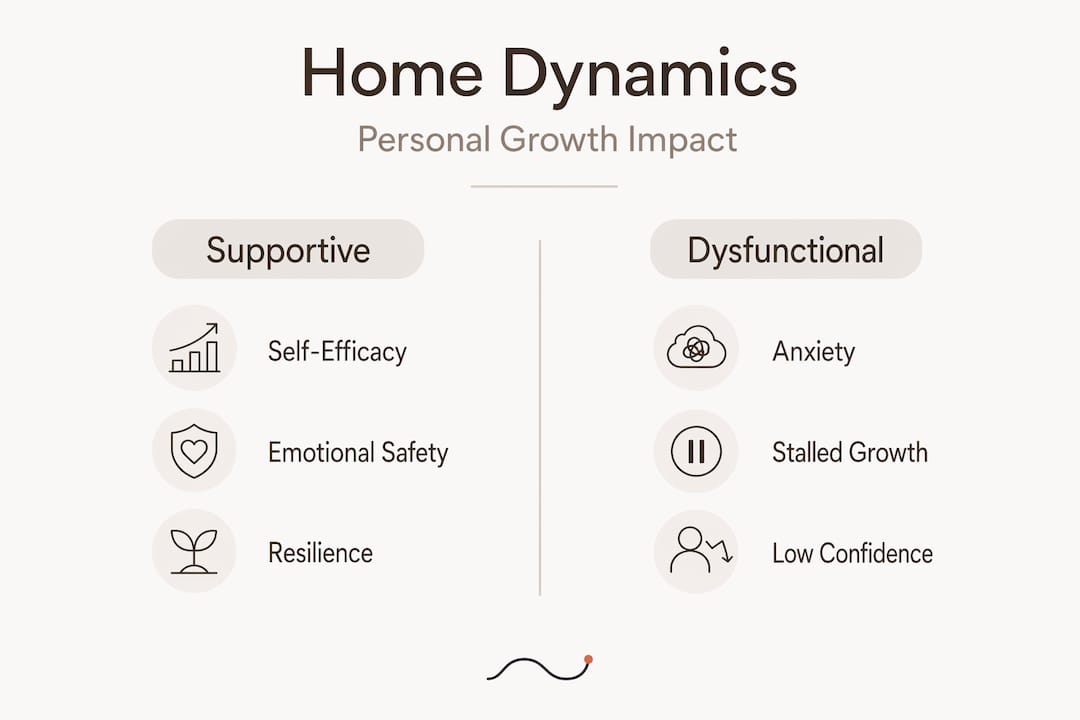
What this tells you is something worth sitting with. The quality of your domestic life is not just a background condition. It is active material for who you are becoming.
When roles shift, and identity opens
One of the most disorienting and genuinely promising things about being 40 or older is that the domestic roles you have been living inside start to loosen. Children need you differently. Relationships renegotiate themselves. The shape of “what I do here” starts to soften at the edges.
This loosening is not loss. Family systems researchers describe it as healthy separation, the process by which mature family roles shift from managing and directing to consulting and supporting. For years, you may have been the architect of everyone’s daily life. That work had real value. The replacement cost of domestic labor is estimated at $160,000 to $220,000 annually when you factor in childcare, household management, and care coordination. It is not invisible. It is just rarely named.
But when that managing role begins to ease, something opens. You are not starting over. You are graduating into a different kind of presence in your own home, and in your own life.
This transition does not happen automatically or painlessly. It asks something real of you.
-
Releasing the identity of being the person who holds everything together
-
Sitting with the discomfort of other people doing things their own way
-
Recognizing that your emotional labor no longer needs to be constant to be meaningful
-
Allowing space for your own preferences, rhythm, and curiosity to re-enter the picture
Pro Tip: When a role shift feels like loss, try naming it differently. Ask yourself what this change is making room for, not what it is taking away. That single reframe can change the emotional texture of a really hard season.
The home dynamics and personal evolution that happen in your 40s and 50s are rarely dramatic. They unfold in small negotiations, in the quiet moment you realize you do not need to fix something you used to rush to fix. That is growth. It counts.
Practical frameworks for growing at home
The personal development industry has a particular obsession with intensity. The 5 a.m. wake-up, the 30-day challenge, the complete overhaul. That model tends to break down fast, especially when your life is full, and your nervous system is already working hard.
Women’s personal growth stalls most often not from lack of resilience, but from overloaded capacity. The answer is not to push harder. The answer is to reduce internal pressure by designing genuine support and choosing smaller, more sustainable practices.
The 1% better method offers a genuinely useful frame here. Rather than aiming for transformation, you aim for a barely perceptible improvement each day. Mathematically, a 1% daily improvement compounds to roughly 37 times as much over a year. Inside domestic life, this looks like reading for ten minutes before bed, having one honest conversation a week, or setting one boundary you used to avoid.
The other piece that changes everything is identity. Anchoring habits in identity — thinking of yourself as “someone who takes walks” rather than “someone trying to exercise” — makes behavior far more durable than motivation alone.
Here are six practical principles for building personal growth within your domestic life:
-
Name the role you are moving into, not just the one you are leaving. Identity shifts need a destination, not just a departure.
-
Audit your domestic labor honestly. Notice what you are carrying that could be shared. Fair space in partnerships is not a luxury. Resentment that builds from imbalance will quietly undermine growth.
-
Choose one tiny daily practice that belongs entirely to you. Not a task. A practice. Something that feeds your sense of self.
-
Protect your nervous system. Sustainable personal development at home means reducing the internal load, not adding to it. Rest is not a reward. It is infrastructure.
-
Build in repair rituals. In any home, things go sideways. Having a known way to reconnect after conflict or disconnection normalizes imperfection and builds resilience.
-
Anchor new behaviors in who you are becoming, not in what you hope to feel motivated to do. The identity statement is the foundation of the habit.
Pro Tip: Before adding any new growth practice to your life, ask yourself what it would need to replace or reduce. Growth at home is less about addition and more about choosing what actually fits.
Facing the emotional barriers honestly
There is something worth naming directly. Fear is one of the most significant barriers to personal growth. Not fear of failing, exactly. Fear of what growth might require you to see or change or let go of.
Growth involves viewing challenges not as competitions or threats, but as invitations to evolve emotionally and relationally. That sounds clean on paper. In real life, with real history and people who know your patterns, it feels considerably more complex.
Women in midlife often carry a specific form of guilt around personal growth. It sounds like: “If I focus on myself, I am taking something from them.” Or: “Who am I to want more, when I already have enough?” These are not small feelings to dismiss. They are worth sitting with, and ultimately worth questioning.
Real growth does not subtract from the people you love. It models something they will eventually need for themselves.
Some of the emotional barriers that show up most often in this season of life:
-
Guilt about prioritizing your own needs after years of orienting around others
-
Grief for a version of yourself that got set aside, and is now quietly asking to return
-
Sadness around shifting family roles, even when those shifts are healthy and wanted
-
Anxiety about what growth might reveal about desires or needs you have not yet articulated
The most useful thing you can do with any of these is not to resolve them quickly. The invitation is to make room for them. Emotional space is not the opposite of closeness. It is what makes real closeness possible.
Practical honesty in communication helps here. Telling your partner or family that you need a certain amount of time, space, or support is not a demand. It is a form of self-knowledge being shared. The domesticity and self-improvement conversation that matters most is often the one that says: “This is what I need to keep growing, and I want us to figure it out together.”
My perspective on growing through home life
For a long time, I thought the most meaningful growth in my life would happen outside my daily responsibilities.
Somewhere beyond the laundry, the schedules, the meals, the conversations, and the quiet emotional work that often happens inside a home.
I imagined growth would come from a course, a trip, a bold new project, or something that finally bore my name.
Over time, I’ve realized that home has been shaping me all along.
Every hard conversation I learned to stay present for. Every moment, I chose repair over pulling away. Every time I softened my grip on something I once thought I had to control. Those moments were teaching me.
They were part of the work.
Midlife has changed the way I recognize growth. I used to think growth had to feel big, visible, and expansive. Now I see it in the quieter moments. The pause before reacting. The gentler answer. The choice to listen longer. The ability to meet a familiar situation with a little more wisdom than I had before.
That kind of growth may be quiet, but it is deeply real.
The women I admire most are the ones who let their lives teach them. They pay attention to what is right in front of them. They learn from the ordinary. They find meaning in the roles, relationships, and responsibilities that shape their days.
Home can become a place where we lose sight of ourselves.
It can also become the place where we come to understand ourselves more fully.
And maybe part of growing in midlife is learning to see the difference.
— Theresa Stairs
Your next chapter starts here
You have spent years being genuinely good at what others needed. And that is the foundation. At Obsessedforlife, the question on the table now is: what do you actually want in this season?
The Obsession Map is an original guided assessment designed specifically for women who are ready to stop moving through life on autopilot and start designing their lives with intention. It helps you explore what brings you real joy, what values are driving you right now, and what possibilities you have not yet considered. You are not starting over. You are finally beginning.
FAQ
How does domestic life support personal growth?
Domestic life builds emotional intelligence, resilience, and self-efficacy through daily practice. Healthy domestic environments are among the strongest predictors of well-being and personal development across a lifetime.
What makes personal growth different for women over 40?
Women in midlife often carry a full load of emotional labor and identity investment in roles. Sustainable growth after 40 requires reducing internal pressure rather than adding more, focusing on nervous system support and identity anchoring.
How can I grow personally without overhauling my entire life?
Small, consistent actions matter more than dramatic change. Daily 1% improvements compound significantly over time, making incremental home-based habits more sustainable and effective than intensity-driven approaches.
Why do role shifts at home feel so disorienting?
Role shifts challenge a long-held identity. When you have been the person who manages everything, moving toward a consulting or supporting role can feel like loss, even when it is a healthy and natural part of family evolution.
How does fair domestic responsibility connect to personal growth?
When one person absorbs most of the household and emotional labor, resentment builds and personal growth stalls. Imbalanced domestic labor consistently undermines individual well-being, making shared responsibility a practical condition for growth rather than a preference.