
Lifelong self-limitations are defined as outdated mental patterns that block your choices, shrink your ambitions, and quietly shape your life from the inside out. The good news is they are not permanent. You can let go of lifelong self limitations through a deliberate, evidence-based process that combines self-awareness, cognitive reframing, and small behavioral experiments. This guide walks you through exactly how that works, using a proven 4-step process grounded in psychology, practical tools like journaling and cognitive defusion, and a realistic timeline for change. If you are a woman in your 40s, 50s, or beyond, this is written for you.
What are lifelong self-limitations and how do they form?
Limiting beliefs are protective, outdated mental patterns your brain developed to keep you safe. They are not character flaws. They are survival mechanisms that once served a purpose and simply never got updated.
Most of these patterns form early. A child who was told she was “too sensitive” learns to suppress her feelings. A teenager who failed publicly learns to avoid visibility. A young woman who was overlooked learns to shrink. By the time you reach 40, these learned responses feel like facts about who you are. They are not facts. They are old instructions.
Here is how limiting beliefs typically take root:
-
Early conditioning: Messages from parents, teachers, or peers become internalized as truth.
-
Repeated experiences: A pattern of outcomes (rejection, failure, criticism) trains the brain to expect more of the same.
-
Protective association: The brain links certain actions with danger and builds avoidance habits around them.
-
Identity fusion: Over time, the belief stops feeling like a thought and starts feeling like you.
Understanding this is not just reassuring. It is the first step toward doing something about it. When you recognize that a belief was learned, you also recognize it can be unlearned.
Pro Tip: When a limiting belief surfaces, try saying: “I notice I’m having the thought that I’m not capable.” This small language shift creates distance between you and the belief, which makes it far easier to examine.
The brain’s association-building process works like a well-worn path through a field. The more you walk it, the clearer it becomes. Overcoming personal barriers means choosing to walk a new path, repeatedly, until it becomes the easier route. That takes time, but it is entirely possible.
What is the proven 4-step process for letting go?
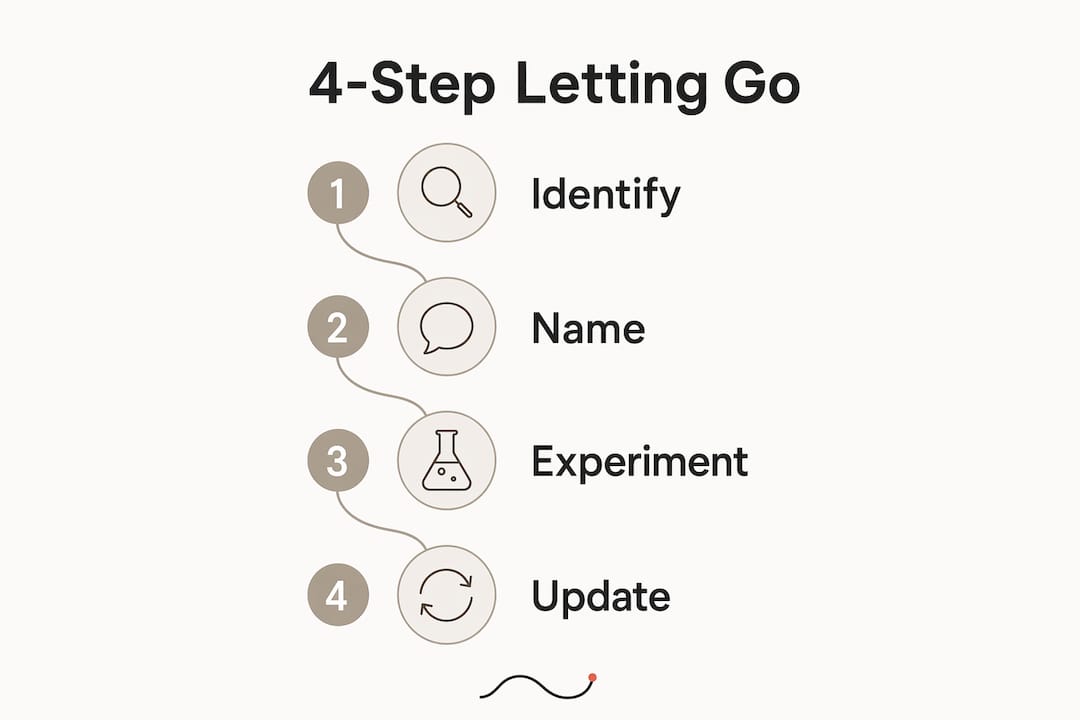
The most effective method for releasing limiting beliefs is a 4-step process involving identification, evidence gathering, reframing, and behavioral experiments. Behavioral testing produces belief change more reliably than logic alone. Thinking your way out of a belief rarely works. Acting your way out does.
Here is how to apply each step:
-
Identify the hidden belief. Look at where you avoid, procrastinate, or pull back. Ask: “What would I have to believe about myself for this behavior to make sense?” Write it down plainly. “I am not smart enough.” “It is too late for me.” “I do not deserve more than this.”
-
Gather contradicting evidence. Search your own history for moments that challenge the belief. You finished something hard. You learned something new. You showed up when it mattered. These are not small things. They are data points that the belief has been ignoring.
-
Construct a reality-based reframe. This is not forced positivity. It is a more accurate statement. Instead of “I am not creative,” try “I have not practiced creativity in years, and I am starting now.” The reframe must feel true, not just hopeful.
-
Run small behavioral experiments. Behavioral experiments should be small, planned, and followed by evidence recording. Sign up for the class. Send the email. Speak up in the meeting. Then write down what happened, not what you feared would happen.
| Step | What You Do | What It Changes |
|---|---|---|
| Identify | Name the belief driving avoidance | Moves belief from unconscious to visible |
| Gather evidence | List past moments that contradict the belief | Weakens the belief’s grip on your story |
| Reframe | Write a more accurate, kinder statement | Builds a new mental reference point |
| Experiment | Take one small action aligned with the new belief | Creates lived proof that change is real |
Experiential learning is the engine here. Reading about courage does not build courage. Taking one small, deliberate step does.

How can you use mindset shifts to handle doubt and setbacks?
The observer mindset is the practice of viewing your thoughts as temporary events rather than absolute truths. This single shift changes everything. Internal transformation is sustainable when you separate your identity from your current beliefs and adopt this observer stance.
Self-doubt does not have to disappear before you act. Uncertainty tolerance is the real skill. Meaningful decisions are made while feeling unsure, not after achieving complete confidence. Waiting to feel ready is a trap. Readiness is built through action, not before it.
Cognitive defusion techniques, drawn from Acceptance and Commitment Therapy, help you do this in practice:
-
Label the thought: “I’m having the thought that I’ll fail.” This creates space between you and the belief.
-
Use mindfulness: Sit with the discomfort for 60 seconds without reacting. Notice it does not destroy you.
-
Practice self-compassion: Speak to yourself the way you would speak to a close friend facing the same fear.
-
Pace your breathing: Nervous system regulation during action reduces the immobilization caused by fear. Slow, deliberate breathing signals safety to your body.
Pro Tip: When doubt rises before a new action, place one hand on your chest and take three slow breaths. This is not a trick. It is physiology. Your nervous system responds to breath before it responds to reason.
Growth is about updating old nervous system learning through regulation and tolerating discomfort. It is not about eliminating fear. Fear is a passenger. You are the driver. Let it ride along while you go where you want to go.
What common traps slow down your progress?
The biggest trap in breaking free from self-doubt is trying to defeat it. Fighting self-doubt reinforces it neurologically. The more energy you spend resisting a thought, the more attention your brain gives it. Acceptance is not surrender. It is a smarter strategy.
Here are the traps that most commonly stall progress:
-
Waiting for certainty. Certainty does not arrive before action. It arrives because of action. Waiting for it causes paralysis, not preparation.
-
Forced positivity. Telling yourself “I am amazing and nothing can stop me” when you do not believe it creates internal conflict. Your brain knows the difference. Accurate reframes work. Cheerleading does not.
-
All-or-nothing thinking. One setback does not erase your progress. Progress in releasing lifelong limitations is gradual and non-linear. A hard week is not a failed process.
-
Expecting a permanent fix. Old beliefs resurface, especially under stress. That is normal. The goal is not to never hear the old voice again. The goal is to stop letting it make your decisions.
“Accepting self-doubt as a passenger, not a driver, leads to peace and functional progress.” Source
Values-aligned action is the antidote to all of these traps. When you act from what matters to you rather than from what feels comfortable, you build a kind of confidence that does not depend on mood or certainty. That is the confidence worth having.
What practical tools support lasting change after 40?
Meaningful change in limiting beliefs typically spans 12–20 weeks with sustained intentional commitment. Deeper belief restructuring takes 3–5 months. That timeline is not discouraging. It is clarifying. You are not failing if you do not feel transformed in two weeks. You are simply in the middle of the process.
The tools that support lasting release of negative beliefs are practical and accessible:
Journaling and evidence documentation are the most underused tools in this process. After each behavioral experiment, write down what you did, what you feared, and what happened. Over weeks, this record becomes a compelling counter-narrative to the old belief.
Environmental supports matter more than most people expect. Internal work is more effective when paired with real-world behavioral change and structural adjustments. Surround yourself with people who reflect the version of you that you are becoming. Reduce time with those who reinforce the old story.
Community and coaching accelerate the process. Isolation feeds old beliefs. Connection challenges them. Whether that is a therapist, a coach, or a group of women in similar seasons of life, being witnessed in your growth matters.
| Tool | Best Used For | Frequency |
|---|---|---|
| Journaling | Recording experiments and contradicting evidence | Daily or after each experiment |
| Mindfulness practice | Regulating the nervous system and observing thoughts | 10–15 minutes daily |
| Behavioral experiments | Building lived proof of new beliefs | Weekly, small and specific |
| Community or coaching | Accountability and external perspective | Ongoing |
Pro Tip: Start a “proof journal.” Each evening, write one thing you did that the old belief said you couldn’t. After 30 days, read it from the beginning. The accumulation is powerful.
For women rediscovering themselves at midlife, these tools are not just self-help practices. They are the architecture of a new chapter. The rhythm of small, consistent actions is what builds a life that finally feels like yours.
Key takeaways
Letting go of lifelong self-limitations requires consistent behavioral experiments, cognitive reframing, and self-compassion practiced over 12–20 weeks, not a single moment of insight.
| Point | Details |
|---|---|
| Beliefs are learned, not fixed | Limiting beliefs are outdated survival patterns, not permanent truths about who you are. |
| Action changes belief | Behavioral experiments build lived proof that the old belief is wrong, faster than logic alone. |
| Doubt is a passenger | Accepting self-doubt rather than fighting it allows you to act freely and make real progress. |
| Change takes 12–20 weeks | Meaningful belief restructuring requires sustained commitment over months, not days. |
| Tools and environment matter | Journaling, community, and structural supports accelerate and sustain inner transformation. |
What I’ve learned about letting beliefs go
By Theresa Stairs
The most surprising thing I’ve observed in women doing this work is how much relief arrives simply from naming the belief out loud. Saying to themself: “This is the story I’ve been running on.” Something loosens in that moment.
What I’ve also seen is that the women who make the most lasting progress are not the women who work hardest to eliminate doubt. They are the women who get curious about it. They treat the old belief like an artifact from an earlier version of themselves, something worth examining rather than something to be ashamed of or defeated.
The identity separation piece is where real freedom lives. When you stop saying “I am not creative” and start saying “I have a belief that I’m not creative,” you step outside the story. From outside the story, you can choose differently. That choice, made repeatedly in small moments, is what transforms your mindset over time.
Patience and self-compassion are not soft additions to this process. They are the process. The women I’ve seen struggle most are those who treat every setback as evidence that they cannot change. The women who move forward are those who treat setbacks as information. There is a profound difference between those two stances.
You are not too late or too old. You are, in many ways, better positioned for this work now than you were at 25. You have more self-knowledge, more perspective, and more clarity about what matters. Use it.
— Theresa Stairs
How Obsessedforlife supports women ready to begin again
If this article has stirred something in you, that stirring is worth following. Obsessedforlife was built for exactly this moment: the one where you realize that the life you built for everyone else was excellent, and now you want to build something for yourself.

The Obsession Map, Obsessedforlife’s original guided assessment, helps you identify what genuinely lights you up in this season of life. It listens to who you are right now and reflects back a picture of what your next chapter could look like. This is not about reinventing yourself from scratch. It is about finally asking the question that belongs entirely to you. Visit Obsessedforlife to take the first step toward a life that feels like yours.
FAQ
What does it mean to let go of lifelong self-limitations?
Letting go of lifelong self-limitations means recognizing outdated mental patterns as learned survival responses and choosing new beliefs through deliberate reframing and behavioral practice. It is a gradual process, not a single decision.
How long does it take to change a limiting belief?
Meaningful belief change typically takes 12–20 weeks of sustained, intentional effort. Deeper restructuring can take 3–5 months depending on the belief’s depth and your consistency.
Do i have to eliminate self-doubt to move forward?
No. Accepting self-doubt as a passenger rather than trying to eliminate it is more effective. You act alongside doubt, not after it disappears.
Is it harder to change limiting beliefs after 40?
Research does not support that idea. Women over 40 often have greater self-awareness and clearer values, both of which support the life redesign process and make belief change more grounded and sustainable.
What is the single most effective tool for releasing limiting beliefs?
Behavioral experiments are the most reliable tool. Taking small, planned actions that contradict the old belief and recording what happens builds lived evidence that the belief is no longer true.