

Intentional living is the practice of aligning your daily choices with your deepest values to build a life that feels genuinely yours, and its benefits extend far beyond simple productivity gains. Research from Gallup shows that more than 40% of people who frequently live aligned with their values meet the threshold for thriving, compared to just 20% of those who rarely do. That gap is not a coincidence. It is the measurable distance between a life that happens to you and one you are actively shaping. For women at 40 and beyond, that distinction carries particular weight. This is the season when the question shifts from what does everyone need from me? to what do I want now?
1. What are the key mental health benefits of intentional living after 40?
Meaning and purpose are not soft, feel-good concepts. They are the most powerful psychological predictors of mental well-being in midlife. A JMIR Mental Health study found that meaning and purpose account for 71% of the variance in mental well-being among middle-aged to older adults. That figure reframes the entire conversation. You are not chasing happiness as a mood. You are building the structural conditions for it.

When you live with intention, you are not just thinking about your values. You are enacting them. That distinction matters because purpose, when actively practiced rather than merely contemplated, functions as a genuine stress buffer. PLOS ONE research confirms that higher purpose correlates with active coping (β=0.36) and support-seeking behavior (β=0.32), while reducing disengaged coping. In plain terms, women with a strong sense of purpose reach for better tools when life gets hard.
The mental health case for living intentionally rests on three connected benefits:
-
Reduced subjective stress through purpose-driven coping that replaces avoidance with engagement
-
Greater emotional resilience as value-aligned routines create a stable sense of self during midlife transitions
-
Higher thriving rates when daily choices consistently reflect what matters most to you
Pro Tip: You do not need a dramatic life overhaul to feel these benefits. Prioritize two or three repeatable value-aligned choices you can make even on your most exhausted days. Consistency with small choices outperforms occasional grand gestures every time.
2. How intentional living improves relationships and social fulfillment
Relationships are not a backdrop to a fulfilling life. They are a central pillar of it. The Harvard adult development study, one of the longest-running studies on human happiness, confirms that deliberate social investment in a small number of close relationships produces higher life satisfaction and better health outcomes than broad, passive socializing.
The difference between intentional and passive relationships is the difference between a weekly phone call you protect, and a group chat you scroll through without responding. One deepens connection. The other creates the illusion of it.
Small, consistent rituals are the currency of intentional relationships. Consider what these look like in practice:
-
A standing monthly dinner with one close friend, treated as non-negotiable
-
A brief daily check-in with a partner or adult child that asks a real question, not just how was your day?
-
Writing a short note to someone you have been meaning to reconnect with, sent this week rather than someday
These are not grand gestures. They are the kind of repeatable value-aligned actions that Gallup research links directly to thriving. The women who report the deepest social fulfillment in midlife are not the ones with the fullest social calendars. They are the ones who show up consistently for the relationships that matter most.
3. Practical strategies to implement intentional living consistently
Knowing your values is the beginning. Translating them into daily behavior is the work. The most research-supported method for closing that gap is implementation intentions, a framework developed by psychologist Peter Gollwitzer. A meta-analysis of 642 tests found that if-then planning produces a medium-to-large effect size (d=0.65) on goal follow-through. That is a meaningful result, and it works because it removes the need for willpower in the moment.
An if-then plan looks like this: If it is 7 a.m. on Tuesday, then I will write in my journal for ten minutes before opening my phone. The situational cue automatically triggers the behavior. You are not deciding in the moment. You decided in advance.
Here is how to build your own intentional living practice using this framework:
-
Identify your top three values. The values that show up in your best days. (eg. courage, honesty, trust)
-
Name your most common obstacles. Fatigue, distraction, other people’s urgency. Be specific.
-
Write obstacle-specific if-then plans. If I feel too tired to walk after work, then I will put on my shoes and walk to the end of the street. Starting is the plan.
-
Conduct a weekly values alignment audit. Score each major activity as aligned, neutral, or misaligned with your values. This is not a judgment exercise. It is a life audit practice that shows you where your time is going.
-
Protect intentional time with structure. Block one hour each week as a deep work or reflection window. Treat it with the same respect you give a medical appointment.
| Strategy | Best for | Effort level |
|---|---|---|
| If-then planning | Building new habits under stress | Low |
| Values alignment audit | Identifying misaligned time drains | Medium |
| Deep work blocks | Protecting creative or reflective time | Medium |
| Obstacle-specific cues | Sustaining habits during low-energy periods | Low |
Pro Tip: Digital minimalism is not about deleting apps. It is about deciding in advance when and why you open them. A single rule, such as no phone before 8 a.m., can reclaim an hour of intentional morning time that compounds across a year.
4. Broader life satisfaction advantages of an intentional lifestyle
The advantages of conscious living extend well beyond mood. Stanford mindfulness research reports that structured, intentional decision-making leads to 31% fewer regrets and measurably better confidence in life choices. Fewer regrets is not a small thing. Regret is one of the most corrosive forces in midlife, and it tends to accumulate around inaction rather than action.
Verywell Mind’s expert synthesis on intentional decision-making identifies productivity, emotional health, and happiness as direct outcomes of prioritizing meaningful tasks over reactive ones. The mechanism is straightforward. When your spending, your time, and your attention align with what you value, you stop leaking energy into things that leave you feeling empty.
The data on thriving versus non-thriving patterns tells a clear story:
| Habit | Thriving group | Non-thriving group |
|---|---|---|
| Frequent value-aligned activities | More than 40% meet thriving threshold | 20% meet thriving threshold |
| Close relationship investment | Consistent, deliberate | Sporadic, reactive |
| Purpose as active coping tool | Regular practice | Rarely enacted |
| Regret frequency | Significantly lower | Higher, linked to passive choices |
Quality of life, as the JMIR Mental Health study highlights, is a top predictor of well-being alongside meaning and wisdom. This means that intentional living is not just a mindset shift. It is a structural upgrade to the conditions that determine how well you feel in your life.
For women navigating midlife, this is an invitation to set new goals after 40 that reflect who you are now, not who you were expected to be.
Key takeaways
The most direct path to thriving in midlife is consistent, repeatable alignment between your daily choices and your core values, not a single dramatic life change.
| Point | Details |
|---|---|
| Purpose drives well-being | Meaning and purpose account for 71% of mental well-being variance in midlife adults. |
| Small habits outperform grand gestures | Frequent value-aligned choices double thriving rates compared to occasional ones. |
| If-then planning closes the intention gap | Implementation intentions produce a d=0.65 effect size on follow-through without relying on willpower. |
| Intentional relationships deepen fulfillment | Consistent investment in a few close bonds yields greater satisfaction than broad, passive socializing. |
| Fewer regrets follow intentional decisions | Structured decision-making is linked to 31% fewer regrets and greater confidence in life choices. |
What I have learned about living intentionally after 40
I used to think intentional living was for people with more time, more clarity, or fewer obligations. It took me a while to see that I had it backward. Intentional living is most powerful precisely when life is full and complicated, which is exactly where most women find themselves at 40 and beyond.
What I have observed, both in my own experience and in the women I encounter through Obsessedforlife, is that the shift rarely comes from a retreat or a revelation. It comes from one small choice, made deliberately, that feels slightly more like you than the choice you made yesterday. That is the rhythm of it.
The women who find the most joy in this season are not the women who redesigned everything at once. They are the women who got honest about what they value, and then started showing up for it in ordinary moments. A morning walk. A boundary held calmly. A conversation pursued instead of postponed.
As you move through this process, give yourself plenty of room for compassion. Some weeks, your audit may reveal places where your life is asking for more alignment, clarity, or care. That awareness gives you a starting point. Intentional living is built through honest reflection, gentle adjustments, and a growing sense that your life belongs to you.
— Theresa Stairs
Your next chapter is waiting
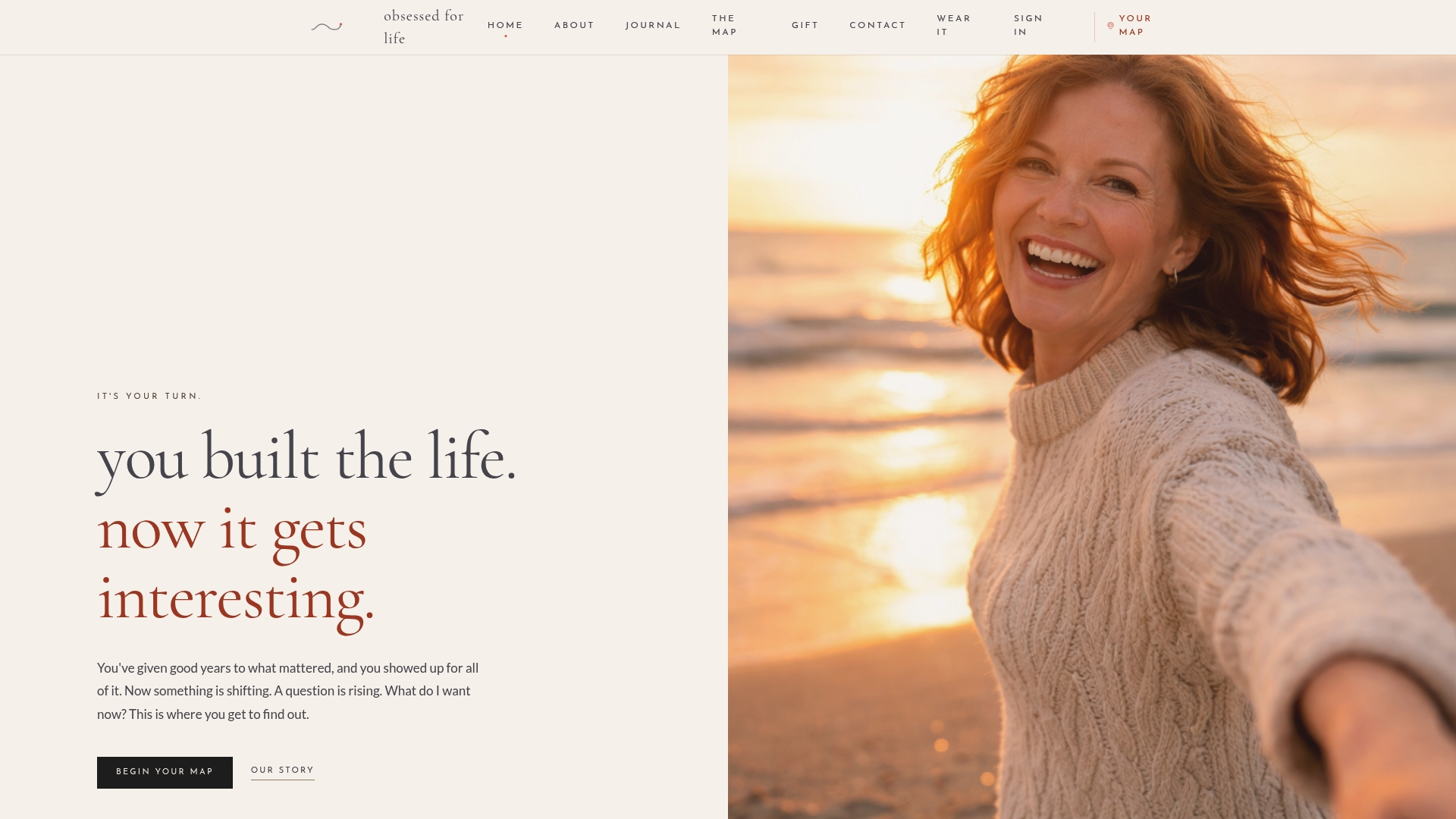
If this article has stirred something in you- that quiet recognition that you are ready to live more deliberately- Obsessedforlife was built for exactly this moment. The Obsession Map is an original guided assessment designed for women 40 and beyond who are ready to ask the question that belongs entirely to them: what do I want? It listens to who you are and reflects back a picture of what lights you up, so the path forward feels like yours. Because it is. Start your Obsession Map and let joy be your compass from here.
FAQ
What is intentional living, exactly?
Intentional living is the practice of making daily choices that align with your personal values and long-term sense of purpose rather than reacting automatically to circumstances. It is less about doing more and more about doing what genuinely matters to you.
How does intentional living reduce stress?
Purpose in life is directly linked to active coping and support-seeking behaviors, while reducing disengaged coping patterns. Women who practice intentional living tend to respond to stressors with engagement rather than avoidance, which lowers subjective stress over time.
Can intentional living really improve relationships?
The Harvard adult development study confirms that deliberate, consistent investment in a small number of close relationships produces higher life satisfaction and better health outcomes than passive or broad socializing. Quality and consistency matter more than quantity.
How do I start living intentionally if I have no idea where to begin?
Start with a values alignment audit. List your major weekly activities and score each one as aligned, neutral, or misaligned with what matters most to you. This single practice reveals where your energy is going and where small shifts could create the most meaningful change.
Is intentional living the same as mindfulness?
They overlap but are not identical. Mindfulness is a present-moment awareness practice, while intentional living is a broader framework for aligning choices with values across time. The benefits of mindfulness support intentional living by improving the self-awareness needed to make deliberate choices.