

Stepping back from an overachieving lifestyle is defined as the deliberate practice of reducing compulsive achievement behaviors to reclaim personal joy, health, and identity. This is not about caring less. It is about caring differently. Psychologists call the underlying pattern "maladaptive perfectionism," a cycle where relentless striving creates anxiety rather than satisfaction. A clinical study from 2026 found that 92% of professionals identify as perfectionists and 59% report burnout directly tied to that perfectionism. Those numbers tell a clear story: the drive that got you here may be the very thing keeping you from feeling good here. If you are a woman in your 40s, 50s, or beyond, and you are quietly wondering whether all this striving is still worth it, you are asking exactly the right question.
What are the psychological and physical costs of an overachieving lifestyle?
Overachievement is not simply working hard. It is a pattern where your sense of worth becomes inseparable from your output. When that happens, rest feels like failure, and slowing down triggers genuine anxiety.
Perfectionism has increased across generations, according to a meta-analysis of 25 years of data. Each generation holds higher and more rigid standards than the last, which means the pressure many women in midlife feel is not imaginary. It is a measurable cultural shift.
The costs show up in specific, recognizable ways:
- Burnout. Chronic self-pressure depletes the nervous system over time. The body treats relentless striving as a low-grade emergency, keeping cortisol elevated and recovery incomplete.
- Identity loss. When achievement is your primary identity, any reduction in output feels like a loss of self. Many women describe a quiet panic when they imagine doing less.
- Emotional suppression. Overachievers often use busyness to avoid emotions, substituting productivity for the harder work of feeling and processing. Busyness becomes a coping mechanism rather than a genuine calling.
- Anxiety and physical strain. Perfectionism correlates strongly with elevated anxiety, sleep disruption, and immune suppression. These are not personality quirks. They are physiological responses to sustained pressure.
The deeper truth is that overachievement often masks unresolved emotional needs. The woman who cannot stop working may be avoiding grief, fear of irrelevance, or a childhood message that love was conditional on performance. Recognizing this is not a diagnosis. It is an invitation to look more honestly at what is driving the engine.
A work-life identity balance checklist designed for women 40 and beyond can help you see where achievement and identity have become fused in ways that no longer serve you.
How can you begin stepping back safely without triggering anxiety or guilt?
The most common mistake women make when they decide to slow down is trying to stop all at once. Stopping overfunctioning cold turkey triggers panic in the nervous system. The body reads the sudden absence of busyness as danger, not relief. Gradual reduction is not a compromise. It is the method that actually works.

The 10% rule
Reduce your effort or output by roughly 10% at a time. If you currently answer emails until 10:00 PM, stop at 9:00 PM for two weeks before adjusting further. If you manage every detail of a project, hand off one task and observe what happens. Small reductions give your nervous system time to learn that less is safe.
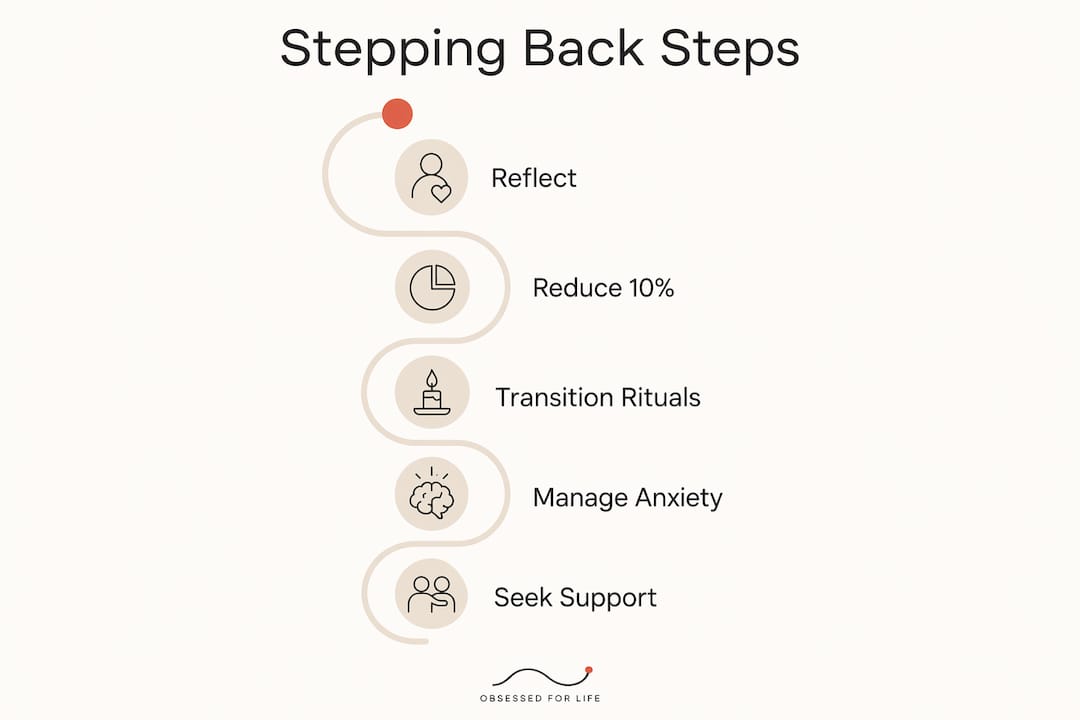
Transition rituals
A transition ritual is a physical action that signals to your body that one mode is ending and another is beginning. Changing clothes after work, taking a short walk, or making a specific cup of tea can all serve this purpose. Transition rituals physically signal the nervous system to reduce overdrive. They work because the body responds to sensory cues, not just intentions.
Gradual vs. abrupt approaches
| Approach | What happens | Why it matters |
|---|---|---|
| Gradual 10% reduction | Nervous system adjusts incrementally | Sustainable and repeatable without panic |
| Cold turkey | Triggers anxiety and identity threat | High relapse rate back to overfunctioning |
| Ritual-based transitions | Creates clear psychological boundaries | Reduces emotional spillover between roles |
| Therapy-supported change | Addresses root emotional drivers | Builds lasting flexibility, not just willpower |
Pro Tip: Before you reduce any commitment, write down what you fear will happen if you do less. Reading that fear out loud often reveals how much of your overachieving is driven by anxiety rather than genuine desire.
Therapy supports emotional flexibility and helps unwind perfectionism patterns without diminishing your capability or your care. Seeking support is not a sign that you cannot handle this alone. It is a sign that you understand how deep the pattern runs.
What mindset shifts support overcoming perfectionism and redefining success?
Not all perfectionism is harmful. Adaptive perfectionism means holding high standards while remaining flexible when circumstances change. Maladaptive perfectionism means those standards become rigid, self-punishing, and tied to your worth as a person. The goal is not to stop caring about quality. The goal is to stop letting quality define your value.
Self-compassion enhances achievement motivation and resilience more effectively than self-criticism does, according to research by Kristin Neff. This is a counterintuitive finding for high achievers. Most women who identify as overachievers believe that being hard on themselves is what keeps them performing. The evidence says the opposite is true.
Here are the mindset shifts that create lasting change:
- Replace "work-life balance" with fulfillment goals. The work-life balance framework creates an unproductive opposition between two things that are both part of your life. Fulfillment goals ask a different question: what do I actually want to feel at the end of a day, a year, a decade?
- Audit your standards, not just your schedule. Auditing standards for recovery cost rather than simply lowering them reduces anxiety and produces better outcomes. Ask whether each standard you hold is worth what it costs you to maintain it.
- Separate identity from output. You are not what you produce. This is easy to say and genuinely difficult to internalize. Cognitive behavioral therapy techniques, including thought records and behavioral experiments, help retrain the brain's reward system away from achievement as identity.
- Practice "good enough" deliberately. Choose one low-stakes area each week where you will intentionally do less than your best. Notice that the world does not end. This builds tolerance for imperfection in higher-stakes areas over time.
Cognitive reward retraining reduces anxiety by 67%, according to a 2026 meta-analysis. That figure reflects what becomes possible when you stop fighting your brain and start working with it instead.
Pro Tip: When you catch yourself adding one more task to an already full day, pause and ask: "Am I doing this because it matters, or because stopping feels unsafe?" The answer will tell you more than any productivity system ever could.
Exploring values-based living gives you a concrete framework for making these shifts. When your choices are anchored in what you genuinely value, achievement becomes a tool rather than a tyrant.
What practical changes can women 40+ make to build joy and sustainable balance?
Rest is not a reward for finishing your work. Rest is a resource that makes everything else possible. Larger blocks of rest are more effective than frequent shorter breaks for well-being and recovery, according to research from the University of Georgia. A two-hour Sunday afternoon with no agenda does more for your nervous system than ten five-minute breaks scattered through a workday.
Practical changes that work for women in this season of life include:
- Design a real end to your workday. Choose a specific time and a specific ritual that closes the professional chapter of your day. This is not about being less dedicated. It is about being present in the rest of your life.
- Protect one morning or afternoon per week as unscheduled. Treat it the way you would treat a medical appointment. It is not optional, and it is not available for other people's priorities.
- Reconnect with people, not projects. Overachievers often let friendships and personal connections erode because relationships do not produce measurable outcomes. The research on well-being consistently shows that connection is one of the strongest predictors of life satisfaction.
- Reset your goals for this chapter. The goals that made sense at 32 may not fit who you are at 52. Midlife is an invitation to ask what you actually want now, not what you wanted then.
- Celebrate completion, not just excellence. Finishing something matters. Doing it imperfectly and finishing still counts.
Wisdom-driven life goals for women 40+ offer a practical framework for shifting from achievement-driven goals to goals rooted in meaning and experience. This is where the real redesign begins.
Key Takeaways
Stepping back from an overachieving lifestyle requires gradual nervous system adjustment, specific mindset shifts away from maladaptive perfectionism, and deliberate practices that treat rest and connection as non-negotiable resources.
| Point | Details |
|---|---|
| Overachievement has real costs | Burnout, identity loss, and anxiety are measurable outcomes of sustained perfectionism. |
| Gradual reduction works best | A 10% incremental approach prevents panic and builds sustainable change over time. |
| Self-compassion outperforms self-criticism | Research shows self-compassion improves both motivation and resilience more than pressure does. |
| Rest needs to be large and protected | Bigger blocks of unscheduled time restore well-being more effectively than fragmented breaks. |
| Fulfillment goals replace balance | Shifting from "work-life balance" to specific fulfillment goals creates sustainable personal growth. |
What I have learned about letting go of the overachiever identity
I spent years believing that my value lived in my output. Every finished project, every solved problem, every person I helped felt like proof that I was worth something. What I did not see clearly until much later was that I had built an identity so dependent on doing that simply being felt like a threat.
The hardest part of stepping back is not the schedule change. It is the identity change. When you slow down, a voice often rises that says you are being lazy, selfish, or irrelevant. That voice is not wisdom. It is fear wearing the costume of ambition.
What I have found, and what the research confirms, is that the women who make this transition most successfully do not abandon their standards. They renegotiate them. They ask which standards are genuinely theirs and which ones were borrowed from a culture that measures worth in productivity. That question alone can be clarifying in a way that no to-do list ever is.
Guilt and restlessness are normal in the early weeks of doing less. They are not signs that you are failing. They are signs that your nervous system is adjusting to a new rhythm. Give it time. Give yourself the same patience you would offer a woman you love who is learning something genuinely difficult.
The self-exploration that later life makes possible is not a consolation prize for getting older. It is one of the most honest and rewarding things you can do with the years ahead.
— Theresa Stairs
What Obsessedforlife offers women ready for this shift
You have spent decades being excellent at what others needed. That is real, and it matters. And now a different question is asking for your attention: what do you want with this chapter?

Obsessedforlife was built for exactly this moment. The Obsession Map is an original guided assessment that helps women 40 and beyond identify what brings them genuine joy in this season, what values are truly theirs, and what kind of life they actually want to build. It is not a productivity tool. It is a clarity tool. Whether you are 44 or 66, this is the kind of reflection that changes what comes next. You do not need to have it all figured out before you begin.
FAQ
What does stepping back from overachieving actually mean?
Stepping back from an overachieving lifestyle means deliberately reducing compulsive achievement behaviors to prioritize personal well-being, joy, and identity over relentless output. It is not about caring less. It is about redefining what success means to you.
Why does slowing down feel so uncomfortable at first?
Stopping overfunctioning suddenly triggers a nervous system response that reads reduced busyness as danger. Gradual 10% reductions allow the body to adjust safely without panic or identity threat.
Is perfectionism always harmful?
Adaptive perfectionism, which involves high standards with flexibility, supports performance. Maladaptive perfectionism, where standards are rigid and tied to self-worth, causes anxiety and burnout. CBT techniques help distinguish between the two.
How does self-compassion help with overcoming perfectionism?
Research by Kristin Neff shows that self-compassion improves achievement motivation and resilience more effectively than self-criticism. Treating yourself with kindness does not lower your standards. It makes you more capable of meeting them.
What is the most effective way to build rest into a busy life?
Larger, protected blocks of unscheduled time restore well-being more effectively than short, frequent breaks. Scheduling one full morning or afternoon per week as genuinely unstructured is a practical and evidence-backed starting point.