

There is a quiet frustration that settles in when you are working hard toward a goal that no longer fits your life. You feel the effort, but not the pull. Understanding why life seasons require new goals is not just a philosophical exercise. It is the difference between grinding toward someone you used to be and moving with intention toward who you are becoming. If your goals were written for a different chapter, they will always feel slightly off. This article will help you recognize your current season, release what no longer serves you, and build goals that actually belong to this moment.
Table of Contents
Key Takeaways
| Point | Details |
|---|---|
| Seasons shape what is possible | Your energy, focus, and priorities shift with each life season, making old goals misaligned. |
| 90-day cycles work better | Setting 3-5 focused priorities quarterly prevents burnout and builds realistic momentum. |
| Transitions create emotional tension | Clinging to outdated goals during change causes dissatisfaction and identity confusion. |
| If-then planning builds follow-through | Pre-deciding how to handle obstacles dramatically increases your chances of staying on track. |
| Self-compassion is a strategy | Recognizing your season and adjusting your goals is wisdom, not weakness. |
Why life seasons require new goals
Most goal-setting advice treats your life as a constant. Pick a goal, make a plan, stay consistent. But your life is not constant. It is rhythmic. It moves through seasons, and each season carries its own demands, its own gifts, and its own honest limits.
Think of four broad life seasons: growth, stability, transition, and recovery. A growth season feels expansive. You have energy, curiosity, and appetite for challenge. A stability season is quieter. You are maintaining what you have built, and that is genuinely valuable work. A transition season is the one that tends to catch women off guard. Something has shifted, maybe a career change, an empty nest, a loss, or a health shift, and the old map no longer matches the territory. A recovery season asks you to restore before you can reach again.
The problem is that most women over 40 have been taught to treat every season like a growth season. Push harder. Do more. Achieve bigger. Women misinterpret transitional seasons as failure, pushing for high growth when maintenance or recovery is what the season actually requires. That mismatch is not a character flaw. It is a structural problem with how most of us were taught to set goals.
Your energy, motivation, and focus genuinely fluctuate across seasons. A goal that felt exciting and manageable at 38 might feel like a weight at 47, not because you have become less capable, but because your season has changed. Planning goals in 90 to 100 day cycles mirrors natural rhythms and prevents the quick burnout and abandonment that comes from locking yourself into a year-long plan that no longer fits.
Pro Tip: At the start of each quarter, ask yourself one honest question: “What season am I actually in right now?” Let your answer shape what you commit to, not what you think you should want.
The emotional weight of outdated goals
Transitions are rarely clean. There is almost always a messy middle, a stretch of time where you have left something behind but have not yet arrived anywhere new. In that space, old goals can feel like anchors rather than guides.
“Purpose is an evolving dialogue between your inner growth and external circumstances.” The Dream Catcher
This is why the importance of setting new goals during transitions goes beyond productivity. It is about identity. When your goals no longer reflect who you are, a low-grade tension builds. You might feel restless on Sunday evenings, or notice a creeping sense that you are performing a version of your life rather than living it. Restlessness and the “Sunday Scaries” often signal the need for a real shift in direction, not just a better morning routine.
Clinging to old goals when your season has shifted creates genuine dissatisfaction. Resisting change creates strain because you are expending real energy trying to fit yourself into a shape that no longer fits you. The discomfort is not a sign that something is wrong with you. It is an invitation to look more honestly at what this season is actually asking of you.

The messy middle of transitions is where many women get stuck, held in place by outdated beliefs about who they should be. Releasing that old identity is not giving up. It is the prerequisite for moving forward. Self-awareness and self-compassion are not soft extras here. They are the actual tools. Seeking support during transitions is a sign of strength and self-awareness, not weakness.
How to identify your season and set aligned goals
Knowing your season is the first step. Acting from it is the practice. Here is a grounded approach to life transitions and goal setting that works specifically for women navigating midlife.
Step 1: Reflect on your current reality, not your ideal one. Before writing a single goal, sit with what is actually true right now. What is demanding your energy? What feels depleted? What feels alive? This is not about lowering your expectations. It is about starting from where you actually are.
Step 2: Name your season. Use the four seasons as a lens. Are you in growth, stability, transition, or recovery? You might be in more than one area of life at once. Your career might be in stability while your relationships are in transition. That is normal. Name each one honestly.
Step 3: Choose 3 to 5 focused priorities for the next 90 days. Setting 3 to 5 focused priorities quarterly aligns your goals with your actual energy capacity and dramatically improves goal realism. Not 12 goals. Not a vision board with 40 items. Three to five things that genuinely matter in this season.
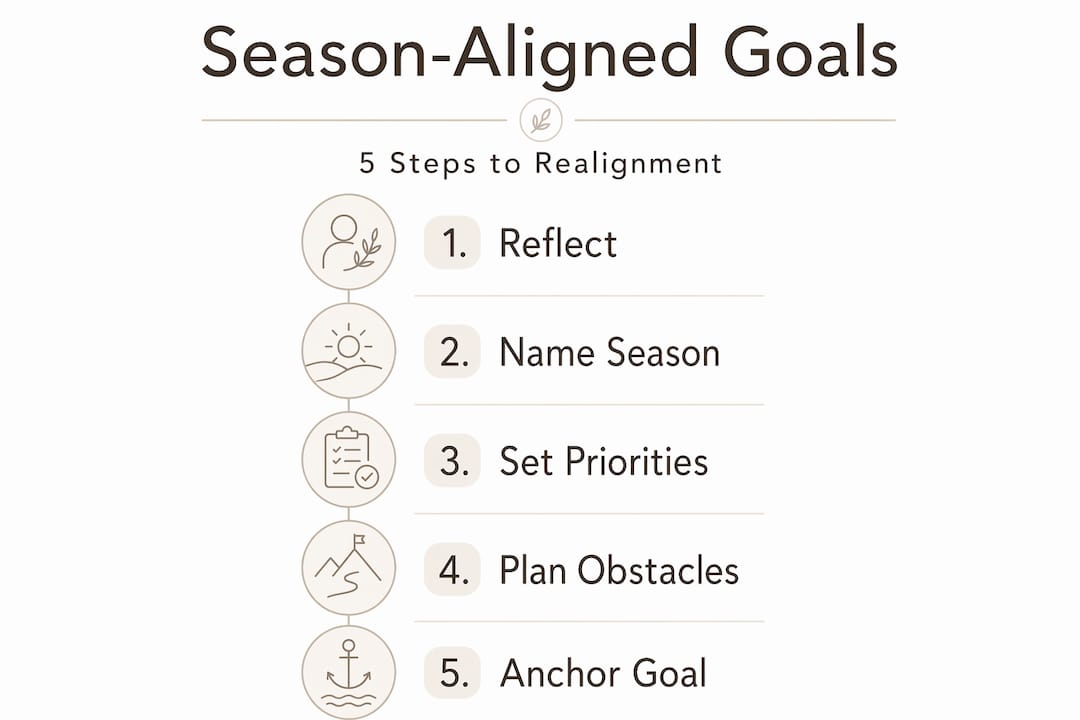
Step 4: Build if-then plans for your biggest obstacles. Specific goals paired with if-then plans dramatically boost long-term follow-through. An if-then plan sounds like this: “If I feel too tired to work on my resume after dinner, then I will spend 15 minutes on it during my lunch break instead.” You pre-decide your response, so you are not relying on motivation in the moment.
Step 5: Consider anchoring to one keystone goal. A single keystone goal creates ripple effects, making other goals easier or even unnecessary. For a woman pivoting careers at 48, the keystone goal might be “complete one informational interview per week.” That one action builds confidence, expands her network, and clarifies her direction all at once.
Here is how goal adaptation looks across common midlife scenarios:
| Life scenario | Old goal (misaligned) | Adapted goal (season-aligned) |
|---|---|---|
| Career pivot | “Get promoted in current role.” | “Explore 3 new fields through conversations and research this quarter.” |
| Caregiving season | “Launch a new business this year.” | “Protect 2 hours weekly for a creative project I care about.” |
| Health transition | “Train for a half-marathon.” | “Walk 20 minutes daily and build consistent sleep habits.” |
| Empty nest | “Keep the same social schedule.” | “Identify 2 new communities that reflect who I am now.” |
Pro Tip: Schedule a 30-minute “season review” at the end of each 90-day cycle. Ask what shifted, what worked, and what the next season is calling for. This single habit builds more self-trust than any productivity system.
What happens when your goals finally fit
The relief of setting a goal that actually fits your season is hard to describe until you feel it. There is less resistance in the morning. Less guilt at night. The work feels purposeful rather than performative.
Research supports what this feels like intuitively. Pre-deciding responses to obstacles reduces decision fatigue and builds consistent action over time, which means you stop relying on motivation and start relying on structure. That shift alone changes everything.
Here is what women who adapt their goals to life seasons tend to experience:
-
Reduced burnout. When your goals match your capacity, you stop running on empty and start building genuine momentum.
-
Stronger self-trust. Completing a realistic goal feels better than abandoning an unrealistic one. Every small win reinforces the belief that you can follow through.
-
Clearer identity. Goals that reflect your current values tell you who you are right now, not who you were five years ago.
-
More sustainable pacing. Seasonal goals give you permission to rest, recover, and then reach again, without the all-or-nothing spiral.
Consider a woman at 52 who spent years chasing a leadership title she had outgrown in her heart. When she finally named her season a transition and reset her goals around mentoring younger colleagues and exploring a side project she loved, her engagement at work increased. The goal changed. The energy followed.
Pitfalls to watch for
Even with the best intentions, certain patterns can pull you off course as you learn to adapt goals to life changes.
-
Doing too much at once. A transition season is not the time to overhaul everything simultaneously. Pick one anchor and build from there.
-
Ignoring emotional signals. Exhaustion, resentment, and persistent restlessness are data. They are telling you something about fit, not about your worth.
-
All-or-nothing thinking. Missing a week does not erase a quarter. Progress in seasonal goal-setting is cumulative, not linear.
-
Going it alone. Therapeutic support helps break big changes into manageable goals and builds emotional resilience during transitions. Community, coaches, and trusted friends serve the same function.
-
Measuring yourself against someone else’s season. Your college roommate’s growth season is not your growth season. Comparison here is genuinely useless.
Pro Tip: When you notice resistance toward a goal, pause before pushing harder. Ask: “Is this resistance telling me to try differently, or is it telling me this goal no longer belongs to this season?”
My take on honoring the season you are in
I have watched women carry goals like old luggage. Heavy, familiar, and full of things that no longer fit. The goals made sense once. They were built for a different version of life, a different set of demands, a different understanding of what mattered. But the woman kept hauling them forward because letting go felt like quitting.
What I have learned, and what I keep coming back to, is that recognizing your season is not resignation. It is precision. When you stop trying to force a summer harvest in the middle of winter, you stop wasting the season you are actually in. You start using it.
The women I find most inspiring at 40, 50, 60, and beyond are not the ones who never changed their goals. They are the ones who changed them thoughtfully, with honesty and without apology. They gave themselves permission to want something different. That is not starting over. That is finally beginning.
Transitions are not the interruption of your story. They are the story. And the goals you set inside them, the ones that fit this season, are the ones that will actually carry you somewhere worth going.
— Theresa
Your next step with Obsessedforlife

If this article stirred something in you, that quiet recognition that your goals might belong to a season you have already left, Obsessedforlife was built for exactly this moment. Through the Obsession Map, an original guided assessment, you can explore what genuinely brings you joy right now, what values are driving you in this season, and what possibilities you have not yet considered. This is not a generic goal-setting program. It is a structured invitation to finally ask what you want. Visit Obsessedforlife to begin your own season-aligned self-discovery.
FAQ
Why do goals need to change with life seasons?
Your energy, identity, and priorities shift as life seasons change, and goals built for a past season create misalignment and frustration. Adapting your goals to your current season keeps your efforts meaningful and sustainable.
How often should women over 40 reassess their goals?
A 90-day review cycle works well for most women, as quarterly goal cycles mirror natural rhythms and allow flexibility as circumstances evolve without losing forward momentum.
What are the four life seasons for goal-setting?
The four seasons are growth, stability, transition, and recovery. Each carries different energy levels and demands, which is why the motivations for changing life goals shift from one season to the next.
How do I know which life season I am in?
Reflect honestly on your current energy, what is demanding your attention, and what feels alive versus depleted. Restlessness, identity questions, or a sense that your goals feel hollow are strong signals that a seasonal shift has occurred.
What is a keystone goal, and why does it help?
A keystone goal is one focused objective whose achievement naturally supports or simplifies other areas of your life. For women in midlife transitions, anchoring to one keystone goal reduces overwhelm and builds momentum without requiring you to overhaul everything at once.