

Designing your life around your priorities is the most direct path to fulfillment in midlife. Most women over 40 have spent decades organizing their lives around other people’s needs. The question that rises now is quieter but more urgent: what do I want? Life design, the practice of intentionally structuring your time and energy around what matters most to you, gives that question a real answer. Research shows that dedicating 95% of your time to your top five priorities reduces overwhelm and sharpens focus. That single shift changes everything.
How to design life around your priorities: start with clarity
Life design asks you to define your life strategy before you set a single goal. Most people treat goal-setting as the starting point. It is not. Strategy comes first, and strategy means deciding what kind of life you want and what trade-offs you are willing to make to get there.
At midlife, that question lands differently. Your roles have shifted. Your children may be older. Your career may feel settled or stale. Your body has opinions. The priorities that drove you at 32 may feel hollow at 52. That isn't failure. That's information.

How to choose your top 3–5 priorities
Start with three reflective questions:
-
What activities make you lose track of time?
-
What would you regret not doing or being in the next ten years?
-
Where do you feel most like yourself?
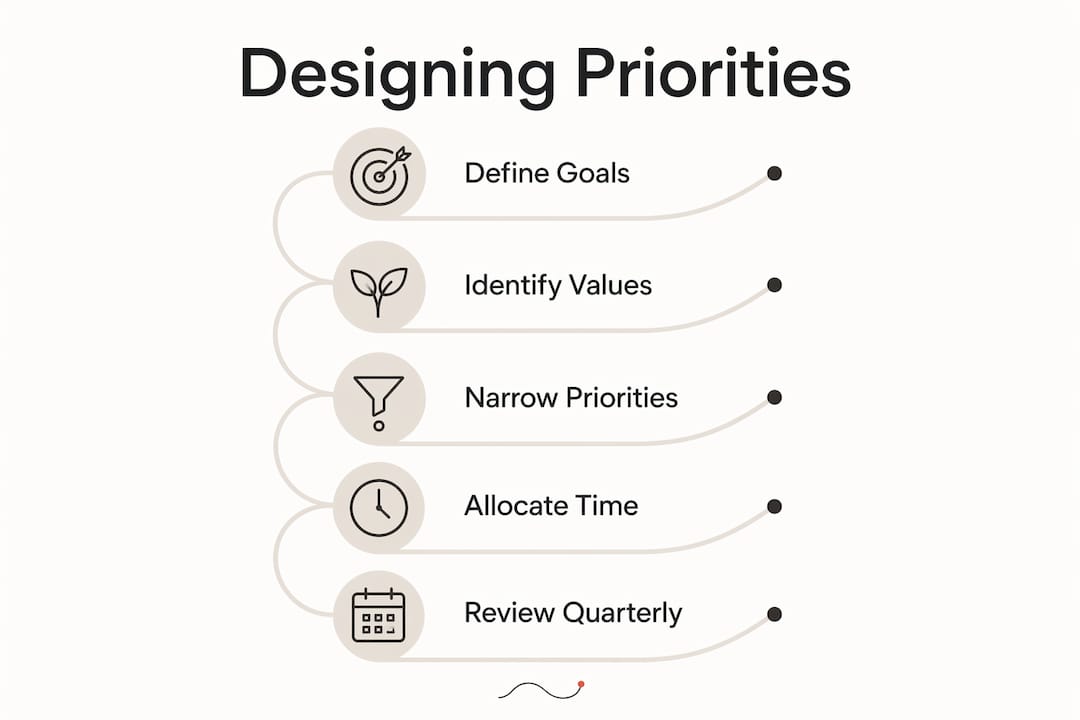
Your answers point toward your real priorities, not the ones you think you should have. From there, narrow your list to three to five areas. Common domains include health, relationships, creative work, learning, spirituality, and contribution. The goal is not to cover everything. The goal is to choose what gets your full attention.
Aligning your priorities with your personal values is the step most women skip. A priority without a value beneath it is just a task. When you connect “I want to move my body daily” to the value of vitality, it becomes a commitment rather than a chore. The work-life identity balance checklist from Obsessedforlife is a useful starting point for mapping your values to your current life roles.
Pro Tip: Review your priorities every quarter. Life changes, and your list should reflect who you are now, not who you were two years ago.
The most common mistake women make at this stage is overloading their priority list. Ten priorities is not a priority list. It is a to-do list with ambition attached. Keep it tight. Five is the ceiling.
How do you allocate time and energy to match your priorities?
Time is the currency of life design. The 168-hour week framework treats your entire week as a system, distributing attention across six life domains: work, health, relationships, personal growth, rest, and contribution. Every hour belongs somewhere. The question is whether you are spending hours intentionally or by default.
A practical allocation model divides your “designable” hours, meaning the hours outside sleep and fixed obligations, into three tiers. Roughly 50% goes to your one or two active priority domains. About 30% supports secondary areas that need maintenance. The remaining 20% covers everything else, including rest and spontaneity.
| Allocation method | Best for | Trade-off |
|---|---|---|
| 168-hour week framework | Whole-life visibility | Requires weekly audit |
| 50-30-20 domain split | Focused priority domains | Less flexibility day to day |
| Quarterly focus model | Sustainable depth | Other areas get minimal attention |
| Time blocking | Daily execution | Rigid if life is unpredictable |
Focusing on 1–2 life domains per quarter for active improvement, while keeping others in maintenance mode, is more sustainable than trying to improve everything at once. Maintenance mode is not neglect. It is intentional holding. You water the plant enough to keep it alive while you tend the garden.
Pro Tip: Create a short transition ritual between your priority work and other tasks. Even five minutes of stillness signals to your brain that one context has ended and another has begun. This protects your focus and your energy.
What does the step-by-step process look like?
Life design is not a one-time event. It is a rhythm. Here is a repeatable process that works:
-
Clarify your priorities. Use the reflective questions above. Write them down. Name the values beneath each one. Do not skip this step.
-
Set a quarterly focus. Choose one or two domains to actively develop this quarter. Be specific. “Health” is not a focus. “Walking 30 minutes five days a week and cooking at home four nights a week” is a focus.
-
Plan your week with intention. Block time for personal priorities as non-negotiable appointments. Treat a Tuesday morning walk the same way you treat a dentist appointment. It is in the calendar. It happens.
-
Manage your trade-offs consciously. Prioritization means deliberate trade-offs. When you say yes to a deep investment in your health, you are saying a quieter no to something else. Name that trade-off. Accepting it consciously removes the guilt.
-
Review weekly. A weekly review takes 20 minutes. Ask: Did I live this week according to my priorities? Where did I drift? What needs to shift next week? This is where life design stays alive instead of becoming a good intention you forgot by february.
-
Adjust without judgment. Life interrupts. A sick parent, a work deadline, a hard week emotionally. The goal is not perfection. The goal is return. You notice the drift and come back.
Reflection plays a central role in keeping this process honest. Without it, you can be very busy and very far from your priorities at the same time.
What challenges do women face when redesigning life priorities?
The obstacles are real. Naming them makes them smaller.
Guilt is the most common one. When you start investing time in yourself, it can feel selfish. It is not. You can't give from an empty cup. But guilt does not respond to logic. It responds to repetition. The more consistently you honor your own priorities, the quieter the guilt becomes.
Societal expectations add external pressure. Women over 40 are often expected to be caregivers, supporters, and stabilizers. Choosing to prioritize your own creative work or physical health can feel like a departure from what others expect. It is. That is the point.
Shifting roles creates real disruption. An empty nest, a retirement, a divorce, a parent who needs care. These transitions require honest reassessment of your life structure and energy. What worked before may not fit now.
-
Recognize that work-life balance is a dilemma to manage, not a problem to solve. There is no perfect arrangement. There are only trade-offs you choose consciously or ones that choose you.
-
Use mindfulness and boundary setting to protect your priority time. A boundary is not a wall. It is a clear signal about what you are available for and when.
-
Adjust your priorities when life shifts. Flexibility is not a weakness. It is wisdom applied to real circumstances.
Pro Tip: Self-compassion is not a soft skill. It is the foundation of sustained change. Women who practice it stay in the process longer and recover from setbacks faster.
The benefits of intentional living compound over time. Small, consistent choices aligned with your priorities build a life that feels like yours.
Key Takeaways
Designing your life around your priorities requires a clear strategy, deliberate trade-offs, and a weekly rhythm of review and return.
| Point | Details |
|---|---|
| Strategy before goals | Define the life you want and your trade-offs before setting any specific goals. |
| Limit your priorities | Choose three to five priority areas maximum to maintain real focus and depth. |
| Use the 168-hour framework | Treat your full week as a system and allocate time across life domains intentionally. |
| Block time as non-negotiable | Schedule priority activities like appointments so they happen. |
| Review and return weekly | A short weekly review keeps your daily life aligned with your stated priorities. |
What I’ve learned about priorities that no one tells you
Here is the uncomfortable truth I have come to after years of thinking about midlife and what women do with it: most of us are not confused about our priorities. We are afraid of what it would mean to live with them.
Saying “my health is a priority” is safe. Canceling a family obligation to go for a long walk is a statement. It tells the people around you that you matter to yourself. That is harder than it sounds for women who have spent decades being indispensable to others.
The other thing no one tells you is that redesigning your life reveals your life. When you start redesigning life at midlife, you will notice where your energy goes versus where you say it goes. Those two things are often very different. That gap is not something to feel bad about. It is the most useful data you have.
I have also seen women wait for the “right time” to start. There is no right time. There is only the decision to begin, followed by the willingness to keep beginning every time you drift. The women who do this well are not more disciplined. They are more honest. They know what they want, they name the trade-offs clearly, and they return to their priorities without drama when life pulls them away.
Midlife is not a crisis. It is an invitation. The question is whether you accept it.
— Theresa Stairs
Your next chapter starts with one honest question
What do you want with this season of your life? That question is the beginning of everything.
Obsessedforlife exists for exactly this moment. Through the Obsession Map, an original guided assessment, you can explore what brings you joy right now, what values are driving you, and what experiences belong to this chapter. It is not a quiz. It is a mirror. The path forward it reflects is yours because it is built entirely around who you are. If you are ready to stop organizing your life around everyone else’s needs and start building something that genuinely fits you, Obsessedforlife is where that begins.
FAQ
What does it mean to design life around your priorities?
Life design is the practice of intentionally structuring your time and energy around what matters most to you. It starts with defining your top priorities and then aligning your daily schedule to reflect them.
How many priorities should I focus on at once?
Focus on three to five priorities total, with one to two receiving active development each quarter. Keeping others in maintenance mode makes the process sustainable without spreading your energy too thin.
Why is midlife a good time to redesign your priorities?
Midlife often brings role shifts, such as an empty nest or career changes, that create natural space for reassessment. These transitions are an invitation to ask what you want now, not what you needed at 30.
How do I handle guilt when I prioritize myself?
Guilt is a common response, especially for women who have spent years putting others first. Consistent practice of honoring your own priorities gradually reduces it, and self-compassion accelerates that process.
What is the 168-hour week framework?
The 168-hour week framework treats your entire week as a system with 168 hours to allocate intentionally across six life domains. It helps you see where your time goes versus where you want it to go.