

Life beyond professional goals is defined as a holistic framework for personal fulfillment that draws from relationships, growth, contribution, presence, and authenticity rather than career achievement alone. For women over 40, this framework is not a consolation prize after a successful career. It is the main event. Research confirms that relying solely on career success leads to diminishing returns on life satisfaction once basic financial security is met. The question is no longer what you can achieve. It is who you are becoming, and what genuinely lights you up.
What does life beyond professional goals mean for women over 40?
Identity starvation is the quiet cost of an outsized career role. When your job title answers the question “Who are you?” for long enough, the rest of your identity quietly goes dormant. You may not notice it happening. But somewhere between your third promotion and your fiftieth work dinner, the woman who loved painting, or hiking, or hosting long dinners for no reason at all, stopped showing up.
Identity starvation occurs when individuals outsource their sense of self entirely to professional roles. The good news is that dormant identities do not disappear. They wait. Reintroducing them gradually, through small and low-pressure experiments, replenishes energy, patience, and clarity.
Women over 40 face a specific version of this challenge. Decades of showing up for employers, children, partners, and communities often mean that self-directed life design feels unfamiliar, even uncomfortable. Psychological research on midlife transformation consistently points to this period as one of the most fertile for reinvention. The discomfort you feel is not a warning sign. It is an invitation.
-
Your career gave you structure, status, and a sense of contribution. Those needs are real and valid.
-
Outside of work, those same needs can be met through mentoring, creative projects, community leadership, or deep friendships.
-
Shifting from external expectations to self-directed choices is not selfish. It is the work of this season.
-
The women who thrive after major career milestones are not the ones who stop caring. They are the ones who redirect that care toward themselves and what matters most to them now.
Pro Tip: Write down three roles you held before your career consumed most of your attention. Artist. Traveler. Cook. Friend. Pick one and give it 20 minutes this week. That is enough to start.
How can women shift mindset from career-centric to a me-centered life?
A me-centered life is not a narcissistic one. It is a life designed around your own values, energy, and joy rather than around external demands and other people’s definitions of success. Transitioning to this approach reduces stress and burnout in high-achieving women by prioritizing self-awareness and personal agency. The result is greater joy, flow, connection, and calm.
The mindset shift requires three concrete moves:
-
Run an energy audit. Track which activities leave you feeling full versus depleted over one week. Not productive. Not efficient. Full. This single practice reveals more about your actual values than any personality test.
-
Separate purpose from goals. Purpose acts as a stable orientation that guides daily habits and identity over time, unlike goals, which are replaceable and tied to specific outcomes. Goals end. Purpose evolves with you.
-
Treat your life like a garden, not a ladder. Applying career goal structures to personal fulfillment causes burnout. Gardens have dormant seasons. They need tending, not just measuring. Rest is not failure. It is part of the cycle.
The practical application of these shifts looks like choosing a slow Saturday morning over a packed schedule, not because you have nothing to do, but because presence is the point. It looks like saying no to commitments that drain you and yes to the ones that feel like coming home. These are conscious daily choices, not reactive behaviors. That distinction matters.
Pro Tip: Ask yourself once a week: “What did I do this week that was entirely for me?” If the answer is nothing, that is your data.

Which life dimensions beyond career contribute most to lasting fulfillment?
Fulfillment grows from multiple pillars working together. No single dimension carries the full weight. The concept of Ikigai is often misread as a career optimization tool, but its broader cultural meaning includes community, family, and personal growth. That wider lens is the one worth borrowing.
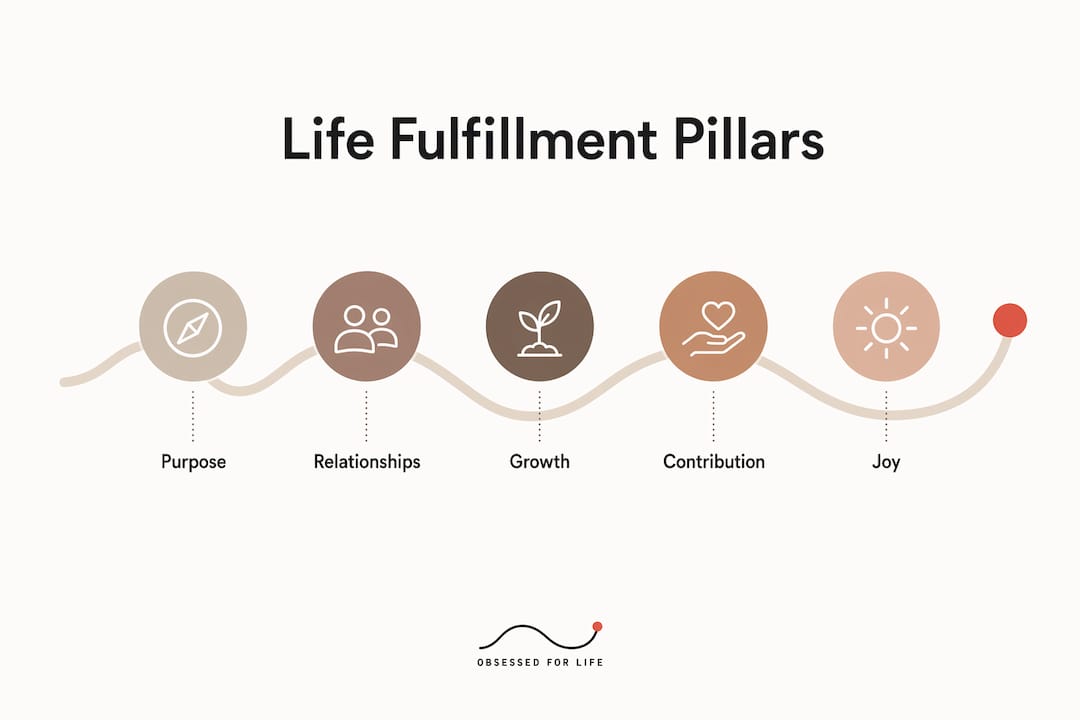
| Life pillar | Role in well-being | Starting point |
|---|---|---|
| Relationships | Deep connection reduces isolation and anchors identity | Invest in one friendship intentionally each month |
| Personal growth | Learning outside work builds confidence and curiosity | Take a class, read widely, or pick up a dormant skill |
| Contribution | Giving without a job title attached creates lasting meaning | Volunteer, mentor, or support a cause you believe in |
| Presence | Being fully in your own life reduces anxiety | Practice one screen-free hour daily |
| Authenticity | Living by your values reduces internal conflict | Name your top three values and check your calendar against them |
Engaging in hobbies and passions outside work correlates with higher productivity and better mental health, particularly during burnout recovery. Social connections and hobbies together meaningfully improve happiness and burnout management. That is not a soft finding. It is a practical reason to protect your personal time.
The distinction between goals and purpose matters here, too. Goals are milestones you reach and then replace. Purpose is the thread running through all of it. A woman whose purpose is to create beauty might express that through her garden, her relationships, her cooking, and her work. When the career chapter shifts, the purpose remains. That continuity is what makes the work-life identity balance feel less like loss and more like expansion.
What practical steps help women rediscover purpose after career success?
Rediscovery is not a grand gesture. It is a series of small, honest experiments. Understanding what a career provides emotionally is the most useful starting point. Did your work give you structure? Intellectual stimulation? A sense of being needed? Visibility? Once you name those needs clearly, you can find new and often smaller ways to meet them.
-
Name the emotional function. If your career gave you structure, build a personal rhythm around creative projects, physical practice, or community involvement. Structure is the need. The job was just one way to meet it.
-
Start with what you already know you love. You do not need to find a new passion. You need to return to an old one with fresh eyes. The wisdom-driven approach for women over 40 starts with what already resonates, not with what sounds impressive.
-
Chunk reinvention into small steps. You do not redesign a life in a weekend. You redesign it on Tuesday afternoons and Saturday mornings, one small choice at a time.
-
Allow dormant seasons. Not every week will feel productive or purposeful. That is not stagnation. It is recovery. A garden that never rests does not grow well.
-
Avoid the replacement trap. Replacing lost professional roles with identical activities often fails. The goal is not to recreate your career in a new costume. It is to meet your real needs in ways that feel genuinely yours.
The headstone test is a useful reality check here. Status, job titles, and salaries are rarely what people reflect on at life’s end. What gets remembered are the daily connections, the seeds planted for others, and the moments of genuine presence. That is not a reason to dismiss ambition. It is a reason to broaden its definition.
Key takeaways
Life beyond professional goals is best built by nurturing multiple dimensions of life, not by replacing one career with another.
| Point | Details |
|---|---|
| Holistic fulfillment requires multiple pillars | Relationships, growth, contribution, presence, and authenticity each play a distinct role in lasting well-being. |
| Identity starvation is real and reversible | Dormant identities return when reintroduced gradually through small, low-pressure experiments. |
| Purpose outlasts any single goal | Purpose is a stable orientation that guides habits and identity through life transitions, unlike career goals. |
| Life is a garden, not a ladder | Dormant seasons are necessary recovery, not failure. Tending matters more than constant measurable output. |
| Emotional needs drive reinvention | Naming what your career provided emotionally helps you find new, authentic ways to meet those same needs. |
What I have learned about life after professional success
By Theresa Stairs
The conventional wisdom says that after a successful career, you should feel grateful and ready. What nobody tells you is that you might also feel untethered. That's not ingratitude. It's the honest experience of a woman whose identity has been tightly woven into her professional role for decades.
What I have come to believe is this: the discomfort of that untethered feeling isn't a problem to solve. It's information. It's your life asking you a question you have not had time to answer until now.
The garden metaphor is one I return to often. A garden does not apologize for its dormant season. It does not measure its worth by last summer’s harvest. It simply rests, and then it grows again. The women I have seen thrive in this chapter are not the ones who immediately filled the space with new achievements. They are the ones who sat with the question long enough to hear their own answer.
The small moments matter more than we are trained to believe. A long phone call with a friend you have neglected. A class you take badly and love anyway. A Saturday with no agenda. These are not consolation prizes. They are the actual texture of a life well lived.
You have spent years being excellent at what others need. This is the season to find out what you need. That is not a small thing. It is everything.
— Theresa Stairs
Obsessedforlife: a place to begin this chapter
You have built something real. Now a new question is rising, one that belongs entirely to you.
Obsessedforlife is a self-discovery platform designed for women 40 and beyond who are ready to ask that question out loud. Through the Obsession Map, an original guided assessment, you explore what brings you joy in this season, what values drive you, and what experiences are waiting for you in this chapter. It is not a career pivot tool. It is a life tool. Whether you are 42 or 68, the path forward is yours to shape. Obsessedforlife is here to help you see it clearly, so you can follow it with confidence.
FAQ
What is life beyond professional goals?
Life beyond professional goals is a framework for personal fulfillment that draws from relationships, personal growth, contribution, presence, and authenticity rather than career achievement alone. It becomes especially relevant for women over 40 who are ready to redefine identity and purpose on their own terms.
Why do women over 40 struggle with identity after career success?
Identity starvation occurs when a sense of self is outsourced entirely to a professional role for years. When that role shifts or ends, dormant personal identities need to be gradually reintroduced to restore energy and clarity.
How is purpose different from a career goal?
Purpose is a stable orientation that guides habits and identity over time, while career goals are specific milestones that end once reached. Purpose evolves with you through every life transition.
What are the most effective ways to find fulfillment beyond work?
Engaging in hobbies, deepening relationships, contributing to community, and practicing presence each contribute to lasting well-being. Starting with small, low-pressure experiments in areas you already love is the most sustainable approach.
How does Obsessedforlife support women in this transition?
Obsessedforlife offers the Obsession Map, a guided assessment that helps women over 40 identify what brings them joy, clarify their values, and shape a life that feels genuinely their own beyond professional achievements.