

Values-based living is the practice of consciously aligning your daily actions with your chosen personal values, treating those values as ongoing life directions rather than destinations you reach and check off. Rooted in Acceptance and Commitment Therapy (ACT), this approach was articulated clearly by Dr. Jenny Shields, who defines values as ongoing life directions rather than finite goals. For women over 40 navigating midlife transitions, this distinction is not just theoretical. It is the difference between feeling perpetually behind and feeling genuinely grounded.
What is values-based living and how does it work?
Values-based living means letting your core personal values function as a compass. According to the ACT framework, values are freely chosen, global qualities of ongoing action. You do not complete them. You practice them, the way a musician practices scales, returning to them daily regardless of circumstance.
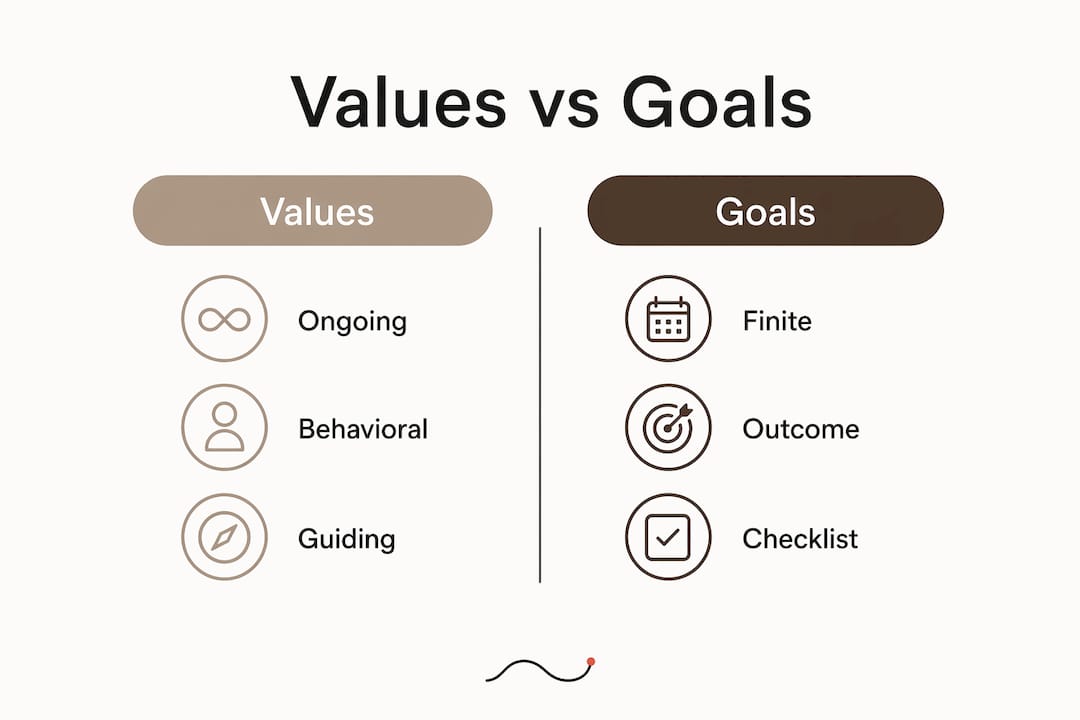
This is what separates a values-driven lifestyle from ordinary goal-setting. A goal has an endpoint. “Lose 20 pounds” or “get promoted” can be achieved or abandoned. A value like connection or creativity never expires. It shows up in how you answer your daughter's texts, how you spend a Sunday afternoon, and how you respond when life does not go as planned.
The principles of values-based living rest on three foundations. First, values are behavioral, not aspirational. They describe how you act, not who you wish you were. Second, they are self-chosen. No one assigns them to you. Third, they are flexible enough to guide you across every role you hold: partner, professional, parent, friend, and the person you are when no one is watching.

Pro Tip: Write your top three values as verbs, not nouns. Instead of “creativity,” write “I create something every day.” That small shift makes the value feel lived, not just labeled.
How do values differ from goals in practice?
The confusion between values and goals is one of the most common obstacles women face when starting this work. A goal is a specific outcome you pursue. A value is the direction you move in while pursuing it.
| Feature | Values | Goals |
|---|---|---|
| Duration | Ongoing, never finished | Finite, has an endpoint |
| Response to setbacks | Pivot opportunity, realign | Can feel like failure or defeat |
| Source | Freely self-chosen | Often externally influenced |
| Function | Life direction and meaning | Specific outcome or milestone |
| Flexibility | Applies across all life areas | Tied to one context or result |
Dr. Russ Harris, a leading ACT trainer, explains that failure to meet a value is not as distressing as goal failure. Missing a goal feels like losing. Drifting from a value simply means it is time to pivot back. That reframe alone changes how you relate to imperfection.
This matters enormously in midlife, when life rarely cooperates with the plans you made at 30. A values-driven lifestyle gives you something stable to return to when the plan falls apart. It supplies the why behind your actions, which is what enables integrity and persistence even when outcomes are uncertain.
How can women over 40 identify their core values?
Clarifying your personal core values is a structured process, not a moment of sudden insight. Simply Psychology outlines a values clarification process that moves through five clear steps, and it is worth following deliberately.
-
Generate a broad list. Start with 30–50 values that resonate with you. Words like honesty, adventure, service, learning, solitude, and humor all belong on the table.
-
Narrow to your top 10. Ask yourself which values feel non-negotiable. Which ones, when violated, leave you feeling hollow or resentful?
-
Select your core 3–5. These are the values that define how you want to move through the world right now, in this season of your life.
-
Define each value as a behavior. Abstract values stay abstract unless you translate them. “Family” becomes “I am fully present during dinner, without my phone.” “Growth” becomes “I read or learn something new three times a week.”
-
Rate your current alignment. On a scale of 1–10, how consistently are you living each value today? The gap between your rating and a 10 is your starting point.
Translating vague values into concrete behaviors is the step most people skip. Without it, values remain aspirations pinned to a vision board rather than lived commitments.
Midlife adds a layer of complexity here. You may be managing aging parents, grown children, career pivots, and a shifting sense of identity all at once. Competing priorities pull your attention in many directions, which is exactly why midlife often prompts reflection on whether your daily life aligns with what you care about most.
Pro Tip: Focus on one value-based behavioral change per week rather than overhauling everything at once. Focusing on one area for intentional alignment is more effective than trying to realign all values simultaneously.
What are the real benefits of a values-driven lifestyle?
The benefits of values-based living are not abstract. Research from ACT consistently shows that values-consistent action leads to better functioning outcomes, even when the actions themselves are difficult or uncomfortable. Living by your values does not mean life gets easier. It means you have a reason to keep going when it does not.
Here is what women over 40 report most often when they commit to this approach:
-
Clearer decisions. When you use your values as a filter, the question shifts from “What should I do?” to “What would a person who values X do here?” That reframe, as Simply Psychology notes, shifts focus from uncertain outcomes to a known, consistent personal identity.
-
Greater authenticity. Living according to your beliefs closes the gap between who you are and how you show up. That consistency is what authentic living feels like from the inside.
-
Resilience after setbacks. When you miss a goal, it can feel like defeat. When you drift from a value, it is simply a signal to pivot. Resilience in values-based living comes from treating setbacks as temporary misalignments rather than permanent failures.
-
Reduced internal conflict. Many women describe a quiet exhaustion that comes from living out of alignment. Values-based living addresses that directly by giving your choices a coherent organizing principle.
-
More meaningful daily life. When your Tuesday looks like your values, not just your to-do list, ordinary moments carry more weight.
The challenges are real too. Conflicting values create genuine tension. You may value both adventure and security, or both solitude and deep connection. Feeling overwhelmed when you first try to articulate your values is normal. Many people only recognize misalignment after a crisis, which is why building daily support systems before you need them matters so much.
How to integrate values-based living into daily life
Knowing your values is the beginning. Living them requires structure. Psychology Today’s Everyday Resilience blog describes value-aligned living as a system built on four practical pillars: clarity, boundaries, promises to yourself, and scheduling.
Here is how to build that system in midlife:
-
Create a To-Do, To-Be, and Not-To-Do list. Your To-Do list captures tasks. Your To-Be list captures how you want to show up as you do them. Your Not-To-Do list names the behaviors that pull you away from your values, like saying yes when you mean no, or scrolling instead of resting.
-
Schedule values-aligned time as non-negotiable. If learning is a core value, block 30 minutes three mornings a week. Treat it the way you treat a medical appointment. It belongs on the calendar, not the wish list.
-
Set one boundary per week that protects a core value. Boundaries are not walls. They are the practical expression of what you have decided matters. If health is a value, declining a late-night commitment is not selfish. It is consistent.
-
Anchor values to existing routines. Attach a values-based behavior to something you already do. If you value connection, call one friend while you walk. If you value creativity, keep a notebook by your coffee maker.
The importance of personal values shows up most clearly in the small, repeated choices that build a life over time. Not the grand gestures. The Tuesday morning decisions.
Pro Tip: Review your values alignment every Sunday evening. Ask yourself: “Where did I live my values this week, and where did I drift?” Five minutes of honest reflection prevents months of quiet dissatisfaction.
Key takeaways
Values-based living is the most direct path from feeling scattered in midlife to feeling genuinely grounded, because it replaces outcome-chasing with a consistent, self-chosen direction.
| Point | Details |
|---|---|
| Values are directions, not goals | They never expire and apply across every area of your life. |
| Clarify before you commit | Translate abstract values into specific, weekly behaviors to close the gap between aspiration and action. |
| Start with one change | Focus on one value-based behavioral shift per week to build momentum without overwhelm. |
| Setbacks are pivots | Drifting from a value is a signal to realign, not evidence of failure. |
| Structure makes it real | Use scheduling, boundaries, and reflection to embed values into your daily rhythm. |
What living by values taught me
by Theresa Stairs
I spent years thinking I had clear values. I could list them easily: family, creativity, growth. What I could not do was point to a Tuesday and show you where those values a lived. They were on the list. They were not in the day.
What changed things for me was not more reflection. It was action. I started treating my values like commitments I had already made, not aspirations I was still working toward. That shift felt uncomfortable at first, almost presumptuous. Who was I to say I was a creative person when I had not made anything in months?
But that discomfort was the point. Action clarifies values more effectively than reflection alone. You learn what a value costs you, and whether you find it worth paying, only by living it. Not by thinking about it on a Sunday afternoon.
The women I see doing this work most effectively are not the ones with the most perfectly articulated value statements. They are the ones willing to act imperfectly in the direction of what matters, and then adjust. Midlife is not a crisis. It is an invitation to stop performing a version of your life and start living the actual one. That begins with knowing what you are orienting toward.
Ready to find what lights you up?
Understanding your values is one thing. Knowing what genuinely excites you in this season of life is another. Obsessedforlife was built for exactly this moment, the one where you stop asking what everyone else needs and start asking what you want.
The Obsession Map, Obsessedforlife’s original guided assessment, helps women over 40 explore what brings them joy right now, what values are driving them, and what this chapter of life is genuinely for. It is not a personality test. It is a mirror. If you are ready to see a clearer picture of what lights you up, this is where that begins.
FAQ
What is values-based living in simple terms?
Values-based living means making daily choices that reflect your most deeply held personal values, treating those values as ongoing directions rather than goals to achieve. It is the practice of letting what matters most to you guide how you act, not just what you think.
How do i know what my core values are?
Start by generating a broad list of values that resonate with you, then narrow them to 3–5 that feel non-negotiable. The values clarification process from Simply Psychology recommends defining each value as a specific behavior and rating how consistently you currently live it.
How is values-based living different from goal-setting?
Goals are finite outcomes with endpoints. Values are ongoing directions you practice continuously. As Dr. Russ Harris explains, missing a goal feels like failure, while drifting from a value is simply a signal to pivot back toward alignment.
Why does values-based living matter especially in midlife?
Midlife brings competing roles, shifting identities, and a natural pull toward reflection. A values-driven lifestyle gives you a stable organizing principle when external structures, career, parenting, relationships, are changing. It answers the question “What do I want?” with something more durable than a goal.
Can values change over time?
Yes. Values are freely chosen, which means they can evolve as you do. What mattered most at 35 may not be what matters most at 52. Revisiting your values every year, or after a major life transition, keeps your daily life aligned with who you are now, not who you used to be.