

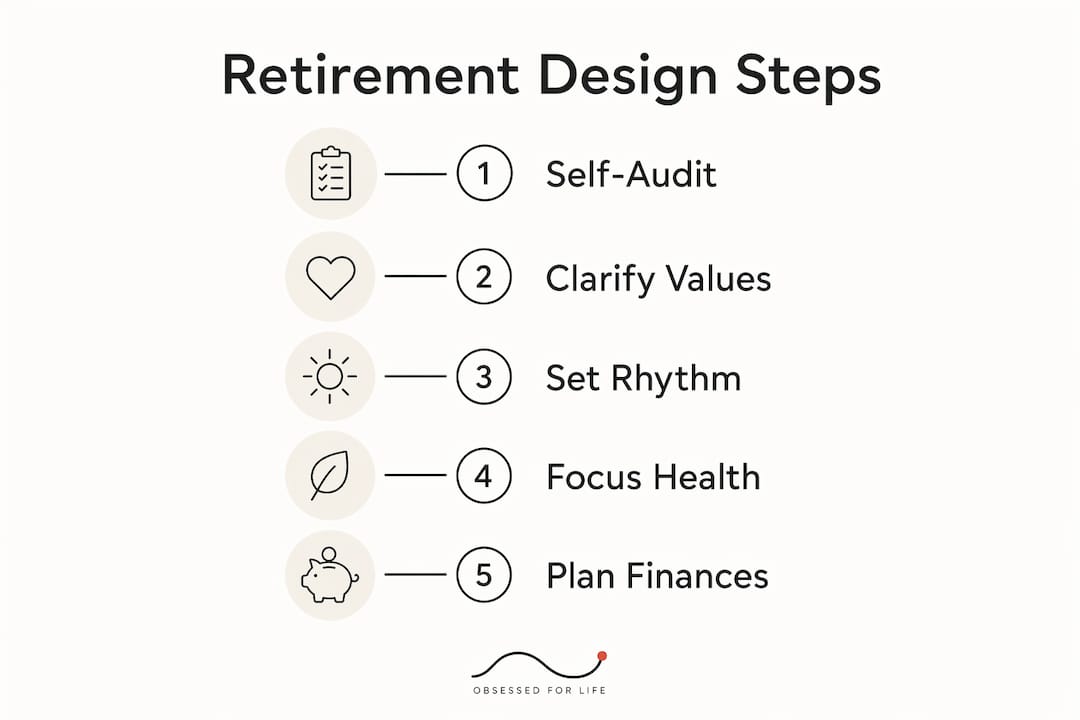
Designing a fulfilling retirement life means intentionally aligning your daily choices with your core values, personal joy, and sense of purpose. This is not simply about leaving work behind. It is about building a life you genuinely want to wake up to. The standard industry term for this process is retirement life design, and it goes far beyond financial planning. It asks you to consider who you are, what lights you up, and what kind of presence you want to have in the world. This guide walks you through the practical steps, from self-audit to weekly rhythm, so the life ahead feels like yours.
What does designing a fulfilling retirement life mean?
Designing a fulfilling retirement life is the practice of building your post-career years around personal values, joy, and purpose rather than around default leisure. Most people plan their exit from work around what they are leaving behind: the commute, the stress, the early alarms. Almost nobody plans around what they are walking toward. That gap is where aimless retirement is born.
The shift retirement life design asks you to make is simple but profound. Instead of asking “What am I done with?” you ask “What do I refuse to miss?” That reframe changes everything. It moves you from passive relief to active intention. Happiness in retirement depends more on structure, connection, and purpose than on leisure or money alone, even when financial security is present.
For women over 40, this process carries a particular weight. Many of you have spent decades showing up for everyone else. Retirement is the first extended invitation to ask what you want. That question deserves a real answer, not a default one.

How to assess and clarify your values and life purpose
A self-audit is the starting point for creating a satisfying retirement. It gives you an honest picture of where you are and where you want to go. The five life domains most relevant to retirement fulfillment are:
-
Support: Do you have people and systems that hold you when things get hard?
-
Sense of self: Do you know who you are outside of your roles?
-
Meaning: Do your days feel purposeful and worth showing up for?
-
Feeling valued: Do you contribute in ways that matter to others and to yourself?
-
Connection: Do you have relationships that feel genuinely reciprocal?
Rate each domain on a scale of 1 to 10. Then look at where the gaps are. A score of 4 in “meaning” and 8 in “support” tells you exactly where to focus your energy first. Reviewing these ratings annually keeps your retirement design responsive to who you are becoming, not just who you were when you retired.
One of the most useful tools for overcoming choice paralysis is inversion thinking. Asking what you would regret not pursuing cuts through the noise of endless options. If you imagine yourself at 80 looking back, what would you be glad you did? What would feel like a missed invitation? Those answers point directly toward your priorities.
Pro Tip: Complete your life audit for women 40+ before making any major retirement decisions. Knowing your domain scores first makes every other choice clearer.
How do you build a weekly rhythm that feels good?
Structure matters more in retirement than most people expect. Without the external frame of a work schedule, days can blur together. Successful retirement design replaces productivity with a lifestyle rhythm built around three zones: rest, purpose, and deliberate play.
Here is a practical way to build that rhythm:
-
Anchor two to three purpose-led activities each week. These could be volunteering at a local organization, taking a ceramics class, joining a book group, or mentoring younger women in your field. The activity matters less than the fact that it gives your week a reason to begin.
-
Schedule daily rest without guilt. Rest is not wasted time. It is a resource you invest in your capacity to show up fully for everything else. A walk, a quiet hour, an afternoon nap: these are not indulgences. They are part of the design.
-
Protect time for play. Play is any activity you do purely because it delights you. Gardening, dancing, painting, cooking something elaborate on a Tuesday: these moments are not extras. They are the point.
-
Review your rhythm monthly. What felt energizing? What felt like an obligation? Adjust accordingly. A rhythm that served you in January may need updating by June.
Experts suggest scheduling 2–3 purpose-led activities weekly alongside daily rest and play to sustain emotional well-being after a career exit. The goal is not a packed calendar. It is a calendar that reflects who you are.
Pro Tip: Treat your weekly rhythm as a living document. Write it down, live it for a month, then revise it. The version that fits you best will take a few iterations to find.
Why physical health and social connection are non-negotiable
Physical health and social connection are not lifestyle bonuses in retirement. They are the foundation on which everything else rests. Maintaining 150 minutes of moderate physical activity weekly and approximately 7,500 daily steps reduces cognitive decline and supports longevity. That is not a suggestion. It is the baseline for a body and mind that can enjoy the life you are designing.
Movement does not have to mean going to the gym. It means walking with a neighbor, swimming, cycling, or taking a yoga class. The form is flexible. The consistency is not.
Social connection works the same way. Physical activity and social engagement together improve cognitive health, emotional satisfaction, and overall longevity. The combination is more powerful than either alone.
| Engagement type | Examples | Primary benefit |
|---|---|---|
| Physical activity | Walking groups, yoga, swimming, cycling | Cognitive health, longevity |
| Community roles | Volunteering, neighborhood associations | Sense of purpose, feeling valued |
| Learning communities | Classes, workshops, book clubs | Mental stimulation, connection |
| Intergenerational ties | Mentoring, grandparenting, tutoring | Meaning, legacy, joy |
Proactive social engagement requires intention. Clubs, volunteer organizations, and intergenerational connections do not appear automatically. You have to choose them and then show up consistently. The women who thrive in retirement are not the ones who wait for connection to find them. They are the ones who deliberately build it.
How does financial planning connect to a meaningful retirement?
Financial security enables the life you design, but it does not create it. Purpose and social ties drive happiness in retirement far more than financial resources alone. This means your financial planning needs to be in conversation with your lifestyle vision, not separate from it.
A few ways to align money with meaning:
-
Fund experiences, not just expenses. Build line items in your budget for the activities that score highest in your self-audit. A ceramics class, a travel fund, a community membership: these are not luxuries. They are investments in your fulfillment.
-
Plan for evolving interests. What you love at 60 may shift by 70. Build flexibility into your financial plan so you can redirect resources as your priorities change.
-
Consider a soft retirement. Part-time work or consulting helps some women maintain purpose, social ties, and supplemental income without the full weight of a career. It is not a compromise. For many, it is the ideal design.
-
Talk to your financial advisor about lifestyle, not just numbers. Bring your domain scores and your weekly rhythm to that conversation. A plan built around your actual values will serve you better than one built around generic retirement benchmarks.
The women who feel most satisfied in retirement are not necessarily the wealthiest. They are the ones whose spending reflects what they genuinely care about.
How do you keep your retirement design relevant as life changes?
Retirement is a continuous transition, not a finish line you cross once and then coast. The life you design at 62 will need revisiting at 67 and again at 72. That is not a sign of failure. It is a sign that you are still growing.
Build regular check-ins into your year:
-
Annual domain review: Return to your five life domain scores each year. Notice what has shifted. Celebrate what has improved. Address what has slipped.
-
Quarterly “zoom out” questions: Ask yourself what is working, what feels hollow, and what you have been putting off. These questions surface the adjustments you need before dissatisfaction sets in.
-
Legacy reflection: Ask what you want to be known for and how your daily life reflects that. Legacy is not only what you leave behind financially. It is the quality of presence you bring to the people and communities around you.
Pro Tip: Explore retirement life redesign approaches specifically designed for women over 40. Having a framework for regular reassessment makes the process feel less daunting and more like a natural rhythm.
Embracing flexibility is not the same as having no direction. It means holding your vision firmly while staying open to the form it takes. The women who age most vibrantly are the ones who keep asking good questions about their own lives.
Key Takeaways
Designing a fulfilling retirement life requires a self-audit of your core values, a rhythm built around rest, purpose, and play, and a financial plan that funds what matters to you.
| Point | Details |
|---|---|
| Start with a self-audit | Rate five life domains on a 1–10 scale to identify where to focus your energy first. |
| Build rhythm, not a schedule | Schedule 2–3 purpose-led activities weekly alongside daily rest and deliberate play. |
| Move and connect consistently | Aim for 150 minutes of weekly activity and proactive social engagement to support cognitive and emotional health. |
| Align money with values | Fund experiences that reflect your domain priorities, not just standard retirement expenses. |
| Plan for evolution | Review your retirement design annually and adjust as your interests, needs, and sense of purpose shift. |
What I have learned about intentional retirement design
By Theresa Stairs
The most common mistake I see women make when approaching retirement is treating it as an escape plan. They count down to the last day of work, and then they arrive in an open space with no map. The relief is real. But relief fades, and what is left is the question they never answered: what am I for now?
The women I have watched thrive in this season share one trait. They planned toward something, not just away from something. They knew which domain of their life felt most depleted, and they built their first year of retirement around replenishing it. One woman I know had spent 30 years in a demanding corporate role. Her “meaning” score was a 9. Her “connection” score was a 3. She did not sign up for more projects. She joined a community garden and a weekly dinner group. Within a year, she described her life as fuller than it had ever been.
The other thing I have come to believe firmly: a self-audit is not a one-time event. It is a practice. The women who do it annually stay responsive to who they are becoming. The ones who skip it tend to drift into a default retirement, filling time rather than living it. Living fully in later years is not about doing more. It is about doing what is genuinely yours.
Retirement is not a reward for decades of hard work. It is a creative chapter. Treat it that way, and it will surprise you.
— Theresa Stairs
What Obsessedforlife offers women ready to design what comes next
Obsessedforlife was built for the woman who has spent years being excellent at what others needed and is now ready to ask what she needs. The platform offers guided self-discovery tools, including the Obsession Map, an original assessment that reflects back a clear picture of what brings you joy in this season of life.
Whether you are 42 and planning ahead or 65 and ready to redesign right now, Obsessedforlife gives you a structured place to start. You Built the Life. Now What? landing page connects you with courses and coaching built specifically for women over 40 who are ready to move from showing up for everyone else to finally showing up for themselves. The path forward is yours. Obsessedforlife helps you see it clearly.
FAQ
What is retirement life design?
Retirement life design is the practice of intentionally building your post-career years around personal values, joy, and purpose rather than default leisure. It goes beyond financial planning to address how you spend your time, energy, and attention each day.
How do I start planning a meaningful retirement?
Start with a self-audit of five life domains: support, sense of self, meaning, feeling valued, and connection. Rate each on a scale of 1–10 to identify where to focus your energy first.
How much physical activity do I need in retirement?
The recommended baseline is 150 minutes of moderate activity per week and approximately 7,500 steps per day. This level of movement reduces cognitive decline and supports long-term vitality.
Can part-time work fit into a fulfilling retirement?
Yes. Soft retirement options, such as part-time work or consulting, help some women maintain purpose, social connection, and supplemental income without the full demands of a career.
How often should I reassess my retirement plan?
Conduct a full domain review annually and ask yourself quarterly check-in questions about what is working and what feels hollow. Retirement is an ongoing transition, not a fixed destination.