

Reflection in life design is the practice of turning inward with intention, using what you find there to make deliberate choices about how you live. For women over 40, this practice carries particular weight. Midlife arrives with a quiet but persistent question: What do I want now? The role of reflection in life design is not decorative. Self-reflection shifts you from reactive patterns to purposeful decisions, building the emotional intelligence that makes real change possible. This is where intentional living begins, not with a plan, but with a pause.
How does reflection shape life design during midlife transitions?
Life design is not a straight line. The process is iterative, built on curiosity and frequent reframing rather than a fixed master plan. That framing matters enormously for women in midlife because the changes that arrive at 40, 50, and beyond rarely follow a schedule. Children leave home. Careers shift. Relationships evolve. The woman you were at 35 may feel like a stranger to the woman you are now.
Reflection is what helps you make sense of that distance. It gives you a way to examine what you have outgrown and what you are growing toward. Allowing questions to stay open before rushing to answers is a radical act in a culture obsessed with immediate outcomes. That incubation period, sitting with uncertainty rather than solving it, is where genuine clarity tends to emerge.
Several themes surface repeatedly for women navigating this season of life:
-
Values realignment: What mattered at 30 may not resonate now. Reflection surfaces the shift.
-
Role identity: Many women have defined themselves through caregiving or career. Reflection opens space to ask who they are beyond those roles.
-
Energy and desire: What genuinely excites you? What drains you? These answers change over time.
-
Unfinished longings: Creative pursuits, travel, education, or relationships that were set aside often resurface in midlife reflection.
-
Legacy and meaning: What do you want this chapter to stand for?
Documenting the why behind your choices is one of the most clarifying habits you can build. When you write down not just what you decided, but why, you create a record of your own values in motion. That record becomes a compass.
Pro Tip: Set a timer for 15 minutes after any significant decision and write one paragraph about why you made it. Over time, patterns emerge that reveal what you prioritize, not what you think you prioritize.
What are the benefits and pitfalls of reflection in life planning?
Reflection builds a stable self-concept by aligning your actions with your values. That alignment is the foundation of emotional intelligence and wise decision-making, especially in later life stages. Women who reflect regularly report a stronger sense of direction and a greater capacity to make choices that feel genuinely theirs.
The benefits extend further than clarity. Reflection accelerates wisdom. It compresses years of trial and error into usable insight by forcing you to examine what worked, what did not, and why. Writers like Ann Smyth describe reflection as a dynamic cycle involving inquiry, expression, and calibration. Each loop teaches you something the last one could not.
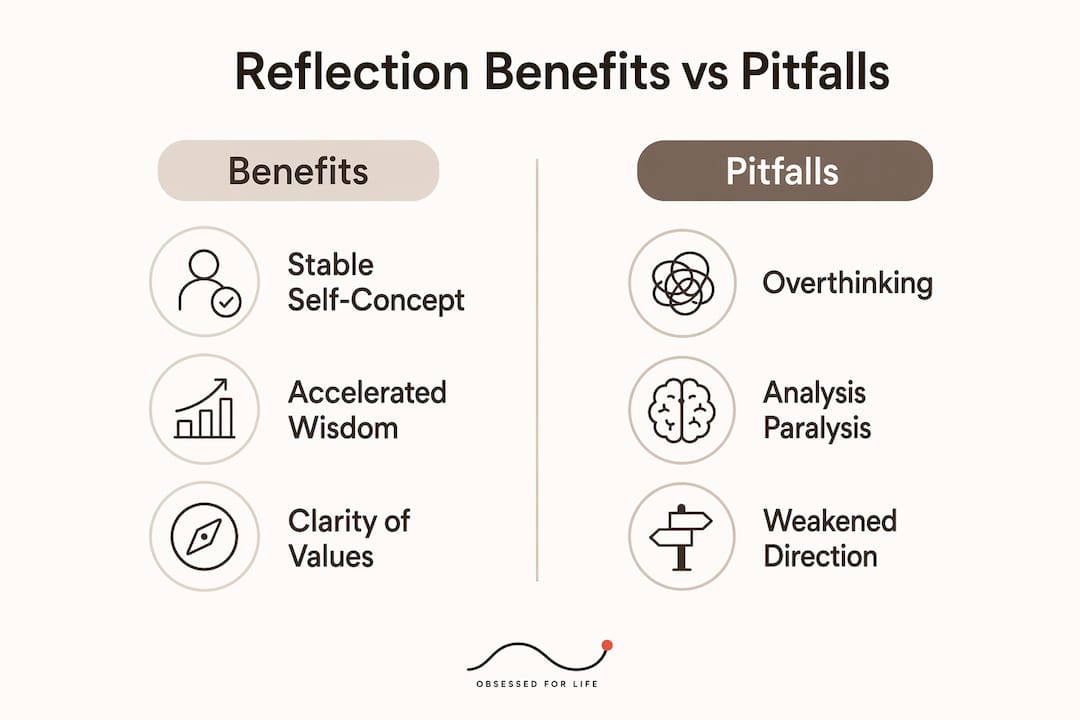
But reflection has a shadow side. Excessive self-evaluation can trap you in cycles of analysis that weaken direction and delay action. Psychology Today calls this the “reflection trap,” and it is more common than most people admit. Meaning tends to arise through involvement in life, not through constant self-examination.
| Benefit | Pitfall |
|---|---|
| Builds stable self-concept and values clarity | Excessive reflection creates hesitation and analysis paralysis |
| Accelerates wisdom and emotional intelligence | Continuous self-evaluation can disrupt engagement with real life |
| Aligns choices with authentic desires | Over-filtering experience limits spontaneity and growth |
| Supports intentional, purposeful life design | Reflection without action produces insight but no change |
| Strengthens decision-making in midlife transitions | Inward focus without outward engagement leads to disconnection |
The distinction between healthy reflection and the reflection trap comes down to one question: Is this inquiry moving me forward, or keeping me stuck? Reflection is a tool, not a destination.
Pro Tip: After a reflection session, write one concrete next step, however small. This closes the loop between insight and action and prevents reflection from becoming a substitute for living.
How to develop effective reflective practices for a meaningful life
Reflective practice, as it is known in psychology and design thinking, is the structured habit of examining your experience to extract learning and guide future choices. The term comes from the work of theorists such as Donald Schön and applies directly to life design. For women over 40, building this practice does not require hours of journaling or a silent retreat. It requires consistency and a few reliable structures.

Iterative micro-reflective loops are more effective than marathon reflection sessions. Small, regular check-ins after decisions prevent the erosion of embodied learning and support steady progress. Think of it as a rhythm rather than an event.
Here is a numbered sequence for building your practice:
-
Start with a weekly review. Set aside 20 minutes each Sunday to ask: What felt right this week? What felt off? What do I want more of?
-
Journal your why. After any meaningful choice, write the reason behind it. Articulating your reasons prevents external pressures from quietly dominating your decisions.
-
Create a physical planning system. Paper-based command centers and planning notebooks support sustainable reflection over time. A physical system you return to regularly becomes a record of your own evolution.
-
Use open questions as prompts. Questions like What am I tolerating that I no longer need to? or Where did I feel most like myself this month? Open reflection without forcing premature answers.
-
Pair reflection with a sensory anchor. Morning tea, a walk, or a particular chair can signal to your brain that it's time to reflect. Ritual reduces resistance.
-
Review quarterly. Every three months, read through your notes again. Patterns you cannot see week to week become visible across a season.
The Obsessedforlife Obsession Map is built on exactly this kind of structured self-inquiry. It guides you through the questions that matter most in this season, so you are not starting from a blank page.
Pro Tip: Avoid the trap of over-filtering your reflections for “acceptable” feelings. Write what is true, not what sounds wise. The raw version is where the real information lives.
How does reflection uniquely support women 40 and above in finding purpose?
Women over 40 bring something to reflection that younger women simply do not yet have: a long record of lived experience to examine. That record is an asset. Life experience and wisdom accumulate in ways that make midlife reflection unusually rich and productive. You have enough data points now to see your own patterns clearly.
The Templeton Foundation notes that many people struggle with reflection and meaning-making, particularly with the gap between knowing something intellectually and integrating it into their lives. That integration is the real work of midlife. It is less about discovering who you are and more about honoring what you already know.
Women in this season also face specific challenges that make reflection both harder and more necessary. Hormonal shifts affect mood and cognition. Relationships restructure as children grow and partnerships evolve. Career identity may feel uncertain. These pressures can make turning inward feel like a luxury. It is not. It is the infrastructure of good decisions.
Reflection in midlife also develops what writer Ann Smyth calls somatic attunement, the ability to read your own body’s signals as data. Fatigue, excitement, dread, and joy are not just emotions. They are information about alignment. When you reflect regularly, you get better at reading that information accurately.
Key themes worth exploring in your own midlife reflection practice:
-
Values: Which ones have deepened? Which have you outgrown?
-
Relationships: Which connections sustain you? Which ones cost more than they give?
-
Legacy: What do you want to have built or contributed by the end of this chapter?
-
Creativity and expression: What have you been meaning to make, write, or explore?
-
Physical well-being: How does your body want to be cared for now, in this season specifically?
Later life is genuinely ideal for this kind of self-exploration, not despite the complexity, but because of it.
Key takeaways
Reflection is the foundation of intentional life design, and for women over 40, it is the most direct path from living by default to living by choice.
| Point | Details |
|---|---|
| Reflection enables intentional living | Regular self-inquiry shifts you from reactive patterns to purposeful, values-aligned decisions. |
| Midlife is prime time for reflection | Accumulated experience gives women 40+ richer material to examine and more clarity to gain. |
| The reflection trap is real | Excessive self-evaluation without action weakens direction and delays meaningful change. |
| Small, consistent loops work best | Weekly reviews and micro-reflective habits outperform occasional marathon journaling sessions. |
| Document your why | Writing the reason behind your choices creates a values record that guides future decisions. |
What I have learned about reflection and moving forward
I used to think reflection meant sitting quietly until the right answer arrived. I spent a lot of time sitting quietly.
What I have found, both personally and from watching women navigate this season, is that reflection only becomes useful when paired with small, real-world experiments. You reflect, you try something, you reflect again. The loop is the practice. Neither half works without the other.
I kept a planning notebook for two years before I realized I was using it to feel productive without changing anything. The writing felt like progress. It wasn't. The shift came when I started ending every reflection session with one concrete action, even something as small as making a phone call or signing up for a class. That small commitment changed the texture of the whole practice.
The other thing I would tell you is this: your reflection does not need to be tidy. The most useful entries in my notebooks are the ones that contradict each other, the ones where I changed my mind, the ones where I admitted I had no idea what I wanted. That honesty is where the real work happens. Imperfect, honest reflection beats polished, performed reflection every time.
If you are in a season of transition right now, give yourself permission to not have the answers yet. Reflection is not about arriving. It is about staying curious long enough to find out what is true for you.
— Theresa Stairs
Ready to turn your reflection into a real design for your life?
Reflection without a structure can feel like circling the same questions without getting anywhere. Obsessedforlife was built for exactly this moment: the one where you are ready to stop circling and start designing.
The Obsession Map is Obsessedforlife’s original guided assessment for women 40 and beyond. It listens to who you are right now and reflects back a clear picture of what lights you up in this season. It is not a personality test. It is a life design tool built around joy, values, and what you genuinely want next. If you have spent years showing up for everyone else, this is your invitation to show up for yourself. Start here.
FAQ
What is the role of reflection in life design?
Reflection in life design is the practice of examining your values, choices, and experiences to make more intentional decisions about how you live. It shifts you from reactive patterns to purposeful ones, which is the foundation of meaningful life redesign.
How often should I reflect to support personal growth?
Short, consistent reflection sessions work better than occasional long ones. A weekly 20-minute review, combined with brief journaling after significant decisions, builds the habit without overwhelming your schedule.
What is the reflection trap and how do I avoid it?
The reflection trap occurs when continuous self-evaluation replaces engagement with real life, weakening your sense of direction. Avoid it by ending every reflection session with one concrete next step.
Why is midlife a particularly good time for self-reflection?
Women over 40 bring decades of lived experience to reflection, making patterns easier to spot and values easier to clarify. That accumulated data makes midlife self-exploration unusually productive compared to earlier life stages.
What questions are most useful for life reflection at midlife?
The most productive questions for life reflection focus on values, energy, and desire: What am I tolerating that no longer fits? Where did I feel most like myself recently? What have I been meaning to do for years? These open-ended prompts surface honest answers rather than rehearsed ones.