

Life redesign in midlife is the deliberate process of realigning your inner beliefs, values, and identity with the external structure of your daily life. It is not a single dramatic decision. It is a sustained, evolving practice that draws on psychological insight, honest self-reflection, and practical change. If you are somewhere in your 40s, 50s, or 60s and feel the quiet pull of a question you cannot quite name, this is the guide that meets you there.
What life redesign at midlife really means
Life redesign, sometimes called midlife reinvention in psychological literature, is best understood as a set of orientations that support transition rather than a fixed, step-by-step formula. That distinction matters. It means there is no single correct sequence, no checklist that works for everyone, and no finish line where redesign is declared complete. The process is alive, and so are you.
What makes this kind of transformation different from a simple career change or a new hobby is its holistic nature. You are not just rearranging the furniture of your life. You are asking whether the house itself still fits who you are. Adult developmental theories from Erik Erikson and Carl Jung both describe midlife as a generative stage, a time when women reconcile past achievements with their current authentic selves. That reconciliation is the real work.

The invitation here is not to become someone else. It is to become more fully yourself. That is a quieter, slower, and ultimately more lasting kind of change.
What internal and external changes define life redesign at midlife?
The most useful framework for understanding midlife redesign separates the work into two distinct but connected layers: internal and external.
Internal work lives in the territory of therapy, reflection, and identity. It involves examining the beliefs you formed early in life, the fears that have quietly governed your choices, and the identity attachments that may no longer serve you. This is where you ask: Who did I become to survive, and who do I want to be?
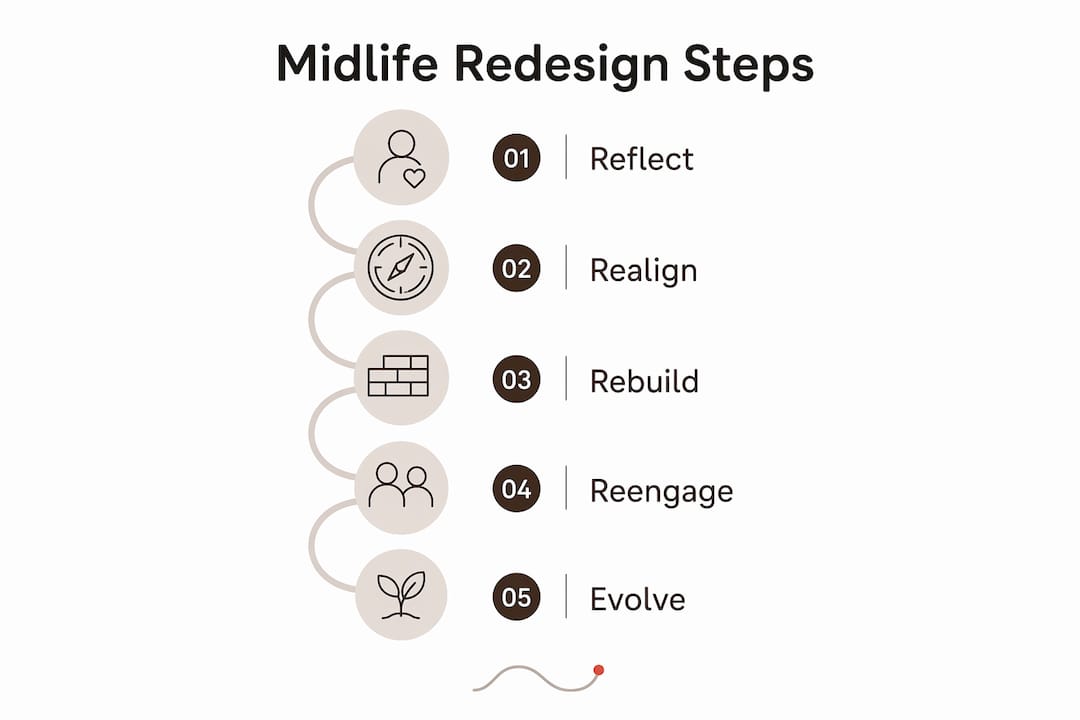
External redesign lives in the territory of coaching, action, and structure. It involves career shifts, relationship renegotiations, changes in social circles, and lifestyle choices. This is where internal clarity becomes visible in the world.
Therapy and coaching each serve a distinct purpose, and both are often needed together for genuine alignment. Therapy addresses the painting. Coaching addresses the frame. Changing only the frame while leaving the painting untouched leads to repeated dissatisfaction, a pattern many high-achieving women recognize immediately when they hear it described.
Here is what that looks like in practice:
-
A woman leaves a demanding corporate role but brings the same perfectionism and people-pleasing into her next chapter, and wonders why she still feels depleted.
-
A woman does deep therapy work and gains clarity about her values, but never takes external action, and wonders why nothing in her life shifts.
-
A woman works both layers simultaneously, and finds that small external changes feel sustainable because they are rooted in something real.
Pro Tip: If you are unsure where to start, ask yourself which feels more uncomfortable: sitting with your own thoughts, or taking a concrete step toward change. The more uncomfortable direction is usually where the growth is.
How does accepting uncertainty and grief enhance midlife redesign?
One of the most counterintuitive truths about midlife transformation is that not knowing is not a problem to solve. It is a phase to inhabit.
Tolerating the unknown is not a weakness in the redesign process. It is the clearing phase. Premature answers foreclose discovery.” — Annie Wright, LMFT
When you rush to find the answer, the new plan, the next identity, you skip the part where you listen to yourself. The uncertainty of “I don’t know yet” is a necessary space for authentic desires to surface. Filling it too quickly with someone else’s blueprint, a course, a pivot, a reinvention story you read online, closes off the very discovery you are seeking.
Grief is the other piece that most midlife transformation guides skip entirely. Missed-opportunity grief at midlife is natural and requires real processing. You may grieve the career path you did not take, the relationship you stayed in too long, the version of yourself you set aside to meet everyone else’s needs. That grief is not a sign that something went wrong. It is a sign that something mattered.
The shift that supports real growth is moving from seeking one big solution to pursuing what might be called “one notch” progress. One honest conversation. One boundary set. One morning spent doing something that belongs entirely to you. These incremental moves compound over time into a life that genuinely feels like yours.
What role does menopause and mental health play in midlife redesign?
Menopause and perimenopause are not just physical events. They are psychological ones, and any honest midlife transformation guide must address them directly.
Menopause triggers significant psychological effects, including mood swings, cognitive fog, identity grief, and a disrupted sense of self. These symptoms are not character flaws or signs of weakness. They result from hormonal shifts that affect cognitive and emotional regulation at the neurological level. Understanding that distinction changes everything about how you respond to yourself during this season.
The data on awareness is striking. Only 28% of women knew that menopause could trigger depression or anxiety, yet 56% report experiencing psychological symptoms during this transition. That gap between experience and understanding causes enormous unnecessary suffering, because women misread biological symptoms as personal failure.
| Symptom type | What it may feel like | Recommended support |
|---|---|---|
| Cognitive fog | Difficulty concentrating, word-finding struggles | Menopause-literate physician evaluation |
| Mood instability | Anxiety, irritability, low mood | Trauma-informed therapy plus medical review |
| Identity grief | Feeling lost, purposeless, or invisible | Therapy focused on self-concept and values |
| Sleep disruption | Fatigue affecting decision-making and resilience | Integrated medical and psychological care |
Seeking a menopause-literate physician is not optional. It is a prerequisite for accurate diagnosis. Many symptoms that look like depression or burnout are, in part, hormonal. Therapy during this period helps with grief and identity work, building a stable sense of self that does not depend solely on cognitive output or productivity.
Pro Tip: When speaking with a new physician, ask directly: “Are you familiar with the psychological symptoms of perimenopause?” Their answer tells you immediately whether they are the right partner for this season.
How can women pursue authentic evolution rather than dramatic overhaul?
The cultural pressure to “start all over” at midlife is real and worth naming as a trap. The reinvention trap is the belief that meaningful change requires becoming someone entirely different. It does not. It requires becoming more of who you already are.
Here is the distinction that changes the frame:
| Overhaul | Evolution |
|---|---|
| Becoming someone new | Becoming more authentically yourself |
| Driven by cultural pressure | Driven by inner values |
| Dramatic, often unsustainable | Incremental, deeply rooted |
| Requires discarding the past | Integrates past achievements with new desires |
| Produces anxiety and performance | Produces steadiness and genuine satisfaction |
Psychological research supports this. Women’s core personality traits mostly settle after age 30. What changes at midlife is not who you are at the core. It is how you choose to express those traits, and which ones you finally give permission to lead.
Authentic evolution shows up in small, specific ways:
-
Setting a boundary with a family member you have always accommodated
-
Trusting your own taste in how you spend a Saturday, without justifying it
-
Saying no to an obligation that drains you and yes to one that genuinely interests you
-
Allowing yourself to explore new experiences without needing them to become a new identity
Midlife redesign requires shifting from “either/or” thinking to “both/and” thinking. You can honor what you have built and still want something different. Those two things are not in conflict. They are the whole picture.
What practical strategies support career and lifestyle redesign at midlife?
Reinventing life in midlife does not always mean quitting your job, selling your house, or moving to a different country. Those stories make headlines because they are dramatic. The quieter strategies are often more effective and far more sustainable.
-
Explore internal mobility before external pivots. Many women assume that career redesign requires leaving their organization. Often, a new role, a reduced schedule, or a lateral move within the same company delivers the change they need. Negotiating a new arrangement is a skill worth developing before assuming that departure is the only option.
-
Name your transferable skills explicitly. Women’s accumulated life transitions build adaptability, a genuinely valued asset in modern workplaces. Caregiving, managing complexity, holding multiple roles simultaneously: these develop capacities that many younger colleagues have not yet had the chance to build. Articulating this clearly, in interviews, in performance conversations, and in your own self-concept, changes how you are perceived and how you perceive yourself.
-
Build a community of peers in transition. Isolation amplifies doubt. Finding even two or three women who are navigating similar transitions provides both accountability and perspective. You stop feeling like something is wrong with you and start recognizing the shared terrain of this season.
-
Treat lifestyle redesign as a series of experiments, not commitments. You do not need to know whether something will become your new purpose before you try it. A pottery class, a volunteer role, a writing practice: these are data points, not declarations. Approaching them with curiosity rather than pressure changes the entire experience.
-
Anchor new goals to your values. New goals after 40 land differently when they are rooted in what matters to you now, not what mattered at 28 or what you think should matter. The Obsessedforlife Obsession Map was designed precisely for this: to help you identify what lights you up in this specific season, not a previous one.
Key takeaways
Life redesign at midlife succeeds when internal belief work and external life changes are pursued together, supported by grief processing, menopause awareness, and a commitment to authentic evolution over dramatic overhaul.
| Point | Details |
|---|---|
| Internal and external work together | Changing only externals without addressing beliefs leads to repeated dissatisfaction. |
| Uncertainty is productive | Tolerating “I don’t know yet” creates space for authentic desires to surface. |
| Menopause affects redesign | Psychological symptoms of perimenopause require both medical and therapeutic support. |
| Evolution over overhaul | Core traits are stable; midlife change is about expressing them more authentically. |
| Adaptability is a career asset | Life transitions build skills that are genuinely valued in modern workplaces. |
What I have learned from sitting with women in this season
By Theresa
I'm in this stretch of life myself, and here's what I keep coming back to: midlife is a complexity to honor.
The hardest part for me has been the pressure I put on myself. I expected clarity to arrive on a faster clock than clarity keeps. I treated grief as a detour, when grief is part of the road itself. And uncertainty read to me as failure for a long time, when it's the clearing that makes room for something real.
What's worked is a series of small, honest moves made with more compassion than I thought I deserved. A boundary held. A morning protected. A question asked and given time to breathe.
The way through, for me, started with getting quiet enough to hear what I wanted, then taking one step toward it. And another after that. That's the whole method, and it's enough.
If you're in the middle of uncertainty right now, take it as a sign you're paying attention. That counts for more than you realize.
— Theresa Stairs
Start your redesign with Obsessedforlife

Obsessedforlife was built for exactly this moment. You have spent years being excellent at what others needed. Now the question that belongs entirely to you is rising, and it deserves a real answer.
The Obsession Map is an original guided assessment that listens to who you are right now, in this season, and reflects back a picture of what genuinely lights you up. It is not a personality test. It is a tool for finding your joy and following it, whether you are 42 or 68 and finally beginning. Take the first step toward living intentionally on your own terms.
FAQ
What is life redesign at midlife?
Life redesign at midlife is the deliberate process of realigning your inner values and beliefs with the external shape of your life. It combines internal psychological work with practical external changes to create a more authentic and fulfilling second chapter.
Is midlife redesign the same as a midlife crisis?
A midlife crisis and a midlife redesign share some emotional territory, including grief and uncertainty, but they are not the same thing. A crisis is often reactive; redesign is intentional and treats that same discomfort as useful information rather than something to escape.
How does menopause affect midlife redesign?
Menopause and perimenopause produce psychological symptoms including mood instability, cognitive fog, and identity grief that directly affect the redesign process. Seeking a menopause-literate physician alongside trauma-informed therapy provides the integrated support this season requires.
Do I need to make dramatic changes to redesign my life?
A dramatic overhaul is not required and is often counterproductive. Authentic evolution means becoming more of who you already are through incremental, values-driven changes rather than discarding everything you have built.
Where do I start if I feel lost at midlife?
Start by tolerating the uncertainty rather than rushing past it. Small, honest moves, one boundary set, one morning protected, one question asked without forcing an answer, compound into meaningful transformation over time. Tools like the Obsessedforlife Obsession Map can help you identify what genuinely matters to you in this specific season.