

A life audit is a deliberate, structured process of self-reflection that career women use to assess whether their daily reality still matches what they want. It is not a productivity exercise or a goal-setting session. It is a full, honest look at where your energy goes, what you value, and whether the life you are living is the one you chose. Research shows that individuals who audit regularly report 31% higher life satisfaction than those who do not. That number matters because it tells you something most high-achieving women already sense: functioning well is not the same as living well.
Why career women need life audits more than anyone else
The word “audit” comes from the Latin audire, meaning to hear. A life audit asks you to finally hear yourself. For career women over 40, that practice is not optional. It is the difference between a life that keeps accumulating and a life that fits.

73% of adults report feeling that life moves too fast to reflect. That statistic describes most high-performing women perfectly. You are executing at a high level, meeting deadlines, showing up for your family, and still feeling like something is quietly off. The audit gives that feeling a name and a structure.
Career women over 40 carry a particular kind of weight. Decades of professional identity, accumulated obligations, and the habit of prioritizing others create a life that looks successful from the outside and feels hollow from the inside. A career woman's self-assessment, done with honesty, can surface the gap before it becomes a crisis.
The importance of life audits is not about finding what is wrong. It is about getting clear on what is right, what is draining, and what deserves more of your attention in this season.
What is a life audit and how does it differ from other self-assessments?
A life audit is a structured review of the major areas of your life, typically covering career, finances, relationships, physical wellbeing, mental health, and sense of purpose. It differs from goal-setting in that it starts with observation rather than ambition. You are not deciding what to achieve. You are noticing what is happening.
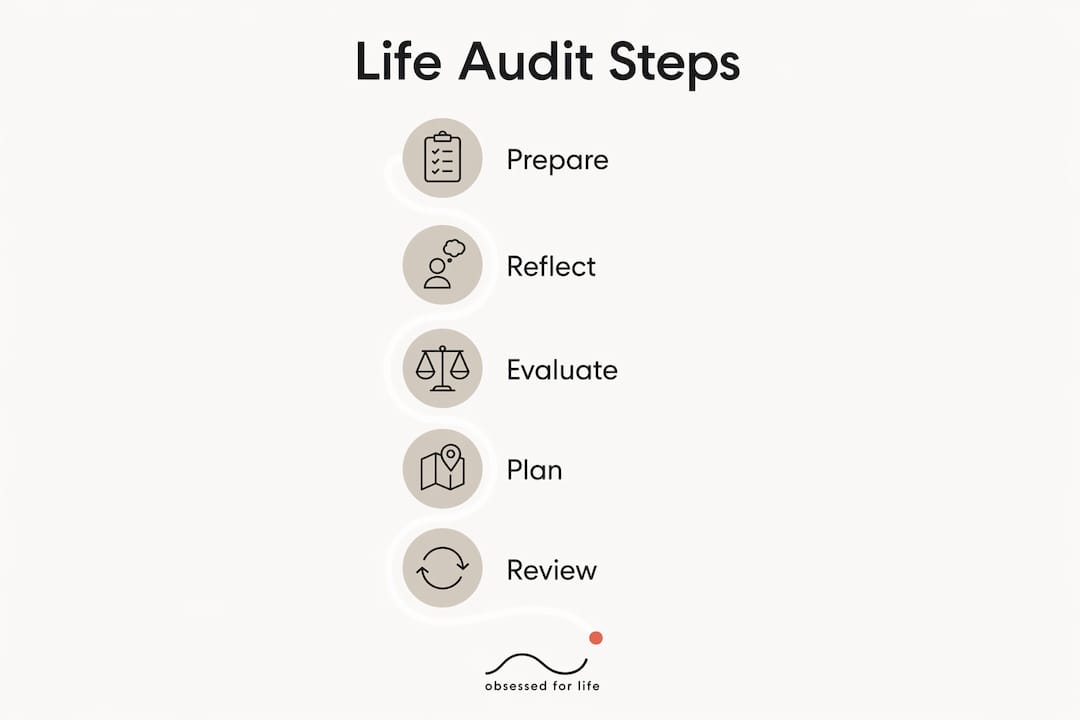
Most self-assessments focus on one domain. A performance review looks at work. A therapy session might focus on relationships. A life audit holds all of it at once. That full-picture view is what makes it so useful for women navigating complex, multi-layered lives.
Two frameworks appear consistently in structured audit practice:
-
The spider graph method: You rate each life area on a scale of 1–10 and map the results visually. The gaps between areas show you where your life is out of balance.
-
The 6-area identity audit examines six dimensions of identity: professional self, relational self, physical self, creative self, values-based self, and future self. It is especially useful for women whose identity has been heavily shaped by career roles.
Structured personal audits take 15–60 minutes depending on depth. That range is meaningful. A 15-minute check-in can surface a pattern you have been ignoring for months. A 60-minute deep audit can reframe an entire chapter of your life.
Pro Tip: Start with the spider graph before any deeper audit work. It gives you a visual snapshot that is harder to rationalize away than a written list.
The goal is not perfection across all areas. The goal is clarity about where you are and honest curiosity about where you want to go.
Why women over 40 face unique pressure that makes audits critical
Career women over 40 carry a disproportionate share of invisible mental labor. Planning, anticipating, coordinating, and managing the emotional lives of others takes up cognitive space that rarely gets counted or credited. 1 in 10 women report symptoms of major depression connected to this accumulated mental load. That figure represents real women who are performing well by every external measure while quietly struggling inside.
Therapist Annie Wright identifies a pattern that shows up repeatedly in high-achieving women: survival mode disguised as success. You are not burned out in the dramatic sense. You are just running on adrenaline, habit, and obligation. The audit interrupts that pattern long enough for you to see it.
Functioning career women may be in chronic stress without realizing it. Audits help identify hidden stress impacts before they become health or career crises.” — Annie Wright, therapist."
The benefits of life audits for this group are specific and measurable:
-
Clarity about energy. You identify which roles, relationships, and responsibilities genuinely energize you versus which ones deplete you.
-
Recognition of misalignment. You see where your values and your daily choices have drifted apart.
-
Permission to change direction. The audit gives you data, not just feelings, to support a shift.
-
Prevention of reactive decisions. Without regular reflection, career pivots often happen in crisis mode rather than from a place of intention.
The benefits of life audits compound over time. Women who audit annually report making fewer impulsive career moves and feeling more grounded in their choices.
How to conduct an effective life audit: steps and best practices
The most common mistake women make with life audits is treating them like performance reviews. They grade themselves, find themselves lacking, and walk away feeling worse. That approach defeats the purpose entirely.
The right starting point is curiosity. You are not here to judge. You are here to notice.
-
Choose your focus areas. Focus on 2–4 key areas rather than trying to audit your entire life at once. Most women find that career, relationships, health, and purpose are the most revealing starting points.
-
Rate each area honestly. Use a simple 1–10 scale. Ask yourself: “How satisfied am I with this area right now?” Do not ask what you think you should feel. Ask what you feel.
-
Identify the gap. For each area you rated below 7, write one sentence describing what is missing. Not what you want to add. What is missing?
-
Create specific next steps. Effective audits produce concrete actions, not vague intentions. “I want to feel more connected” isn't a next step. “I will call one friend I have been avoiding for three months” is.
-
Check your nervous system. Notice where in your body you feel tension as you review each area. A dysregulated nervous system affects both career performance and personal wellbeing. Physical tension during reflection is data, not weakness.
Pro Tip: Schedule your audit for a time when you are not already depleted. A Sunday morning or a quiet weekday afternoon works better than a late-night session after a full workday.
Avoid the trap of trying to fix everything at once. The audit is a map, not a renovation plan. You are orienting yourself, not rebuilding from scratch.
How life audits support sustainable career and life redesign after 40
A single audit is useful. A rhythm of regular audits is transformative. Career strategist Nicole Salama notes that structured audits build the self-awareness needed to avoid reactive career moves. That insight is especially relevant for women in their 40s and 50s who are considering pivots, transitions, or complete reinventions.
Reactive career moves happen when you are running from something. Audit-informed career moves happen when you are moving toward something. The difference in outcome is significant.
Women who use life audits as part of a life redesign at midlife often describe a shift from managing their lives to directing them. That shift does not happen overnight. It happens through repeated, honest reflection over time.
A practical structure that works well for career women is the 12-week reset:
| Phase | Focus | Outcome |
|---|---|---|
| Weeks 1–2 | Full life audit across 4–6 areas | Clear picture of current reality |
| Weeks 3–6 | Deep work on 2 priority areas | Specific changes in targeted domains |
| Weeks 7–10 | Implement and observe | Real-time data on what is shifting |
| Weeks 11–12 | Mini-audit and recalibration | Adjusted plan for the next quarter |
This structure treats life evaluations for career growth as a repeating practice, not a one-time event. The women who benefit most are those who build the audit into their calendar the way they build in performance reviews at work.
-
Audits reveal which career skills are still aligned with your current values and which ones you have outgrown.
-
They surface relationships that are draining your capacity without your conscious awareness.
-
They create space to ask the question most career women never stop long enough to ask: What do I want now?
Life audits, as a leadership skill, are neither soft nor aspirational. They are practical tools for women who want to lead their own lives with the same clarity they bring to their professional roles.
Key Takeaways
Career women over 40 who conduct regular life audits report measurably higher life satisfaction and make more intentional career and personal decisions than those who rely on instinct alone.
| Point | Details |
|---|---|
| Audits differ from goal-setting | They start with honest observation of current reality, not ambition or achievement targets. |
| Focus on 2–4 areas | Narrowing your audit to a few priority areas creates momentum without overwhelming you. |
| Functioning is not thriving | Many high-performing women are in chronic stress mode; audits surface what performance hides. |
| Concrete steps are required | An audit that ends in vague intentions produces no change; specific next steps are non-negotiable. |
| Rhythm matters more than depth | Regular quarterly or annual audits outperform a single deep dive for long-term life satisfaction. |
What I have learned from auditing my own life after 40
I spent years treating my career as the primary measure of whether my life was working. If the work was going well, I assumed everything else was fine. The audit taught me that the assumption was costing me more than I realized.
The first time I sat down with a spider graph and rated my life honestly, I was surprised by what I saw. My career scored high. My sense of purpose scored low. Those two things had quietly separated without my noticing. That gap was not a failure. It was information.
What I have observed in women who go through this process is that the surprise is almost always the same. They expect to find that they need to work harder or do more. They find they need to stop doing certain things entirely. The audit does not add to your list. It clarifies what belongs on it.
The women who get the most from this process are the ones who approach it as an invitation rather than an interrogation. You are not on trial. You are simply listening to yourself, possibly for the first time in years. That act alone, quiet and honest and without an agenda, is where the real work begins.
— Theresa Stairs
What Obsessedforlife offers women ready to look inward

Obsessedforlife was built for the woman who has spent decades excelling at what others need and is now ready to ask a different question. The platform’s original guided assessment, the Obsession Map, walks you through what brings you joy in this season, what values are driving you, and what experiences belong in this chapter of your life.
If you are ready to move beyond functioning and into something that genuinely fits, start with the Obsession Map at Obsessedforlife. It is not a quiz. It is a reflection tool designed specifically for women 40 and beyond who are ready to hear their own answers. The path forward is yours. This is where you begin to see it clearly.
FAQ
What is a life audit in simple terms?
A life audit is a structured self-review of the major areas of your life, including career, relationships, health, finances, and purpose. It helps you see where your current reality aligns with your values and where it does not.
How often should career women do a life audit?
Most career women benefit from a full audit once or twice a year, with shorter monthly check-ins in between. Regular practice builds the self-awareness needed to make intentional rather than reactive decisions.
How long does a life audit take?
Structured audits take 15–60 minutes depending on the depth and number of areas you review. A focused 20-minute session on two priority areas can produce meaningful clarity.
Can a life audit help with career transitions after 40?
Yes. Structured audits build the self-awareness that prevents reactive career moves and supports intentional transitions grounded in your current values and goals.
What is the difference between a life audit and journaling?
Journaling is open-ended reflection. A life audit is structured, area-specific, and designed to produce concrete next steps. An audit without specific outcomes is just journaling with a rating scale.