

A life audit is a structured self-reflection process where you evaluate major areas of your life to identify the gap between where you are now and where you genuinely want to be. Think of it as a personal inventory. Not a performance review, not a crisis response. An honest, unhurried look at whether your daily choices still reflect your actual values. For women at midlife and beyond, this kind of intentional living practice can be the difference between drifting through a season and owning it.
What is a life audit, and why does it matter at midlife?
A life audit is defined as a deliberate method for assessing your current reality across key life categories to determine alignment with your core values and goals. The output is not a to-do list. It is clarity. You see, with data rather than emotion, exactly where your energy is well spent and where it is quietly leaking away.
This matters especially after 40. By this season, most women have spent decades organizing their lives around other people’s needs, career ladders, family rhythms, and social expectations. A life audit is the first formal invitation to ask: Does this life still fit me? That question is not selfish. It is necessary.

The life audit process typically covers seven core areas: health and physical well-being, career and finances, relationships, personal growth, fun and recreation, home environment, and purpose or meaning. These categories are sometimes called the “life wheel” or “wheel of life,” a framework used widely in coaching and personal development. Each area gets examined on its own terms, without comparing it to anyone else’s version of success.
The benefits of a life audit are concrete. You gain clarity on what to prioritize. You identify areas of misalignment before they become regret. You create a foundation for setting new goals that reflect who you are now, not who you were at 28.
What areas does a life audit cover, and how do you score them?
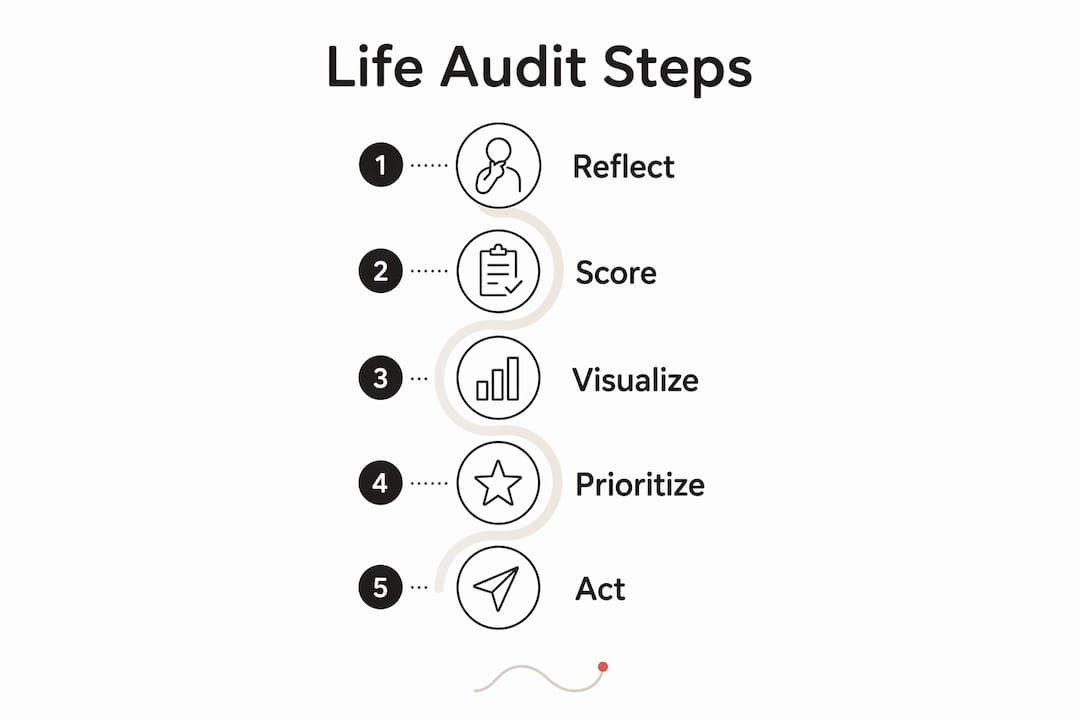
The scoring system is one of the most practical elements of any life assessment guide. Most life audits use a 1 to 10 satisfaction rating for each life category. A score of 1 means deeply dissatisfied or misaligned. A score of 10 means fully satisfied and living in alignment. The number is not a judgment. It is a data point.
Here are the core categories most life audit checklists include:
-
Health and body: Energy levels, sleep quality, movement, and how you feel physically day to day
-
Career and finances: Professional fulfillment, income stability, and whether your work reflects your values
-
Relationships: Quality of connection with a partner, family, friends, and community
-
Personal growth: Learning, creativity, and whether you feel mentally stimulated and evolving
-
Fun and recreation: Joy, play, hobbies, and time spent doing things purely because you love them
-
Home and environment: Whether your physical space supports or drains you
-
Purpose and meaning: A sense of direction, contribution, and feeling that your life matters
Once you have scored each area, plot the numbers visually. A radar chart or spider chart makes the imbalances immediately visible. A life where career scores a 9 but fun scores a 2 tells a story that a list of goals never could.
Pro Tip: Customize your categories. If spirituality, creative expression, or community service are central to who you are, add them. The life audit works best when it reflects your values, not a generic template.
| Life area | Example score | What a low score might signal |
|---|---|---|
| Health | 4/10 | Chronic fatigue, neglected self-care, or unaddressed medical needs |
| Relationships | 6/10 | Surface-level connection or unspoken resentment needing attention |
| Purpose | 3/10 | Feeling invisible, directionless, or disconnected from what matters |
| Fun and recreation | 2/10 | Years of putting joy last, now showing up as flatness or restlessness |
How often should you do a life audit?
Quarterly life audits are the recommended rhythm for anyone serious about staying aligned. Four times a year gives you enough time to see real change between check-ins, while keeping you close enough to your own life to catch drift before it becomes a pattern.
Here is a practical cadence to consider:
-
Annual audit (January or your birthday): A full review of all life areas. Score every category. Write freely. This is your big-picture reset.
-
Quarterly check-ins (every 3 months): A lighter review focused on the priorities you set at the annual audit. Are you moving? What is creating drag?
-
Monthly reflection (15 minutes): A brief gut-check. Not a full audit. Just a temperature read on your energy and focus.
-
Seasonal pause: Many women find natural audit moments at transitions: kids leaving home, a career shift, a health scare, a milestone birthday.
Sahil Bloom’s framework for personal quarterly reviews reframes this rhythm beautifully. Instead of asking “Did I succeed?”, you ask “What created progress, and what created drag?” That shift moves the audit from self-judgment to self-diagnosis. It is a far more useful question.
Pro Tip: Set a recurring calendar reminder for your quarterly check-in. Treat it like a doctor’s appointment. You would not skip that.
How do you turn life audit findings into real goals?
This is where many people stall. The audit reveals something true, and then nothing changes. The reason is almost always the same: trying to fix everything at once.
Three focused priorities for the next three to six months is the recommended number. Not ten. Not a vision board with forty intentions. Three. That number is manageable enough to act on and meaningful enough to create real momentum.
Use the SMART framework to shape each priority into a goal. SMART stands for Specific, Measurable, Achievable, Relevant, and Time-bound. A vague intention like “get healthier” becomes “walk for 10 minutes every morning before breakfast for the next 30 days.” SMART goals starting small like this are not underwhelming. They are the architecture of lasting change.
A few principles that make this work:
-
Start with the lowest-scoring area that you actually have control over. Not the hardest one. The one where a small shift would create the most relief.
-
Run time-boxed experiments. Commit to a new behavior for 30 or 60 days before deciding if it belongs in your life permanently.
-
Write your goals down and keep them visible. Writing thoughts during a life audit helps spot patterns and clarifies what you actually value versus what you think you should value.
-
Schedule your next audit before you close this one. Progress is only visible when you have a before and after.
Pro Tip: At midlife, energy is a real constraint. A practical midlife approach means choosing priorities that respect your actual capacity, not the capacity you had at 35. Sustainable beats ambitious every time.
Common misconceptions about life audits
The biggest misconception is that a life audit is a performance review. It is not. A life audit differs from performance optimization in one critical way: it asks whether your goals reflect your authentic values before asking how efficiently you are pursuing them. You might be climbing the ladder perfectly and still feel hollow. The audit catches that.
A second misconception is that a low score demands a dramatic overhaul. It does not. A score of 3 in “fun and recreation” does not mean you need to quit your job and move to Italy. It means that area deserves attention, curiosity, and perhaps one small experiment this month.
A third misunderstanding is confusing a life audit with mood journaling. Journaling is valuable, but it captures how you feel today. A life audit captures patterns across time. Repeated audits create a baseline that makes trend detection possible. You stop reacting to a bad week and start responding to a real pattern.
The audit is not about self-criticism. It is about honest data. There is a meaningful difference.
What tools and resources support a life audit practice?
You do not need an expensive program to do this well. The most effective tools are often the simplest ones.
Frameworks worth knowing:
-
The Wheel of Life is the most widely used visual framework. It maps your life areas in a circle and lets you shade in your score for each. The resulting shape shows balance or imbalance at a glance.
-
The WOOP method (Wish, Outcome, Obstacle, Plan), developed by psychologist Gabriele Oettingen, pairs well with life audit goal-setting. It adds a realistic obstacle-planning step that most goal frameworks skip.
Practical tools to try:
-
A simple notebook and a set of guided questions work as well as any app. Questions like “What am I tolerating?” and “Where do I feel most alive?” generate more insight than a blank page.
-
For career-related audit components, a skills assessment tool from NueCareer can help you identify strengths and gaps you may have stopped noticing.
-
Printable life audit worksheets are widely available and useful for women who prefer pen to screen.
The single most important tool is consistency. Using structured prompts during self-reflection strengthens insight generation and clarity far more than any single session of deep thinking ever will.
Key takeaways
A life audit works because it replaces vague dissatisfaction with specific, values-based data that you can actually act on.
| Point | Details |
|---|---|
| Define your starting point | Score each life area from 1 to 10 to reveal where alignment is strong and where it is missing. |
| Audit regularly | Quarterly check-ins build a reliable baseline and help you detect patterns rather than react to moods. |
| Limit your priorities | Choose three focused goals for the next 3 to 6 months to keep change sustainable and meaningful. |
| Use the right tools | The Wheel of Life, WOOP method, and guided journaling prompts each strengthen the audit process. |
| Separate audit from judgment | A life audit diagnoses alignment, not failure. Low scores are invitations, not verdicts. |
What I have learned from doing this over and over again
By Theresa
The first time I did a real life audit, I expected to feel motivated. What I actually felt was a little stunned. Not because anything was catastrophically wrong, but because I had been so busy being competent that I had stopped noticing what I actually wanted. My scores in career and relationships were solid. My score in fun was a 2. I had not laughed until my stomach hurt in years. That number sat with me for a long time.
What I have come to believe, after doing this practice repeatedly, is that the value is not in the single audit. It is in the pattern you see across several of them. The first audit shows you a snapshot. The third or fourth shows you a story. And that story is far more honest than any single moment of reflection.
For women at midlife, I think the audit is especially powerful because this season tends to come with a particular kind of confusion. You have done so much. You are capable of so much. And yet something feels unfinished or misaligned, and you cannot quite name it. The audit gives that feeling a structure. It turns a vague ache into a specific question you can actually answer.
My honest advice: start smaller than you think you need to. Score your seven areas. Pick one. Do one small thing differently for 30 days. Then come back and look at the numbers again. The clarity builds slowly, and that is exactly how it should work.
— Theresa
Ready to go deeper with your self-reflection?
If this process is resonating with you, Obsessedforlife was built for exactly this moment. The platform exists for women 40 and beyond who are ready to stop organizing their lives around everyone else’s needs and start asking what they genuinely want.

The Obsession Map, Obsessedforlife’s original guided assessment, takes the life audit one step further. It listens to who you are right now and reflects back a picture of what lights you up in this season. It is not about fixing what is broken. It is about discovering what is waiting. If you are ready to find your joy and follow it, start here and let the map show you what this chapter is actually for.
FAQ
What is a life audit in simple terms?
A life audit is a structured self-reflection process where you evaluate major life areas, such as health, relationships, and purpose, to see how well your current reality aligns with your values and goals.
How long does a life audit take?
A full annual life audit typically takes one to three hours. Quarterly check-ins can be completed in 30 to 45 minutes once you are familiar with the process.
What should I include in a life audit checklist?
A standard life audit checklist covers health, career, finances, relationships, personal growth, fun and recreation, home environment, and purpose. You can add or remove categories to match your personal values.
How is a life audit different from goal setting?
Goal setting focuses on what you want to achieve. A life audit first asks whether your goals reflect your authentic values, so you are not efficiently pursuing the wrong things.
How often should women over 40 do a life audit?
Quarterly audits are recommended for staying aligned with shifting priorities. At minimum, one thorough annual review gives you a reliable baseline to measure growth and change over time.