

Reaching a career peak is defined as the moment when external achievement and internal fulfillment stop moving in the same direction. For many women over 40, this is the point where a quiet but insistent question surfaces: Is this actually what I wanted? The psychological term for this experience is existential reappraisal, and it is not a sign of failure. It is a sign that your inner life has outgrown the goals you were handed. Understanding why career peak triggers life questions is the first step toward answering them honestly.
Why career peaks trigger life questions about purpose
Career peaks expose a gap that busy, high-performing years tend to conceal. When you are climbing, the next goal always justifies the current sacrifice. When you arrive, that justification disappears. What remains is the unfiltered question of whether the destination was ever truly yours.
High achievers often discover that their goals were externally inherited rather than authentically chosen. This realization tends to surface in the late 40s, after what psychologist Carl Jung called the "formation phase" of life. Jung described the first half of life as a period of building identity through external structures: career, status, and social roles. The second half, he argued, calls for a different kind of work. It asks you to build identity from the inside out.

Self-determination theory, developed by psychologists Edward Deci and Richard Ryan, draws a sharp line between extrinsic motivation (status, salary, approval) and intrinsic motivation (curiosity, meaning, personal growth). Career milestones and self-reflection become inevitable when extrinsic rewards are fully achieved and intrinsic needs remain unmet. The promotion lands. The recognition arrives. And something still feels incomplete.
Research on midlife career exhaustion shows that the strategies that once drove high performance can quietly become avoidance mechanisms by midlife. Decisiveness, productivity, and relentless focus are powerful tools early in a career. By the time you reach the peak, those same tools can mask a deeper question you have been too busy to ask.
- The persona problem. The public self you built for professional success may not reflect who you actually are. Midlife often reveals that the persona is a constructed identity reinforced by external validation, not authentic self-understanding.
- The completion signal. Finishing a long chapter of striving sends a neurological signal that the current framework is complete. Your mind naturally begins scanning for what comes next.
- The values gap. When extrinsic goals are met but intrinsic desires are still unaddressed, the dissonance registers as restlessness, not gratitude.
Pro Tip: If you feel flat after a major career win, that flatness is information. It is not ingratitude. It is your intrinsic motivation asking to be heard.
Is it you who changed, or did your work change?
The most practical question you can ask at a career crossroads is not "What should I do next?" It is "What actually changed?" The answer determines whether you need to redesign your role or leave it entirely.
A career dissatisfaction diagnostic built around this distinction identifies two root causes. The first is that you changed: your values evolved, your priorities shifted, and the work that once energized you no longer fits who you are becoming. The second is that work changed: leadership shifted, the culture eroded, the role was restructured, and the environment stopped supporting your strengths. Misdiagnosing one for the other leads to costly, unnecessary pivots.
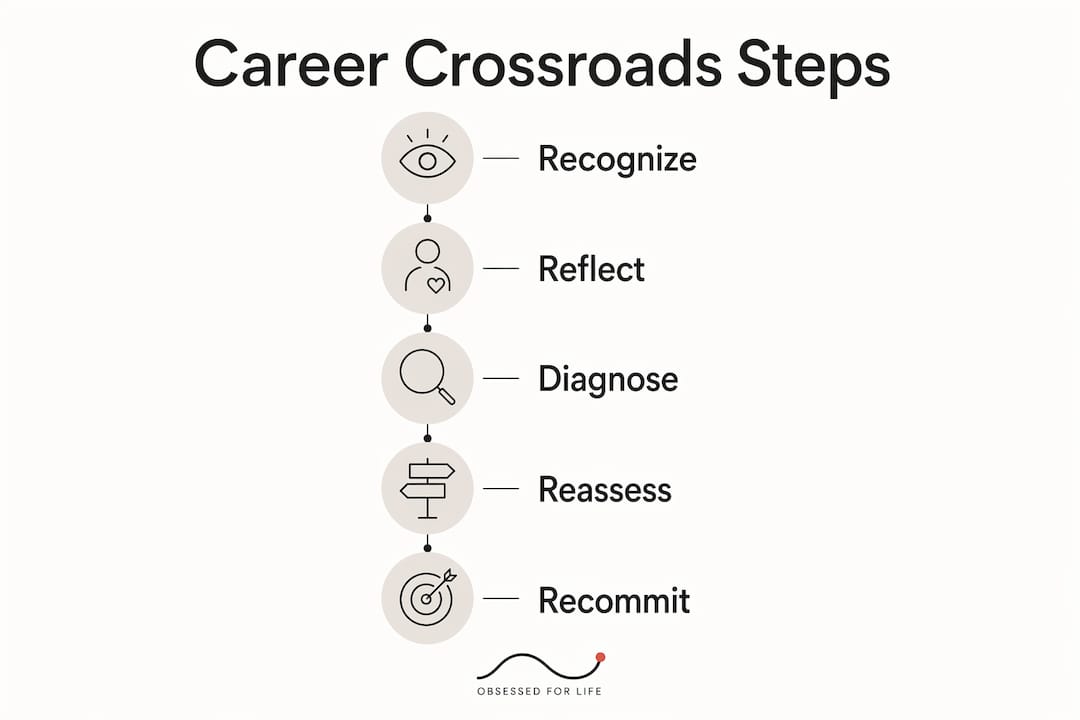
Getting the diagnosis right matters more than most women realize. Leaving a role because the culture changed, when what you actually needed was a values conversation with yourself, wastes years of compounding professional equity. Staying in a role and trying to fix your attitude, when your values have genuinely evolved, produces the same result: slow erosion.
Here is a simple framework to clarify which situation you are in:
- Recall what originally drew you to this work. Was it the mission, the craft, the people, or the status? Be specific.
- Ask whether that original draw still exists. If the mission is intact but your passion for it has faded, the change is likely internal.
- Identify what has shifted in the external environment. New leadership, restructured teams, and changed expectations are external signals.
- Notice where your energy goes outside of work. The activities that absorb you without effort point toward your evolving intrinsic values.
- Separate positive evolution from drift. Growing beyond a role is healthy. Drifting away from your values without awareness is a warning sign.
This diagnostic does not require a career coach or a sabbatical. It requires honest, unhurried attention to your own patterns.
What practical steps reconnect you with what actually matters?
True fulfillment arises where natural strengths meet energizing, meaningful work. Competence alone does not produce it. You can be excellent at something that quietly drains you. The work of this season is to find the intersection between what you are built for and what genuinely lights you up.
Several practices make that intersection visible:
- Value inventories. Tools like the VIA Character Strengths survey or a structured values ranking exercise surface what you actually prioritize, not what you think you should prioritize. The gap between those two lists is revealing.
- Aptitude assessments. Identifying transferable skills through structured reflection helps you see which of your capabilities carry across industries and roles, expanding your sense of what is possible.
- Reflective writing. Reviewing your own writing over time surfaces patterns you cannot see in the moment. Analyzing 12 years of professional reflections with AI assistance reveals repeating themes about what energized you and what consistently drained you. You do not need 12 years of journals. Even 12 months of honest notes will show you something.
- Gradual role redesign. Before making a full pivot, test whether adjusting your current role's scope, relationships, or focus areas resolves the dissatisfaction. Many women find that meaningful life pivots begin with small, deliberate shifts rather than dramatic exits.
Pro Tip: Ask yourself three questions: What would I do if I were not afraid of wasting my credentials? What work makes me lose track of time? What problems do I find myself solving even when no one asks me to? The overlap in your answers is your compass.
The life redesign process does not require certainty before you begin. It requires curiosity. Start with the question, not the answer.
| Practice | What it reveals |
|---|---|
| Value inventory | The gap between stated and lived priorities |
| Aptitude mapping | Transferable strengths across roles and industries |
| Reflective writing review | Repeating patterns in what energized or drained you |
| Role redesign experiment | Whether the problem is the work or the environment |
How does success sometimes deepen existential anxiety?
Achieving a goal you worked toward for years should feel like relief. For many high achievers, it feels like disorientation. This is not a personal failure. It is a predictable consequence of what researchers and career strategists call values destruction.
"Smart people end up in the wrong careers because of four forces: expedience, economic security, expectations, and events. Each one pulls you away from your authentic values, one compromise at a time. By the time you arrive at the top, you may have drifted so far from your original self that success feels like a stranger's reward."
Adapted from McKinsey Insights with Suzy Welch on how values erode over a career
These four forces, what Welch calls the "Four Horsemen of Values Destruction," operate quietly. Expedience means choosing what is convenient over what is meaningful. Economic security means staying in a role because leaving feels financially reckless. Expectations means living out the career script written by family, culture, or industry norms. Events means letting circumstances, a merger, a layoff, a relocation, redirect your path without conscious choice.
Each compromise feels reasonable in the moment. Accumulated over 20 years, they produce a career that looks impressive from the outside and feels hollow from the inside. The impact of success on life choices becomes clear only when you stop moving long enough to look at the full picture.
External validation compounds the problem. When your identity is built on performance and recognition, achieving the peak removes the very structure that organized your sense of self. The question "Who am I without this title?" is not a crisis. It is an invitation. It is the beginning of self-exploration that later life is uniquely positioned to support.
Key Takeaways
Career peaks trigger life questions because they expose the gap between externally inherited goals and intrinsic desires, making honest self-examination the most productive response available to you.
| Point | Details |
|---|---|
| Career peaks reveal value gaps | Success exposes the distance between what you achieved and what you actually wanted. |
| Diagnose before you pivot | Determine whether you changed or work changed before making any major career move. |
| Competence is not fulfillment | Being excellent at something does not mean it aligns with your intrinsic strengths or values. |
| Four forces erode values | Expedience, economic security, expectations, and events quietly pull you away from authentic choices. |
| Reflection is a practical tool | Reviewing your own patterns over time reveals what energizes you more reliably than any single assessment. |
What I have learned about arriving at the top
by Theresa Stairs
The women I have worked with who feel the most lost at career peaks are often the most capable people in the room. That is not a coincidence. High capability makes it easy to succeed at goals that were never really yours. You are good enough to achieve them, disciplined enough to sustain them, and skilled enough to perform satisfaction you do not actually feel.
What I have observed is that the disorientation at a career peak is not a problem to solve quickly. It is a signal to sit with. The women who rush to the next credential, the next title, or the next project often find themselves at another peak with the same hollow feeling. The ones who pause, get honest about their intrinsic values, and build identity beyond their achievements tend to find something more durable than success. They find direction that belongs to them.
The question worth asking is not "What should I do next?" It is "What have I been avoiding knowing about myself?" That question, answered honestly, changes everything.
— Theresa Stairs
What Obsessedforlife offers women at this crossroads
You have spent decades being excellent at what others needed. That excellence is real. And now something else is real too: a question that belongs entirely to you.

Obsessedforlife was built for exactly this moment. The Obsession Map is an original guided assessment that helps women 40 and beyond identify what brings them joy in this season, what values actually drive them, and what experiences are waiting in this chapter. It listens to who you are and reflects back a picture of what lights you up. Whether you are 42 or 68, this is the tool for women who are ready to ask the question and follow where it leads. The path forward is yours. Obsessedforlife helps you see it clearly.
FAQ
Why does reaching a career peak trigger existential questions?
Career peaks remove the forward momentum that kept deeper questions at bay. When external goals are achieved, the gap between extrinsic rewards and intrinsic desires becomes impossible to ignore.
How do I know if my dissatisfaction is about me or my job?
Ask whether the core elements that originally drew you to the work still exist. If they do but your passion has faded, the shift is likely internal. If the environment changed significantly, the cause is more likely external.
Is midlife career questioning a sign something went wrong?
No. High achievers commonly discover at midlife that their goals were inherited rather than chosen. Questioning is a sign of growth, not failure.
What is the fastest way to reconnect with intrinsic values?
Review what activities consistently energize you outside of formal work obligations. That pattern, not your resume, points toward your authentic motivations.
Can I redesign my career without starting over completely?
Yes. A structured role redesign that adjusts scope, relationships, or focus often resolves dissatisfaction without requiring a full career pivot. Start with the smallest change that addresses the root cause.