

Late-life joy mapping is the deliberate practice of auditing and charting the activities, people, and values that generate genuine satisfaction in midlife and beyond. Think of it as drawing a personal road map, not toward a destination, but toward a way of living. Rooted in the joyspan framework developed by gerontologist Dr. Kerry Burnight, it organizes around three core pillars:
- Mood boosters: The immediate, everyday moments that lift your energy right now
- Looking ahead: Joys you can plan and anticipate, giving life a sense of forward motion
- Big picture: The values and purpose that make your life feel meaningful over the long arc
This practice is not journaling for its own sake. It is a structured act of self-knowledge, one that intentionally identifies patterns in what brings you alive so you can make more room for those things. Stanford lifestyle medicine researchers and Dr. Burnight's Joyspan work both recognize this kind of intentional mapping as a legitimate tool for late-life emotional wellbeing, not a luxury but a practice with real psychological weight.
Table of Contents
- How aging gets reframed when you shift from deficit to joyspan
- The four practices that actually build your joyspan
- How to create a personal joy map for your midlife and beyond
- What research and practice reveal about the pillars of joy mapping
- Obsessedforlife gives you a guided path into your own joy map
- Key Takeaways
How aging gets reframed when you shift from deficit to joyspan
Most cultural messages about aging focus on what you are losing: physical capacity, relevance, time. That is the deficit model, and it shapes how many women quietly approach their 40s, 50s, and beyond, as a long subtraction problem.
Dr. Burnight coined the term joyspan specifically to challenge that frame. Where lifespan counts the years you live and healthspan counts the years you live well physically, joyspan describes the depth and duration of well-being and satisfaction you experience across your life. It asks a different question entirely: not "how do I avoid decline?" but "how do I age with vitality, beauty, relevance, humor, and gusto?"

Research supports this reframe in a concrete way. Studies tracking life satisfaction across the lifespan find that happiness tends to increase after 50, a phenomenon researchers call the "satisfaction paradox." Older adults often report higher life satisfaction than younger adults, even alongside physical challenges, because the brain becomes more efficient at meeting its own needs. That is not a consolation prize. It is an invitation.
Joy mapping gives that invitation a structure. Rather than waiting to feel better about aging, you actively build the conditions for it.

The four practices that actually build your joyspan
Dr. Burnight's research, drawing on the Harvard Study of Adult Development and the MIT AgeLab's work on fulfillment, identifies four practices she considers non-negotiable for a flourishing later life. They are all verbs, because they all require effort.
- Grow. Lifelong learning is neurologically protective, not just enriching. Pursuing new skills, whether that means learning an instrument, starting a mentorship, or trying improv, builds cognitive health and a sense of agency. Curiosity is the engine here, not credentials.
- Connect. The quality of your relationships is the single strongest predictor of longevity and wellbeing in later life, according to the Harvard study. Connecting means being the friend who picks up the phone, who remembers the hard anniversaries, who extends the invitation rather than waiting for one.
- Adapt. Life's second half brings real losses: illness, transition, grief. Adaptation is not passivity. It is the capacity to remain present even when circumstances are painful, through mindfulness, therapy, faith, or community, so difficulty does not eclipse the joy that coexists alongside it.
- Give. Generosity correlates strongly with wellbeing and longevity. Small, regular acts of giving activate what researchers call a "giver's high," which lowers inflammation and lifts happiness. You do not need grand gestures. You need the belief that you still have something to offer.
Pro Tip: Treat joy the way you treat physical fitness. You would not skip exercise because you "don't feel like it" and expect to stay strong. Joy works the same way. Dr. Burnight puts it plainly: "Just like eating well or lifting weights, the practices that bring joy are things we have to choose even when we don't feel like it."
How to create a personal joy map for your midlife and beyond
A joy map is not a vision board. It is a thinking tool, a brainstorming web that connects your actual lived experiences of joy to a broader plan for how you want to live. Here is how to build one.
- Define what joy feels like for you. Before you can map it, you need to recognize it. Think of a moment when you felt completely present, free, and alive. What were the conditions? Who was there? What were you doing?
- Conduct a joy audit. Write down every activity, person, place, and experience that has generated genuine joy in the past year. Do not filter for practicality. Just list.
- Sort by pillar. Organize your list into the three categories: immediate mood boosters, experiences you can plan ahead, and the values or purposes that run underneath everything.
- Chart the connections. Draw lines between items that share qualities. You may notice that your deepest joys cluster around creativity, or nature, or teaching others. Those clusters are your signal.
- Identify the gaps. Where are you spending time that appears nowhere on your map? Where are the joys you have stopped making room for?
- Make one concrete commitment. Choose one joy from your map and schedule it this week. Not someday. This week.
A few practices that sustain the map over time:
- Keep a daily joy log to notice micro-joys: a piece of music, sunlight through a window, laughter overheard on the street
- Revisit your map at each major life transition, a new season, a retirement, a move, a loss
- Share it with someone you trust; joy named aloud tends to grow
The goal is not a perfect document. It is a living reference that keeps pulling you back toward what matters.
What research and practice reveal about the pillars of joy mapping
The three pillars of late-life joy mapping are not arbitrary categories. Each one is grounded in a distinct body of research on what sustains wellbeing across the lifespan.
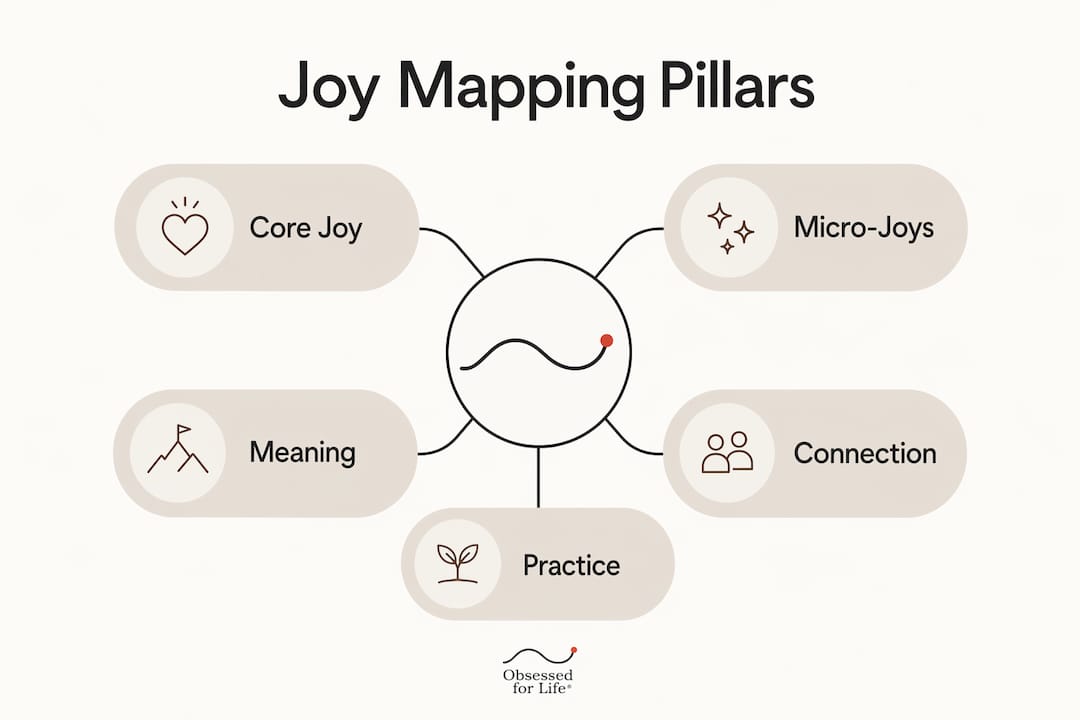
Micro-joys, the smallest unit of the mood boosters pillar, are more powerful than they sound. Actively savoring small pleasures rather than letting them pass unnoticed has measurable effects on wellbeing over time, according to positive psychology research. A good cup of coffee. The specific quality of light at 7 AM. These are not trivial. They are the daily raw material of a joyful life.
The big-picture pillar draws on something deeper. University of Pennsylvania researchers describe joy as happiness connected to purpose, an emotional capacity that builds resilience even under circumstances you cannot control. As one researcher put it: "What joy says is that you can hold out a little piece for yourself. That each and every day, even in the midst of things that you have no control over, there's something that you can envision, that you can manifest, that you can believe in."
The social dimension is the most commonly overlooked. Collective joy, what sociologists since Émile Durkheim have called "collective effervescence," is a crucial component of lasting satisfaction. Joy mapping that focuses only on solitary pleasures misses half the picture. Your community's role in your joyspan is not background noise. It is load-bearing.
"Joy isn't just about you. Joy can be an apparatus for you to think about your capacity, your container, your relationships, and the effect your personalized joy has on family and community — how you connect, how you build relationships, how you sustain those relationships." — University of Pennsylvania researcher, Annenberg School
Obsessedforlife gives you a guided path into your own joy map
You have spent years being excellent at what others needed. The question that belongs entirely to you, what do you actually want with this chapter of your life, deserves more than a blank page and good intentions.
Obsessedforlife was built for exactly this moment. Through the Obsession Map, an original guided assessment, you explore what brings you joy in this season, what values drive you, and what experiences are waiting for you. It listens to who you are and reflects back a picture of what lights you up. Whether you are 42 or 68, this is where you begin. Take the Obsession Map at obsessedforlife.com and let your next chapter take shape.
Key Takeaways
Late-life joy mapping is a structured, research-backed practice that shifts aging from a deficit experience to an active, purpose-driven one, built on daily choices rather than circumstance.
| Point | Details |
|---|---|
| Joy mapping defined | It audits and charts activities, people, and values across three pillars: mood boosters, looking ahead, and big picture. |
| The joyspan shift | Dr. Kerry Burnight's joyspan framework reframes aging as a chapter to live with intention, not a problem to manage. |
| Four non-negotiable practices | Grow, connect, adapt, and give are the daily practices that build joyspan, each requiring consistent, chosen effort. |
| The satisfaction paradox | Research finds life satisfaction often increases after 50, even alongside physical challenges, because the brain adapts more efficiently. |
| Obsessedforlife's Obsession Map | A guided assessment that helps women 40+ identify their joys, values, and the experiences that belong to this chapter of life. |