
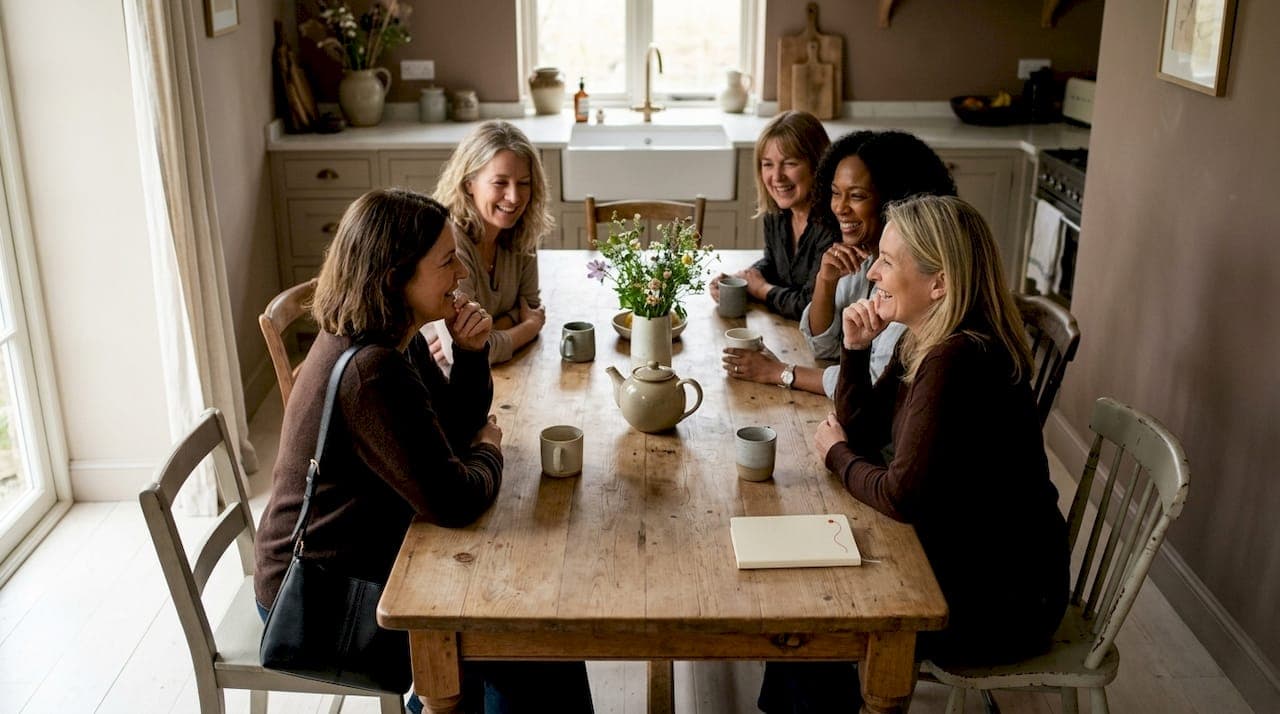
Community is the single most underrated resource for midlife personal development, and the research on why is striking. The role of community in midlife growth goes far beyond friendship. It shapes your health, your identity, and your sense of what is still possible. Women in their 40s, 50s, and 60s are in the middle of a genuine psychological re-architecture, and that process does not happen well in isolation. The right people, gathered with intention, become the mirror you need to see who you are becoming.
What does research say about community's role in midlife growth?
The science on social connection and midlife is not subtle. Individuals with strong social relationships in midlife have a 50% higher likelihood of survival than those with weak ties. That number comes from large-scale research by social neuroscientist Julianne Holt-Lunstad, and it places community support in midlife firmly in the category of a health intervention, not a luxury.
The mental health picture is equally clear. Active community participation during the ages of 40–65 produces measurable reductions in anxiety, increases in happiness, and improved life satisfaction overall. This is not a vague correlation. It reflects what happens when women stop going through midlife alone and start going through it together.
"Fulfilling the core motivational themes of 'communion' and 'agency' through social connection strongly predicts higher life satisfaction at age 65." Journal of Adult Development, longitudinal study of 128 adults
That finding deserves a moment. "Communion" means belonging, being known, and mattering to others. "Agency" means acting with purpose and direction. Both are available through community. Both predict how well you will feel about your life a decade from now.
The importance of community in growth is not just emotional support. It is a biological and psychological need that, when met, changes your trajectory.
How does community support identity evolution in midlife women?
Midlife is not a crisis. It is, in the language of Jungian psychology, a process of individuation: integrating the parts of yourself you set aside while building a career, raising children, or caring for others. Individuation in midlife involves reappraisal, a genuine reckoning with who you have been and who you want to become. Community is where that reckoning becomes possible.
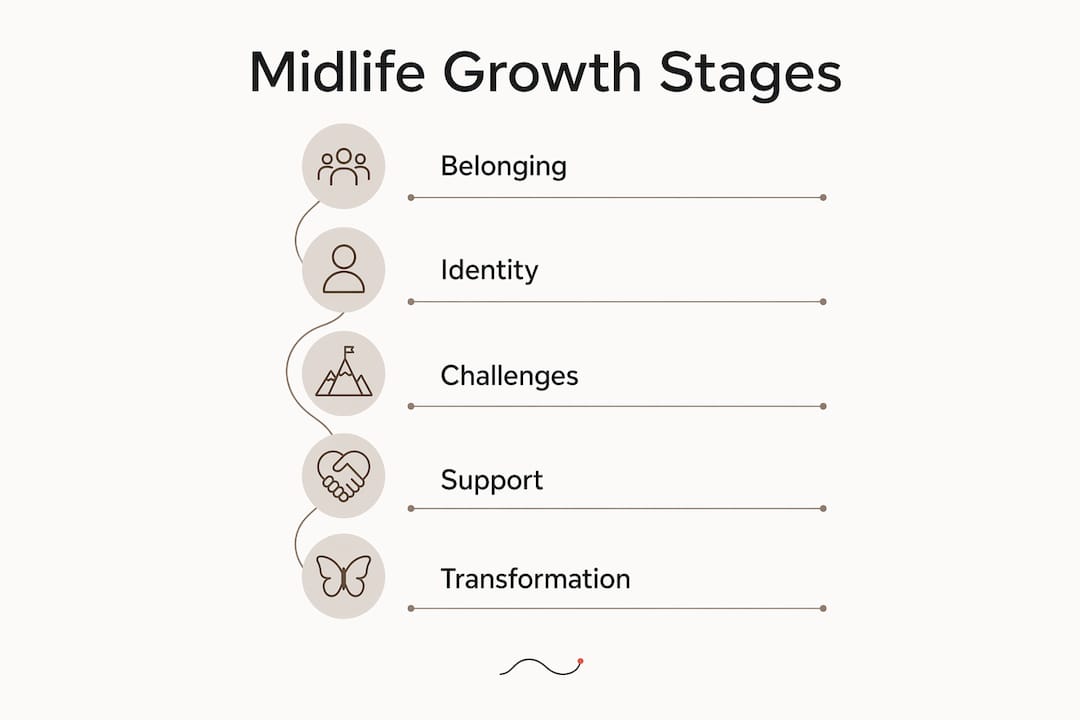
Writer and coach Kathleen Kroner describes midlife circles as fertile ground where new identities take root. The people you gather with do not just witness your growth. They actively shape it. When a group holds space for who you are becoming, rather than who you have always been, something shifts. You start to believe the new version of yourself is real.
This is why the composition of your community matters as much as its existence. Groups built on shared values create safety for vulnerability. Safety creates honesty. Honesty creates growth.
- Witnessing: Being seen by others as you change reinforces the change itself.
- Mirroring: Hearing your own thoughts reflected back helps you clarify what you actually believe.
- Accountability: Gentle, consistent encouragement from trusted people moves you forward when motivation fades.
- Permission: Watching other women claim new identities gives you permission to do the same.
Pro Tip: When evaluating a new group or community, ask yourself one question: do these people see me as I am now, or only as I was? The answer tells you whether the group can support your growth.
Understanding midlife as self-discovery is the first step. Community is what makes that discovery sustainable.
Why is building meaningful community uniquely hard in midlife?
The social structures that built your earlier friendships no longer exist. School, early workplaces, neighborhood parenting groups, and college dorms all created proximity-based connection. You did not have to try. You simply showed up, and relationships formed around shared circumstance.
Midlife removes those structures. Children grow up. Careers shift. Neighborhoods change. What remains is a gap that many women feel but struggle to name. Midlife loneliness often arrives quietly, not as dramatic isolation but as a slow fading of the connections that once felt automatic.
The solution is not to try harder at old social habits. It is to build new ones, deliberately and with structure. Here is what that looks like in practice:
- Identify recurring groups. A fitness class, a book club, a volunteer team, or a faith community all create the repetition that proximity once provided. Repetition is the engine of friendship.
- Commit to consistency. Showing up once is an introduction. Showing up twelve times is the beginning of a relationship. Recurring group engagement is what moves acquaintances into genuine connection.
- Release convenience-based ties. Midlife social pruning, shedding relationships held together only by habit or geography, is not failure. It is alignment. Letting go of what no longer fits creates room for what does.
- Start smaller than you think. One meaningful group is worth more than five surface-level ones. Depth beats breadth at every stage of life, and especially now.
Pro Tip: If you feel resistance to joining something new, treat it as information rather than instruction. Resistance often points directly at the thing that would help most.
How can midlife women find and build communities that actually support growth?
The best midlife communities share three qualities: shared purpose, consistent structure, and freedom from performance pressure. Successful midlife circles allow quiet entry, meaning you do not have to perform confidence or enthusiasm to belong. You simply arrive, and the group holds you while you find your footing.
Where to look
Fitness and movement classes offer built-in rhythm and a shared physical goal. Book clubs and creative groups provide a topic that takes the pressure off self-disclosure while still building intimacy over time. Volunteering connects you to purpose and to people who share your values. Faith communities offer both ritual and belonging. Online groups, when built around genuine shared interest rather than passive scrolling, can be surprisingly real.
The key is not the format. The key is whether the group meets regularly, whether it has a purpose beyond socializing, and whether it feels safe enough to be honest.
How to go deeper once you are in
Deep friendships in midlife form through consistent, intentional contact, not through single intense conversations. Small, repeated interactions build more trust than occasional grand gestures. Text someone after a meeting. Suggest coffee. Show up the next week. These are not grand acts. They are the actual architecture of belonging.
The comparison below shows what distinguishes surface-level social contact from the kind of community that supports real growth:
| Surface-level contact | Growth-supportive community |
|---|---|
| Occasional, unplanned meetings | Regular, recurring structure |
| Shared history or proximity | Shared values and purpose |
| Conversation stays comfortable | Space for honesty and vulnerability |
| Validates who you were | Witnesses who you are becoming |
| Large, loose network | Smaller, trusted core group |
Living by values-based principles makes it easier to recognize which communities are worth your time and which ones simply fill the calendar.
Key Takeaways
Community is the most evidence-backed, underused resource for midlife growth, and building it intentionally is the single most impactful investment a woman in her 40s, 50s, or 60s can make.
| Point | Details |
|---|---|
| Community extends your life | Strong social ties in midlife are linked to a 50% higher likelihood of survival than weak ties. |
| Identity grows in groups | Midlife individuation requires witnesses; community mirrors who you are becoming and makes it real. |
| Old structures are gone | Proximity-based friendships fade in midlife, so intentional, recurring group engagement must replace them. |
| Depth beats breadth | One consistent, values-aligned group produces more growth and well-being than a large casual network. |
| Quiet entry matters | The best midlife communities allow you to arrive without performing, creating safety for real connection. |
What I have learned about midlife community that surprised me
By Theresa Stairs
The research on community and midlife survival rates stopped me cold the first time I read it. A 50% higher likelihood of survival. Not from a medication or a diet. From the quality of your relationships. That is not a soft finding. That is a hard number pointing at something most of us treat as optional.
What surprised me more, though, was how many women I have spoken with who feel lonely in midlife but do not recognize it as loneliness. They are busy. They have people around them. But the connections feel thin, like they are performing a version of themselves that stopped fitting years ago. That is not a social failure. That is a signal that the old containers have run their course.
The uncomfortable truth I have come to believe is this: midlife loneliness is not about having too few people. It is about being in the wrong rooms. The fix is not more socializing. It is more intentional choosing.
What I have also seen, again and again, is that women who step into new communities in midlife, even awkwardly, even with resistance, tend to describe it as one of the most significant things they did in this season. Not because the group was perfect, but because showing up for themselves, in a room full of people becoming something new, changed what felt possible.
The invitation is always there. The question is whether you are ready to walk through the door.
— Theresa Stairs
What Obsessedforlife offers women ready to grow
Knowing that community matters is one thing. Knowing what you are looking for when you walk into a new room is another.

Obsessedforlife was built for the woman who is ready to stop organizing her life around everyone else's needs and start asking what she actually wants. The Obsession Map is a guided self-assessment that helps you clarify your values, identify what brings you genuine joy, and understand what this season of life is genuinely for. When you know what lights you up, you know which communities are worth your time and which ones are just noise. That clarity changes how you show up, and who you attract. Whether you are 42 or 68, the work of rediscovering yourself is not behind you. It is right here, waiting.
FAQ
What is the role of community in midlife growth?
Community provides the social connection, identity mirroring, and emotional safety that midlife personal development requires. Research links strong midlife social ties to a 50% higher likelihood of survival and measurable improvements in mental health.
Why do women feel lonely in midlife even when surrounded by people?
Midlife loneliness often results from outgrowing proximity-based social structures rather than from a lack of people. The connections that remain may no longer reflect your current values or who you are becoming.
How many people do you need in a midlife community?
Quality matters far more than quantity. Deep friendships formed through consistent, intentional contact produce greater well-being benefits than large networks of casual acquaintances.
How do you start building community in midlife from scratch?
Join a recurring group organized around a shared purpose, such as a fitness class, book club, or volunteer team. Consistency over time, not a single meeting, is what builds real connection.
Can online communities support midlife growth?
Yes, when they are built around genuine shared interest and meet with regularity. The same principles apply: shared purpose, consistent structure, and space for honest conversation matter more than the format.