

Legacy thinking in midlife is the conscious, intentional practice of shaping what you leave behind, and it is one of the most powerful drivers of personal growth and fulfillment available to women in this season of life. Psychologist Erik Erikson identified this stage as the battleground between generativity and stagnation, where the central question shifts from “What have I achieved?” to “What will I contribute?” Research confirms that legacy thinking reduces anxiety and depression while increasing a sense of meaning, even among women who are nowhere near the end of their lives. This is not about writing a will or planning a funeral. It is about waking up to the full weight and possibility of the life you are still living.
What is the role of legacy thinking in midlife development?
Legacy thinking is the proactive, ongoing concern for the impact your life has on the people and world around you. It is not a single act. It is a lens through which you make decisions, build relationships, and spend your time. The formal term for this developmental drive is generativity, a concept introduced by Erik Erikson as the central task of middle adulthood.
Erikson framed midlife as a fork in the road. One path leads to generativity, the active investment in future generations through mentoring, creating, guiding, and contributing. The other leads to stagnation, a kind of psychological flatness where life feels repetitive and purposeless. Legacy thinking is the engine that keeps you on the generativity path.

What makes this framework so useful for women in midlife is that it reframes the whole season. You are not declining. You are not simply aging out of relevance. You are entering the developmental stage where your accumulated wisdom, relationships, and values become your most powerful resources.
Pro Tip: Legacy thinking is not reserved for the famous or the wealthy. Every woman who mentors a younger colleague, raises children with intention, or shows up with honesty in her community is already practicing it.
Generativity shows up in concrete behaviors: teaching a skill to someone younger, creating something that outlasts you, advocating for a cause you believe in, or simply being the kind of person others feel steadied by. Legacy as authentic self-expression counters stagnation not through grand gestures but through consistent, values-driven living.
How does legacy thinking influence mental health during midlife?
Legacy thinking produces measurable mental health benefits. Intentional legacy ambitions link directly to lower rates of depression and anxiety in midlife adults. That connection matters because midlife is often when women carry the heaviest emotional load, navigating aging parents, shifting family roles, career transitions, and their own evolving identity.
The mechanism is meaning-making. When you have a clear sense of what you are building and why, daily life feels less random and more purposeful. Grief, loss, and uncertainty become easier to hold when they exist inside a larger story you are consciously writing.
Midlife legacy includes ‘living legacy,’ the way your values and character expressed daily profoundly impact others beyond any material inheritance.”
This distinction between living legacy and end-of-life legacy is one of the most freeing ideas in this space. Your legacy is not something you prepare for later. It is something you are already creating right now, in how you listen, how you show up, and what you choose to prioritize.
Legacy thinking also activates prosocial behavior. Women who articulate their legacy ambitions tend to make more decisions that benefit others, not out of obligation, but because their choices are now anchored to something larger than immediate comfort. Research on midlife legacy narration shows that women facing major life transitions naturally shift toward communion, emphasizing relational warmth, emotional closeness, and unfinished connections they want to repair or deepen.
Key mental health benefits of legacy thinking in midlife include:
-
Reduced anxiety through a clearer sense of purpose and direction
-
Improved emotional resilience when facing loss or transition
-
Greater life satisfaction linked to prosocial and generative behavior
-
Deeper relational connections as legacy shifts toward communion
-
A framework for grief processing that places loss inside a meaningful narrative
What practical steps can women in midlife take to develop legacy thinking?
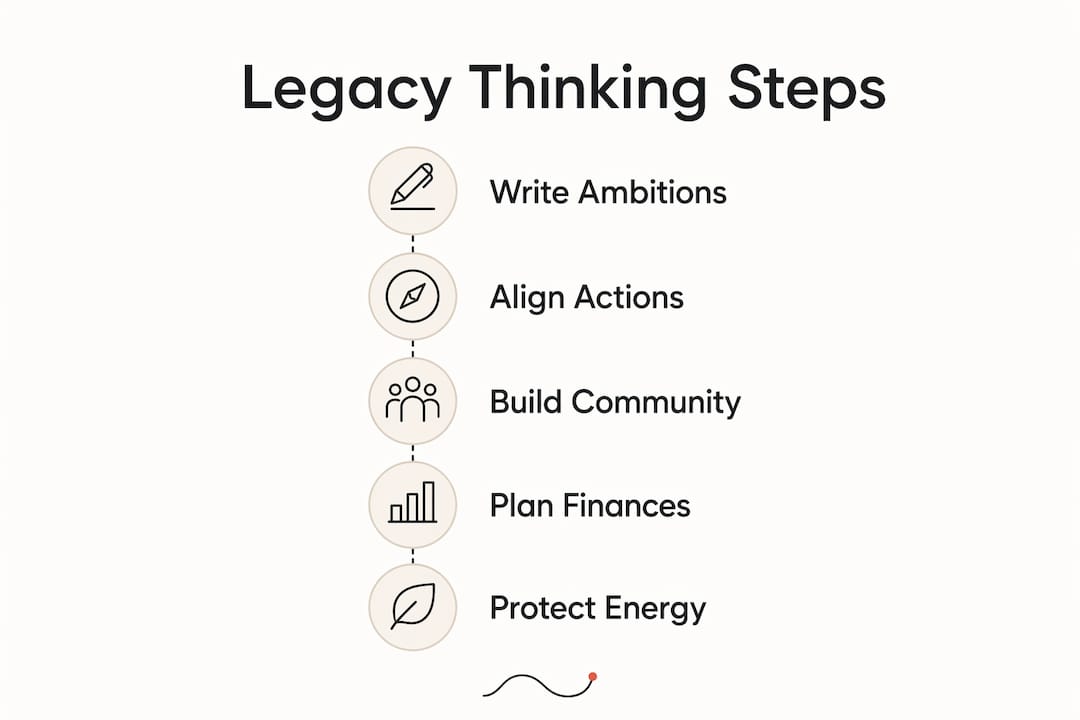
Legacy thinking becomes real when it moves from concept to practice. These steps are not a checklist to complete once. They are ongoing habits that deepen over time.
1. Write down your legacy ambitions
Writing down legacy ambitions throughout life increases the likelihood of making decisions that benefit future generations. This is not journaling for its own sake. It is a way of making your values visible so they can guide your choices. Start with one question: What do I want people to say about how I lived?
2. Align your daily actions with your core values
Intentional living means closing the gap between what you say matters and how you spend your time. If connection is a core value, ask whether your weekly schedule reflects that. If creativity is central to your legacy, protect time for it.
3. Build relational and community legacy
Mentorship, community involvement, and showing up consistently for the people in your life are all forms of legacy building. You do not need a formal program. A younger woman at work, a neighbor navigating a hard season, or a cause you show up for regularly all count.
4. Address financial and estate planning
Proactive estate planning in midlife aligns legacy goals with retirement security and reduces financial stress for the people you love. Tools like wills, trusts, and gifting strategies are not morbid. They are acts of care. A midlife wealth check that reviews retirement income, lifestyle needs, and legacy intentions helps ensure your financial life reflects your values.
5. Protect your energy
Legacy creation requires sustained energy. Women in midlife who neglect self-care often find their generative impulses collapse under exhaustion. Rest, boundaries, and joy are not indulgences. They are the fuel that makes long-term contribution possible.
Pro Tip: Use reflection as a design tool for your legacy. A monthly check-in, even 20 minutes, asking “Did my actions this month reflect what I want to leave behind?” creates compounding clarity over time.
| Legacy area | Practical starting point |
|---|---|
| Values clarity | Write three values you want your life to embody |
| Relational legacy | Identify one relationship you want to invest in more deeply |
| Community contribution | Name one cause or group you want to show up for consistently |
| Financial legacy | Schedule a conversation with a financial planner about estate basics |
| Living legacy | Audit one week of your calendar against your stated values |
How does legacy thinking reframe midlife challenges as opportunities?
The phrase “midlife crisis” has always been a poor description of what happens. What most women experience is closer to a midlife awakening, a shift in focus from accumulation to impact, from performing to contributing. Legacy thinking is the framework that makes that shift feel purposeful rather than disorienting.
When you understand that this season is developmentally designed for generativity, the restlessness makes sense. The dissatisfaction with old roles is not a sign that something is wrong. It is a signal that you are ready for something more aligned with who you have become.
Legacy thinking also functions as a compass for decision-making. When you are clear about the impact you want to have, choices that once felt paralyzing become simpler. Career pivots, relationship changes, and new creative directions all become easier to evaluate against one question: Does this move me toward or away from the legacy I want to leave?
Women navigating midlife transitions, whether that is an empty nest, a career change, the loss of a parent, or a shift in identity, often find that legacy awareness helps them process those changes with more grace. The shift toward communion, toward repairing and deepening relationships, is a natural and healthy response to mortality awareness. It is not morbid. It is wise.
Common ways legacy thinking reframes midlife challenges:
-
Empty nest becomes an invitation to redirect energy toward community and creative legacy
-
Career dissatisfaction becomes a signal to align work with values and generative purpose
-
Grief and loss become part of a larger narrative of meaning rather than isolated pain
-
Identity uncertainty becomes the raw material for conscious life redesign
-
Awareness of mortality becomes motivation for present-tense purposeful living
Key Takeaways
Legacy thinking in midlife is the most direct path from stagnation to fulfillment, and it begins with conscious, present-tense action rather than future planning.
| Point | Details |
|---|---|
| Legacy thinking is a developmental task | Erikson’s generativity framework identifies midlife as the stage designed for legacy-driven contribution. |
| Mental health benefits are real | Intentional legacy ambitions reduce anxiety and depression while increasing life satisfaction. |
| Living legacy starts now | Your daily values, relationships, and choices already constitute your legacy, not a future project. |
| Practical steps matter | Writing ambitions, aligning values, building relationships, and planning financially all activate legacy thinking. |
| Midlife challenges are reframeable | Restlessness and role shifts are developmental signals pointing toward generative purpose, not signs of decline. |
Legacy thinking is not a destination. It is a practice.
I have worked with enough women in midlife to know that the biggest misconception about legacy is that it belongs to the future. Women tell me they will think about their legacy once the kids are grown, once they retire, once life settles down. That postponement is exactly what legacy research warns against. Deferring legacy-building creates what researchers call temporal distortion, a sense that your real life is always just ahead of you, never quite here.
The women I have seen thrive in midlife are not the ones who have everything figured out. They are the ones who got honest about what they value and started living from that place, imperfectly and immediately. One woman I know left a senior marketing role not because she had a perfect plan, but because she realized her legacy lay in teaching and could not keep postponing it. She started mentoring two younger women while still employed. That was enough to shift everything.
Legacy thinking does not require a dramatic pivot. It requires presence. It asks you to look at your ordinary Tuesday and ask whether it reflects the person you want to have been. That question, asked consistently, changes you. It changes the people around you. And that is exactly what legacy is.
— Theresa Stairs
What Obsessedforlife offers women ready to think about legacy
If this article has stirred something in you, that quiet sense that this season is asking more of you than you have been giving it, Obsessedforlife was built for exactly this moment.

Obsessedforlife is a self-discovery platform for women 40 and beyond who are ready to stop organizing their lives around everyone else’s needs and start asking what they want. The Obsession Map is an original guided assessment that helps you identify what brings you joy, what values drive you, and what this chapter of your life is genuinely for. Legacy thinking and personal fulfillment are not separate pursuits. At Obsessedforlife, they are the same conversation.
FAQ
What is legacy thinking in midlife?
Legacy thinking in midlife is the conscious practice of reflecting on and shaping the impact your life has on others. It draws on Erik Erikson’s concept of generativity, the developmental drive to contribute to future generations through mentoring, creating, and values-based living.
How does legacy thinking support mental health?
Intentional legacy ambitions reduce anxiety and depression in midlife adults and increase a sense of meaning and life satisfaction. The act of articulating what you want to leave behind gives daily decisions a larger purpose, which buffers against emotional overwhelm.
Do I need money or status to build a legacy?
No. Legacy is built through relationships, values, and consistent behavior, not wealth or public recognition. Mentoring one person, showing up with honesty in your community, or raising children with intention are all forms of meaningful legacy.
When should I start thinking about my legacy?
Now. Legacy is a present-tense activity, not a future project. Postponing legacy-building until retirement or a major life event creates a false sense that your real contribution is always somewhere ahead of you.
How does legacy thinking relate to midlife identity shifts?
Legacy thinking gives midlife identity shifts a purposeful frame. When roles change, such as after an empty nest or a career transition, legacy awareness helps you redirect energy toward what genuinely matters rather than experiencing the shift as pure loss.