

You already know something has shifted. The goals that once organized your days feel less urgent, and a quieter question has moved into the space they left: What do I actually want now? Finding purpose in midlife means committing to meaningful long-term goals that align with your evolved values and genuinely nourish your well-being. It is not about starting over. It is about listening more carefully to who you have become.
Research from the University of Michigan confirms that purpose matters well beyond youth. Adults who report higher levels of purpose show measurably better physical health outcomes over time, with a dose-response relationship linking purpose scores to 13–14% less likelihood of physical decline in agility, grip strength, and walking speed over four years during midlife. The body, it turns out, pays attention to what the mind is committed to.
Here is what the research and leading practitioners point to as the core of purposeful living at midlife:
- Clarify your values. Purpose grows from what you genuinely care about now, not what you cared about at 30.
- Start with "little p" purposes. Daily meaningful acts compound into a purposeful life over time.
- Contribute beyond yourself. Generativity, the desire to serve and mentor others, produces greater well-being than self-focused achievement.
- Reflect regularly. Self-inquiry is not a luxury; it is the mechanism by which purpose becomes visible.
- Take small, anchored steps. Dramatic pivots rarely hold. Incremental realignment does.
What does midlife purpose really mean, and why does it feel so hard?
Purpose, as researchers at the Greater Good Science Center define it, is one of three elements of meaning. Coherence is your ability to make sense of your life. Significance is the felt sense that your life matters. Purpose is your commitment to long-term goals that organize your choices and actions. Of the three, purpose is the one that actively expresses the others. When it feels absent, everything else tends to feel thin.

Gerontologist and leadership coach Barbara Waxman coined the term middlescence to describe the period between early and later midlife, a phase she compares to adolescence in its intensity of identity reevaluation. Physical changes, an empty nest, shifting careers, the loss of a parent: these transitions arrive together and ask you to rewrite a life script you may not have consciously chosen in the first place. That disorientation is not a flaw. It is the work.
The stereotypical midlife crisis is far less common than culture suggests. MIDUS longitudinal data shows that only 10–26% of adults experience what could genuinely be called a crisis. For most, midlife is better understood as an identity reckoning, a moment of awareness that time is finite and the second half deserves intention.
One of the most common emotional traps is what Waxman calls "purpose stress," the pressure to locate a single grand purpose, something world-changing and permanent. That pressure tends to block rather than reveal. When purpose feels like a fixed object you are supposed to find, the search becomes exhausting. Reframing it as an ongoing practice, something you do rather than something you have, changes the entire experience.
- Identity misalignment often shows up across five domains: work, health, money, relationships, and sense of self.
- "Little p" purposes are the daily acts of meaning that matter right now.
- "Big P" purpose provides direction but does not need to be fully formed before you begin.
- Generativity shifts the focus from self-centered achievement to legacy and contribution.
Practical steps to rediscover what lights you up
The most useful starting point is not a personality test or a career pivot. It is a question, asked honestly and without rushing toward an answer. Barbara Waxman offers three prompts that move from the immediate to the expansive:
- What sparked joy today?
- What skill do I have that connects to that joy?
- What need in the world does that skill fulfill?
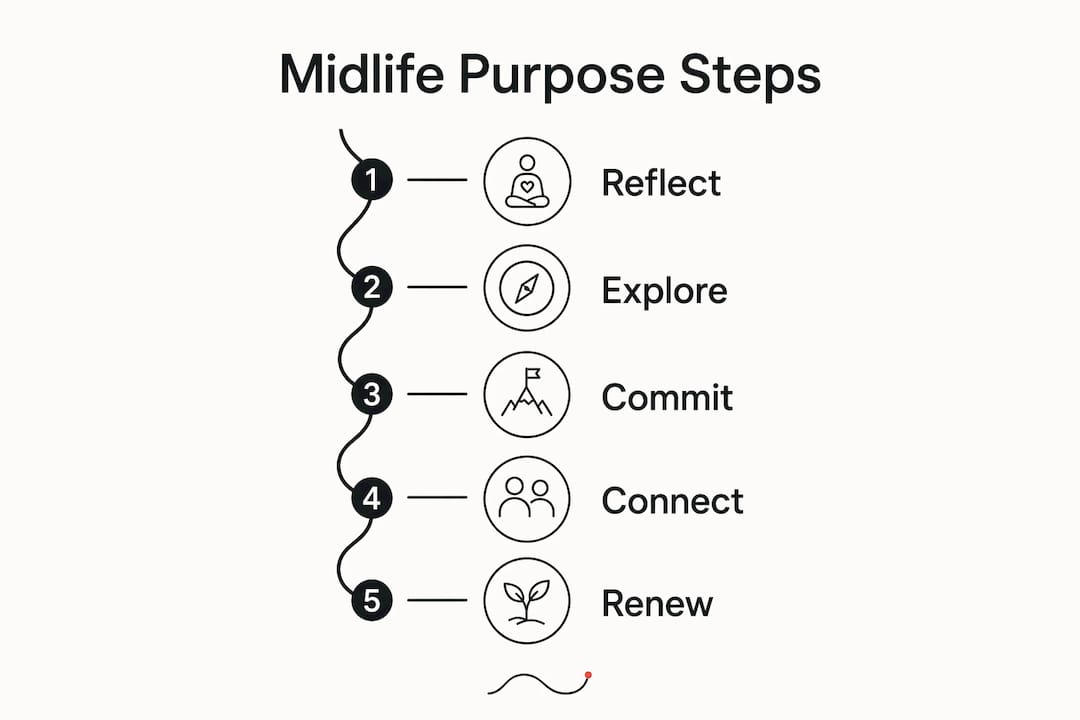
Steps one and two surface your "little p" purposes. Step three points toward something larger. The path from a vegetable garden to a soup kitchen is not a metaphor; it is how purpose actually develops, through noticing what already brings you alive and following it outward.
Values clarification is the next layer. Purpose that conflicts with your core beliefs tends to collapse under pressure. Spend time identifying what you genuinely value now, not what you valued at 25, and let those values filter your choices. The role of self-reflection in this process is not decorative. It is structural.
Community and contribution deserve more credit than they typically receive in purpose conversations. Volunteering and mentoring increase generativity and well-being, though the quality of engagement matters. Volunteering that feels deadening does not serve purpose. The work needs to feel like it is accomplishing something real.
- Ask the three joy prompts from Waxman and write the answers down without editing.
- List your current values, not aspirational ones, and notice where your daily life aligns or diverges.
- Try one new activity in a domain you have been curious about but kept deferring.
- Reach out to one person you could mentor, support, or simply show up for consistently.
- Audit your five domains: work, health, money, relationships, and identity. Where does something feel misaligned?
- Set one small, specific goal tied to a value you identified, with a concrete first step this week.
- Build a daily rhythm that includes at least one "little p" act of meaning, however modest.
Pro Tip: Avoid the temptation to redesign your entire life at once. Forcing dramatic career pivots without clear direction often leads to burnout. Small, anchored lifestyle adjustments aligned with your values create sustainable purpose far more reliably than grand gestures.
Physical and mental health are not separate from this process. They are part of it. When sleep, movement, and connection are neglected, the capacity for reflection narrows. Purpose discovery requires a certain quality of attention, and that attention needs a body that is reasonably well cared for.

What research and expert frameworks tell us about midlife purpose
The science here is more encouraging than most people realize. Purpose-enhancement programs designed for older adults and cancer patients have shown improved health and well-being outcomes, suggesting that purpose is not fixed at birth or locked in by your thirties. It can be developed, cultivated, and renewed.
| Research finding | Source | Practical implication |
|---|---|---|
| Higher purpose scores correlate with 13–14% less physical decline over four years | University of Michigan / Health and Retirement Study | Purpose is a physical health resource, not just a psychological one |
| Only 10–26% of adults experience a true midlife crisis | MIDUS longitudinal study | Most midlife discomfort is identity reckoning, not crisis |
| Prosocial goals produce significantly higher well-being than self-focused goals | Stanford / Colby et al. | Contribution and service are high-leverage paths to meaning |
| "Little p" daily acts compound into overall purposeful living | Barbara Waxman / Stanford Lifestyle Medicine | Small consistent actions matter more than dramatic pivots |
| Volunteering increases generativity when it feels engaging and impactful | Greater Good Science Center | Quality of contribution matters as much as the act itself |
Chip Conley, whose work on meaning through service has shaped how many practitioners think about midlife, argues that following passion is actually less effective at this stage than turning toward prosocial contribution. Serving others, mentoring, building something that outlasts you: these tend to produce a more durable sense of meaning than pursuing personal interests alone.
The Obsession Map, Obsessedforlife's guided assessment, is built around exactly this kind of structured self-inquiry. It helps women explore what brings them joy in this season, what values drive them, and what experiences genuinely await them in this chapter. Rather than asking you to manufacture a purpose from scratch, it listens to who you already are and reflects that back clearly.
- Purpose can be developed and enhanced at any age, not just discovered in youth.
- The MIDUS study frames midlife as a pivotal developmental period, not a decline.
- Incremental action aligned with values stabilizes identity during transition.
- Legacy-focused thinking, the shift from self to contribution, yields measurably higher well-being.
Embracing purpose as a living commitment, not a destination
Purpose in midlife is not something you find once and frame on the wall. It is a commitment you renew, a direction you keep choosing, and a practice that deepens as you do.
- Midlife disorientation is a signal, not a verdict. It means you are paying attention.
- There is no deadline on purposeful living. Barbara Waxman is direct: there is no "sell by" date on your usefulness when you have decades of life ahead.
- "Little p" daily acts matter. Calling someone you love, cooking a meal with care, showing up consistently for a cause: these are not lesser purposes. They are the foundation.
- Reframing midlife as opportunity rather than loss opens the door to legacy thinking and genuine contribution.
- Physical health and purpose reinforce each other. Investing in one tends to strengthen the other.
- Community is not optional. Belonging and contribution are among the most reliable sources of meaning at this stage.
- You do not need a fully formed vision to begin. One honest question, asked today, is enough to start.
The question this season is asking you
Most articles about midlife purpose will tell you to follow your passion. That advice, while well-meaning, tends to send women in circles. Passion is often too diffuse to act on, and it shifts. What the research actually supports, and what practitioners like Chip Conley and Barbara Waxman have observed across thousands of clients, is something quieter and more durable: the turn toward others.
The women who report the deepest sense of meaning at this stage are not usually the ones who finally launched the dream business or moved to a new city. They are the ones who found something worth contributing to and showed up for it consistently. That contribution might be professional or entirely personal. It might be spiritual practice or community work or the patient mentoring of someone younger. The form matters less than the orientation.
What I find most honest about the research is this: purpose does not require certainty. It requires direction. You do not need to know where you are going in full detail. You need to know what you value, what you are willing to work toward, and who you want to become in the process. Midlife is not the end of that question. For many women, it is the first time they have had the freedom and the self-knowledge to ask it clearly.
The Obsession Map exists for exactly this moment. Not to hand you a purpose, but to help you hear yourself more clearly so the path forward feels like yours, because it is.
You have spent years showing up for everyone else. Obsessedforlife was built for the moment you are ready to show up for yourself. The Obsession Map is a guided assessment that helps you explore what brings you joy in this season, clarify what you value, and see what this chapter of your life is genuinely for. Start where you are.
Key Takeaways
Purpose in midlife is a renewable commitment to meaningful goals aligned with your current values, and research confirms it directly supports physical and psychological well-being.
| Point | Details |
|---|---|
| Purpose is a practice, not a destination | Reframe purpose as an ongoing action rather than a fixed object to reduce pressure and sustain engagement. |
| Physical health is linked to purpose | Higher purpose scores correlate with 13–14% less likelihood of physical decline in agility, grip strength, and walking speed over four years during midlife, per University of Michigan research. |
| Small acts compound | "Little p" daily purposes, meaningful moments and contributions, build toward a genuinely purposeful life over time. |
| Contribution outperforms passion | Prosocial goals and serving others produce higher well-being than self-focused pursuits at this life stage. |
| Midlife is a pivot, not a crisis | Only 10–26% of adults experience a true midlife crisis; most discomfort is identity reckoning and an invitation to realign. |