

Midlife is defined as a developmental turning point between ages 40 and 60 where women shift from external roles to internal alignment. The role of midlife in self-discovery is not a crisis to survive. It is a threshold to cross. Developmental psychology frames this phase as a natural progression where the identity you built for everyone else begins to feel too small. Triggers like an empty nest, career burnout, or a shift in caregiving responsibilities don’t signal failure. They signal readiness. Erik Erikson’s theory of generativity versus stagnation places midlife as the exact moment adults must choose between contributing meaningfully to the world or remaining stuck in self-directed patterns that no longer grow.
What types of midlife identity shifts occur for women?
Three distinct identity layers shift during midlife, and most women experience changes in two or more of them at the same time. Understanding these layers removes the confusion that makes midlife feel so disorienting.
The achievement self becomes unstable when professional roles lose their meaning. You may have built a career, earned titles, and defined yourself through output. When that output no longer feels like you, the ground shifts. This is not failure. It is your identity asking for a wider definition.

The relational self evolves as children grow up, friendships change, and social expectations loosen. The roles of mother, caregiver, and community anchor shift in weight and form. Some women grieve this. Others feel a quiet, surprising relief. Both responses are valid.
The body and time self emerges when physical changes and a sharper awareness of mortality arrive together. This layer is often the most confronting because it is visible. Yet it also carries a gift: urgency. When you feel time more acutely, you stop postponing the life you want.
| Identity layer | What shifts | Common feeling |
|---|---|---|
| Achievement self | Career meaning, external roles, titles | Instability, restlessness |
| Relational self | Family dynamics, friendships, social roles | Grief, relief, redefinition |
| Body and time self | Physical changes, mortality awareness | Urgency, confrontation, clarity |
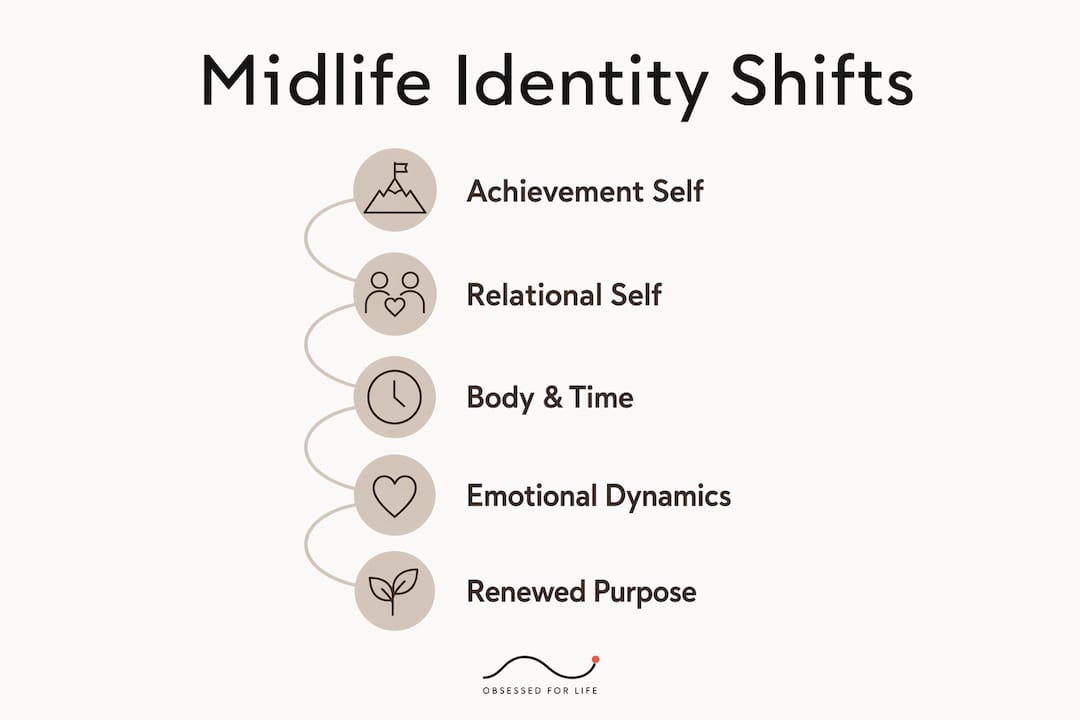
These layers do not shift in sequence. They move together, which is why midlife can feel like standing in several storms at once. Naming each layer gives you a place to stand.
How can women navigate the midlife identity transition effectively?
A practical five-step process helps women move through midlife identity shifts without forcing a premature resolution. The goal is not to arrive quickly. The goal is to move with intention.
-
Notice the old stories. The first step is awareness. Identify the beliefs and roles that feel inherited rather than chosen. “I am the responsible one.” “I don’t have time for what I want.” These stories shaped your early adult life. They are not permanent.
-
Release what no longer serves. Limiting beliefs are not character flaws. They are outdated maps. Releasing them is not betrayal of your past self. It is respect for who you are becoming.
-
Decide on new identity intentions. This step is quieter than it sounds. You are not rebranding yourself. You are asking: what do I value now? What kind of woman do I want to be in this season? Write it down. Say it out loud. Let it feel unfamiliar.
-
Repeat new patterns daily. Small, consistent actions build new identity faster than grand gestures. Experts recommend daily journaling and small experiments as the most reliable tools for identity integration. A ten-minute reflection each morning outperforms a weekend retreat that changes nothing on Tuesday.
-
Trust the transition without needing control. This is the hardest step. Midlife identity work does not resolve on a schedule. Patience is not passivity. It is the practice of staying present while the new self takes shape.
Pro Tip: Avoid the common pitfall of making only external changes. Attempting external changes without internal self-work leads to cyclical dissatisfaction, repeating old patterns in new settings. The internal work comes first.
Reflection as a life design tool is one of the most underused resources women have in this phase. Structured reflection, not vague introspection, is what moves the needle.
What emotional and psychological dynamics shape midlife self-discovery?
Midlife activates grief and growth at the same time. This simultaneity is what makes the emotional experience so complex and so hard to explain to people who haven’t reached it yet.
Grieving lost versions of yourself is not a detour from self-discovery. It is the path. Mourning the woman you thought you would be, or the roles you have outgrown, clears the space for something more authentic to emerge. This grief is healthy. Skipping it tends to produce identity shifts that don’t hold.
“The disorientation you feel in midlife is not a sign that something is wrong with you. It is a developmental threshold, signaling that your early-life constructed identity has reached its limits and your authentic self is beginning to emerge.”
Therapists distinguish this disorientation from psychological disorders. The feeling of “I don’t know who I am anymore” is not a symptom. It is a signal.
Common emotional experiences during midlife self-discovery include:
-
A persistent sense that the life you built no longer fits
-
Grief for identities, relationships, or dreams that are ending
-
Unexpected joy or relief when old obligations fall away
-
Anxiety about who you are without your former roles
-
A quiet but growing curiosity about what you want
-
Moments of clarity that feel both exciting and frightening
Pro Tip: Resist the urge to resolve the discomfort quickly. Rushing the transition often leads to adopting inauthentic new roles. Clinicians recommend living from presence rather than performance during this phase.
The women who move through midlife most gracefully are not the ones who figure it out fastest. They are the ones who stay curious long enough to let the real answer surface.
How does midlife self-discovery empower women to live with renewed purpose?
Midlife shifts the developmental focus from external expansion to internal integration. This is not a retreat from ambition. It is a redirection of it toward what matters.
Erikson’s generativity framework describes this shift precisely. When women move from accumulating achievements to contributing and mentoring, they resolve the stagnation that comes from a purely self-directed life. Legacy thinking replaces status thinking. The question changes from “What have I accomplished?” to “What am I leaving behind?”
This shift shows up in relationships, too. Women in authentic midlife transitions tend to reevaluate friendships, set clearer boundaries, and invest more deeply in connections that feel mutual and real. Relationships built on obligation quietly fall away. Relationships built on genuine affinity grow stronger.
Building a life congruent with your actual values, not the values you inherited or performed, produces a specific kind of calm. It is not the calm of having everything figured out. It is the calm of knowing you are moving in the right direction. The role of legacy thinking in this process is significant. When you begin to ask what you want to contribute rather than what you want to achieve, the answers tend to be more durable and more satisfying.
Women who do this internal work report a quality of aliveness that external success rarely produced. Not because the external world stopped mattering, but because it finally stopped being the only thing that did.
Key Takeaways
Midlife self-discovery is a developmental process, not a crisis, and women who engage it with intention, patience, and internal reflection build lives that are more authentic and more purposeful than the ones they left behind.
| Point | Details |
|---|---|
| Midlife is a threshold, not a crisis | Developmental psychology frames ages 40–60 as integration, not breakdown. |
| Three identity layers shift at once | Achievement, relational, and body/time selves all evolve simultaneously. |
| Internal work precedes lasting change | External changes without inner reflection repeat old patterns in new settings. |
| Grief is part of the process | Mourning lost identities clears space for authentic self-discovery to emerge. |
| Purpose shifts from achievement to contribution | Generativity, mentoring, and legacy thinking define renewed midlife purpose. |
What I’ve learned about sitting with the “not knowing”
The cultural story about midlife is that it is something to get through. A rough patch. A phase of loss. I have come to believe that story is almost entirely wrong.
What I have observed, and what I have lived, is that midlife is the first time many women are genuinely invited to ask what they want. Not what they should want. Not what would make everyone comfortable. What they honestly want. That question is not a crisis. It is a gift, and it arrives wrapped in discomfort precisely because it is real.
The societal myth of the midlife crisis keeps women looking for something to fix. But the women I have seen move through this phase with the most grace are not the ones who fixed anything. They are the ones who got quiet enough to listen. They stopped performing their identities and started inhabiting them.
Patience is the practice no one talks about enough. The new self does not arrive on a deadline. Curiosity, not urgency, is what keeps the door open. If you are in the middle of not knowing right now, that is not a problem to solve. It is a season to move through, slowly, with your eyes open.
— Theresa Stairs
What Obsessedforlife offers women ready to begin
If you are standing at this threshold and wondering what comes next, you are not alone, and you are not behind.

Obsessedforlife was built for exactly this moment. The Obsession Map is a guided assessment that helps women 40 and beyond identify what brings them joy in this season, what values are driving them now, and what experiences belong to this chapter of their lives. It does not tell you who to be. It reflects back what is already true about you, so the path forward feels like yours. Whether you are 42 or 68, this is a place to begin with clarity, not pressure.
FAQ
What is the role of midlife in self-discovery?
Midlife is a developmental turning point between ages 40 and 60 where women shift from externally defined roles to internal alignment. Developmental psychology frames this phase as integration, not crisis.
What triggers midlife identity shifts in women?
Common triggers include an empty nest, career burnout, and changes in caregiving roles. These events signal that early-adult identity structures no longer fit the authentic self.
How long does midlife self-discovery take?
Midlife identity transitions do not follow a fixed timeline. Clinicians recommend embracing the in-between phase rather than rushing toward a new identity, as patience produces more authentic outcomes.
Is midlife disorientation a sign of a psychological disorder?
Therapists distinguish midlife disorientation from psychological disorders. The feeling of not knowing who you are is a developmental signal, not a symptom, indicating that authentic self-emergence has begun.
How does midlife connect to living with purpose?
Erikson’s generativity framework shows that midlife is the stage where adults shift from personal accumulation to mentoring and contributing to others. This shift resolves stagnation and produces a deeper, more durable sense of purpose.