

Wisdom is defined as the ability to translate lived experience into sound judgment, and the role of life experience in wisdom is not automatic. Experience is the raw material. Wisdom is what you build from it, and that construction requires deliberate effort. A 2026 BrainFacts study by researcher Judith Glück confirms that intense life events alone do not yield wisdom without specific psychological prerequisites. For women at midlife, this distinction is not just academic. It is an invitation to stop waiting for wisdom to arrive and start actively cultivating it.
What is the role of life experience in wisdom?
Experience and wisdom are not the same thing. Experience is chronological. It accumulates whether you pay attention or not. Wisdom, by contrast, is metacognitive. It requires you to step back from what happened and ask what it means, what it reveals about you, and how it changes the way you move forward.
Two women can go through the same divorce, the same career loss, or the same health crisis and arrive at entirely different places. One emerges with sharper self-knowledge and greater compassion. The other repeats the same patterns in a new setting. The difference is not the experience itself. The difference is what each woman did with it internally.
Wisdom involves four distinct capacities: intellectual humility, emotional regulation, perspective-taking, and what researchers call epistemic humility, which is the willingness to accept that your current understanding might be incomplete. These are not personality traits you either have or lack. They are skills you can develop.
-
Intellectual humility: Recognizing that your interpretation of an event is not the only valid one
-
Emotional regulation: Processing difficult feelings without being controlled by them
-
Perspective-taking: Genuinely considering how others experience the same situation
-
Epistemic humility: Staying open to revising your conclusions as new information arrives
Pro Tip: After any significant experience, ask yourself: “What would I think about this if I had no personal stake in the outcome?” That single question activates perspective-taking and begins the shift from raw experience to wisdom.
What psychological prerequisites turn experience into wisdom?
Judith Glück’s research identifies five specific prerequisites that determine whether a person extracts wisdom from their experiences. These are: managing uncertainty, openness to new views, reflection, emotional regulation, and empathy. Without these five capacities, even the most dramatic life events pass through you without leaving wisdom behind.
-
Managing uncertainty: Tolerating ambiguity without rushing to a premature conclusion
-
Openness: Genuinely considering perspectives that challenge your existing beliefs
-
Reflection: Actively processing what an experience revealed about yourself and the world
-
Emotional regulation: Feeling the full weight of an experience without letting it distort your reasoning
-
Empathy: Extending understanding to others involved, even when it is uncomfortable
Age alone does not guarantee these capacities. A 2026 JMIR Mental Health study confirms that wisdom grows with experience but requires cognitive, emotional, and cultural factors to develop fully. A 65-year-old who has never practiced reflection is not automatically wiser than a 42-year-old who has.
The encouraging news is that these skills are trainable. Research from The Conversation (2026) reports that participants improved in wise reasoning after practicing distanced reflection and humility prompts. This means wisdom is not a fixed trait you either possess or don’t. It is a practice you return to, especially during the high-stakes decisions that midlife tends to deliver.
“Wisdom is not what life hands you. It is what you do with what life hands you, and that doing is a skill.” — Judith Glück, BrainFacts, 2026
Does the type of experience affect how much wisdom you gain?
Not all experiences contribute equally to wisdom development. The meaningfulness of an experience and the quality of reflection that follows it matter far more than the sheer volume of things you have lived through.

Psychology Today (2026) makes this point directly: experience can reinforce errors if not accurately processed. A woman who has managed difficult relationships for decades but never examined her own patterns in them has not gained wisdom from those relationships. She has reinforced a script. Experience treated as raw input, requiring ongoing testing and adjustment, produces wisdom. Experience treated as confirmation of what you already believe produces stagnation.
The table below illustrates how different experience types translate into wisdom outcomes depending on the quality of processing involved.
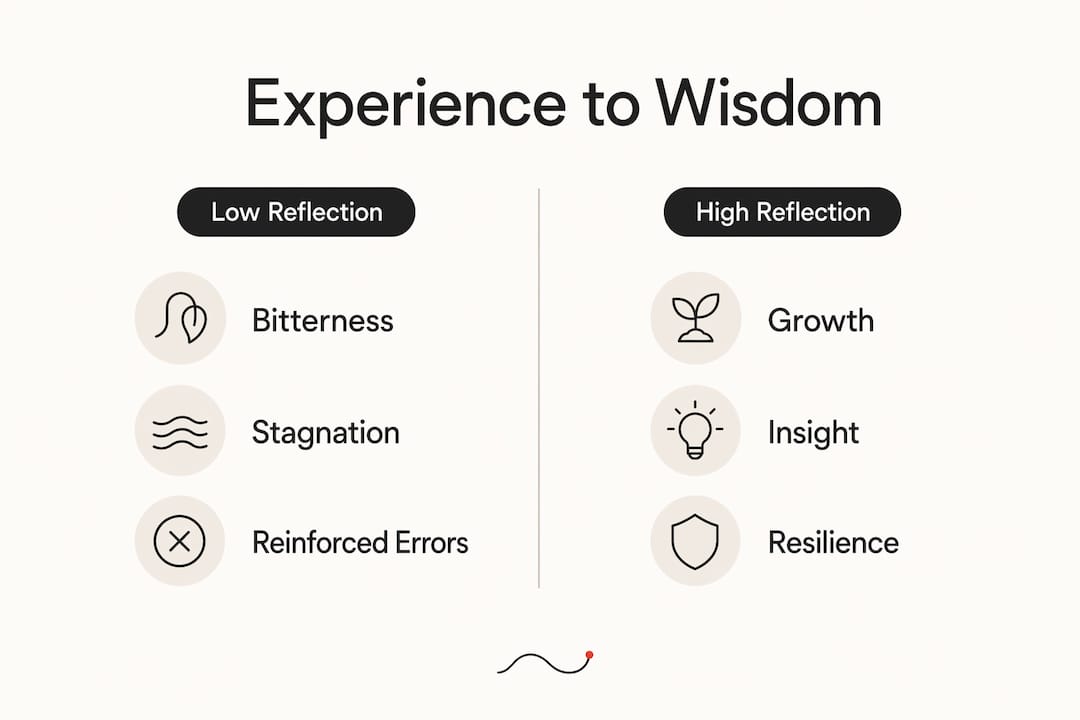
| Experience type | Low reflection outcome | High reflection outcome |
|---|---|---|
| Career setback | Bitterness or avoidance | Clarity about values and boundaries |
| Relationship loss | Repeated patterns | Deeper self-knowledge and empathy |
| Health challenge | Anxiety and control | Acceptance and reprioritization |
| Caregiving role | Resentment and depletion | Compassion and perspective on mortality |
| Major life transition | Confusion and drift | Purposeful redesign of priorities |
Positive experiences matter too, not just adversity. Moments of deep joy, creative flow, or meaningful connection are equally rich sources of wisdom when you reflect on what they reveal about what you truly value.
Pro Tip: A life audit is one of the most direct ways to assess which of your experiences you have processed and which ones are still running in the background, unexamined.
How do midlife and aging relate to wisdom development?
Midlife is a particularly fertile ground for wisdom, not because age automatically delivers it, but because the conditions for it tend to converge around this season. You have enough lived experience to draw from. You have enough self-awareness to question your assumptions. And many women at 40 and beyond are, for the first time, asking questions that belong entirely to them.
The 2026 JMIR study found that 71% of variance in mental well-being among middle-aged to older adults was explained by the combined factors of wisdom, life purpose, and quality of life perceptions. That is a striking finding. It means that cultivating wisdom is not just a philosophical pursuit. It is one of the most direct paths to your own well-being.
| Age stage | Wisdom opportunity | Key mediating factor |
|---|---|---|
| Early 40s | Processing career and identity shifts | Openness and reflection |
| Mid 40s to 50s | Navigating relationships and caregiving | Empathy and emotional regulation |
| Late 50s to 60s | Integrating life meaning and legacy | Purpose and epistemic humility |
| 60s and beyond | Sharing and applying accumulated insight | Generativity and perspective |
Mental well-being and wisdom reinforce each other. Wisdom supports better decision-making and coping throughout the lifespan, which in turn creates the psychological stability needed to keep growing. The relationship is circular and self-reinforcing, which means starting anywhere in the cycle moves the whole thing forward.
What practical steps help midlife women cultivate wisdom from experience?
The gap between having experiences and gaining wisdom from them closes through deliberate practice. These strategies are grounded in current research and designed for the real texture of midlife.
-
Practice self-distancing. Research shows that third-person perspective journaling boosts wise reasoning by reducing egocentric bias. Instead of writing “I feel overwhelmed,” write “She is feeling overwhelmed. What does she need?” The shift is subtle and the effect is real.
-
Conduct a life review. Structured reflection on your personal history, including the chapters you would rather skip, activates the kind of deep processing that builds insight and wisdom. The Obsessedforlife guide on life review and wellness offers a structured way to begin.
-
Ask humility questions. After any significant decision or conflict, ask: “Where might I be wrong here?” and “What am I not seeing?” These prompts directly train intellectual humility, one of the core prerequisites for wisdom.
-
Pursue new experiences with intention. Wisdom gained from experiences is amplified when those experiences stretch your existing frame of reference. Learning a new language, for example, has been shown to build cognitive flexibility across the lifespan, which supports the openness that wisdom requires.
-
Write a personal life vision. Reframing your experiences through the lens of what you want your next chapter to look like is not wishful thinking. It is a form of active meaning-making. Obsessedforlife’s guide to crafting a life vision after 40 walks you through exactly this process.
-
Build emotional regulation as a daily practice. Mindfulness, journaling, and even regular physical movement all reduce the emotional noise that blocks wise reasoning. Wisdom fluctuates with stress and context, so wise reasoning varies day to day depending on your internal state. Stabilizing that state is part of the work.
Key takeaways
The role of life experience in wisdom depends entirely on whether that experience is processed through reflection, emotional regulation, openness, and empathy.
| Point | Details |
|---|---|
| Experience alone is not wisdom | Raw experience requires active processing to become wisdom, not just time passing. |
| Five prerequisites matter most | Managing uncertainty, openness, reflection, emotional regulation, and empathy are the core converters. |
| Quality of reflection beats quantity | A single deeply processed experience produces more wisdom than dozens of unexamined ones. |
| Midlife is a wisdom opportunity | The convergence of experience and self-awareness at 40+ creates ideal conditions for growth. |
| Wisdom is trainable | Self-distancing, life audits, and humility questions are proven methods for developing wise reasoning. |
What I’ve learned about wisdom that most articles won’t tell you
By Theresa Stairs
Here is the uncomfortable truth I have sat with for a long time: I spent years assuming that surviving hard things made me wise. It didn’t. It made me experienced. The wisdom came later, slowly, only when I stopped treating my past as a story I had already finished and started treating it as a text I was still learning to read.
The women I admire most at midlife are not the ones who have had the easiest lives or even the hardest ones. They are the ones who got curious about their own patterns. They asked the questions that felt risky, like “What did I contribute to that?” and “What am I still carrying that no longer belongs to me?” Those questions are not comfortable. They are, however, the ones that move you forward.
What I have also noticed is that wisdom is not a destination. Some days you reason with clarity and generosity. Other days, stress or fatigue pulls you back into old reactions. That is not failure. That is the nature of wisdom as a practice rather than a possession. The goal is not to arrive. The goal is to keep returning.
If you are 40 or 55 or 67 and you feel like you are only now beginning to understand yourself, that is not late. That is exactly on time.
— Theresa Stairs
Ready to turn your experience into your next chapter?
The experiences you have lived through are not behind you. They are the foundation of everything you are building now. Obsessedforlife was created for women who are ready to stop accumulating experiences and start drawing real meaning from them.
Through the Obsession Map, Obsessedforlife helps you identify what genuinely lights you up in this season, what values are driving your decisions, and what kind of life fits who you have become. This is not about reinventing yourself from scratch. It is about finally living with intention from everything you already know. Whether you are 42 or 68, your next chapter is waiting. Start here.
FAQ
Does experience automatically lead to wisdom?
Experience does not automatically produce wisdom. According to Judith Glück’s 2026 research, wisdom requires active processing through reflection, emotional regulation, openness, and empathy, not just the passage of time.
What is the difference between experience and wisdom?
Experience is chronological exposure to events. Wisdom is the metacognitive processing of those events, which involves intellectual humility, perspective-taking, and the ability to apply what you have learned to new situations.
Can wisdom be developed at any age?
Wisdom can be developed at any age. Research from The Conversation (2026) shows that practicing self-distancing and humility prompts measurable improvements in wise reasoning, regardless of how old you are when you start.
How does midlife affect wisdom development?
Midlife creates favorable conditions for wisdom by combining substantial lived experience with growing self-awareness. A 2026 JMIR study found that wisdom and life purpose together explain a significant portion of mental well-being in middle-aged and older adults.
What is the fastest way to grow wiser from past experiences?
The most direct method is structured self-reflection, specifically third-person journaling and life review exercises. These practices reduce egocentric bias and activate the kind of deep processing that converts raw experience into genuine wisdom.