

Building a fulfilling life after corporate achievement is defined as the intentional process of integrating your professional legacy with new personal values, goals, and sources of joy. For women 40 and older, this is not starting over. It is a midlife reinvention that honors everything you have built while opening space for what genuinely lights you up now. The psychological term for this process is life redesign, and it requires narrative reframing, identity work, and structured planning. A strategic career pivot for senior professionals typically takes 11–18 months from decision to new direction. That timeline is not a warning. It is an invitation to move with intention.
What does it mean to build life after corporate achievement?
Life redesign after corporate success means weaving your accumulated wisdom, skills, and identity into a new chapter that belongs entirely to you. It is not a retreat from ambition. It is a redirection of it toward goals that feel personal rather than institutional.
Women who have spent decades in corporate environments often discover that external achievement no longer delivers the same satisfaction it once did. Midlife recalibration is linked to shifts in the brain’s reward circuitry, where dopamine responses to external metrics diminish and motivation moves inward toward value-driven fulfillment. This is not a crisis. It is a signal.

The Both/And reframe is the most useful lens for this season. You are not erasing your corporate identity. You are expanding beyond it, carrying your achievements forward while building something new alongside them.
What emotional and identity challenges do women face after corporate achievement?
The emotional terrain of leaving or shifting away from a long-term corporate role is more complex than most women expect. Your title, your calendar, your team, and your sense of daily purpose are all woven into who you are. When those structures change, the loss is real.
Leaving long-term corporate roles triggers a grief cycle that includes denial, resistance, anger, and sadness. This grief is not linear, and it is not a sign that you made the wrong choice. It is a physiological response to losing social identity and structure. Skipping this phase is one of the most common mistakes women make in transition.
“What I’ve learned coaching women at the highest levels is that many of them aren’t burned out. They’ve simply outgrown the room they’re in. The next step isn’t rest. It’s a larger room.” — Executive coach Chelese Perry
Research based on 20 narrative interviews identifies gendered exhaustion as a primary driver for women seeking life-aligned alternatives after corporate achievement. This exhaustion is distinct from standard burnout. It reflects the compounded weight of performing at a high level while managing expectations that are uniquely placed on women in professional environments.
Misdiagnosing identity crisis as burnout leads to repeated dissatisfaction after transition. Women who treat their restlessness as a symptom to fix, rather than a signal to explore, often find themselves in a new role that replicates the same dissatisfaction. The work is internal before it is external.
The Both/And reframe matters here. You can feel proud of what you built and feel ready for something different. Those two truths are not in conflict. They are the foundation of a well-designed next chapter.
What are the essential prerequisites for a successful life redesign?
Before you redesign your life, you need to understand what you are working with. This means taking honest inventory of your skills, your values, and the story you tell about who you are.
Start with these three foundations:
-
Narrative audit: Write the story of your career as a series of choices, not just accomplishments. What did you move toward? What did you move away from? What patterns repeat?
-
Skills inventory: Identify transferable skills that exist beyond your job title. Leadership, communication, systems thinking, and relationship building travel across industries and life contexts.
-
Values exploration: Name the five values that feel most alive in you right now, not the ones that drove you at 32. A life audit is a structured way to do this work.
Internal support matters as much as planning. Therapy or coaching during this phase is not optional for most women. It is the infrastructure that makes the rest of the work possible. A skilled coach helps you distinguish between what you want and what you have been conditioned to want.
Pro Tip: Stay in your current role while you explore. Maintaining employment during transition stabilizes your nervous system, preserves financial confidence, and gives you a platform to test ideas without pressure. A bridge is stronger than a leap.
The timeline for this phase is realistic when you plan for it. A well-managed transition takes 11–18 months. That means the prerequisite phase alone, the internal work and inventory, deserves two to four months of genuine attention.
| Prerequisite | Purpose | Suggested timeline |
|---|---|---|
| Narrative audit | Connect past choices to future direction | Month 1 |
| Skills inventory | Identify transferable strengths | Month 1–2 |
| Values exploration | Clarify what matters now | Month 2 |
| Coaching or therapy | Process identity shifts | Ongoing |
| Financial review | Confirm stability for transition | Month 2–3 |
How do you execute a step-by-step life redesign plan?
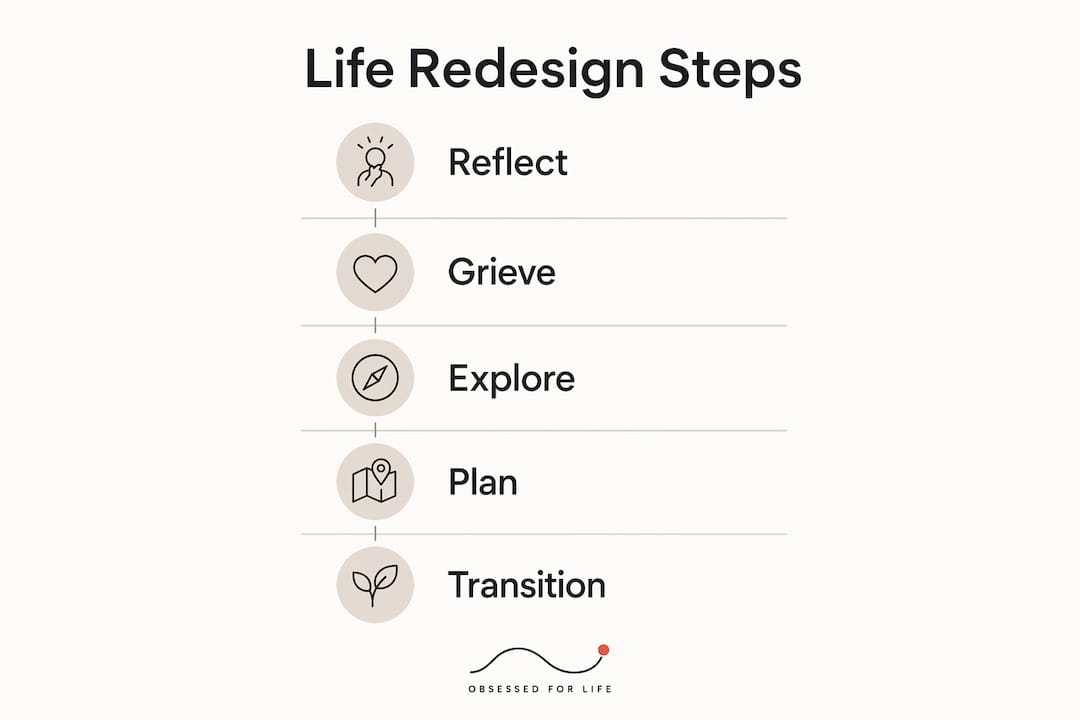
Once the internal foundation is in place, the redesign moves into structured phases. Structured transition phases recommended by career specialists follow a clear arc across 7–8 months: narrative and skill inventory, market research, networking, then applications. Each phase builds on the one before it.
Here is how that arc looks in practice:
-
Months 1–2: Narrative and skills inventory. Document your professional story and identify the skills, values, and experiences you want to carry forward. This is also when you begin exploring what a meaningful life pivot could look like for women in your season.
-
Months 3–4: Research and exploration. Investigate fields, roles, communities, or creative directions that align with your values. Attend events, read widely, and follow your curiosity without committing yet.
-
Months 5–6: Networking with intention. Connect with women who have made similar transitions. Ask questions. Share your story. Relationships built in this phase often become the most important resource in the next one.
-
Months 7–8: Application and commitment. Whether you are pursuing a new role, launching a project, or building a community, this is when you move from exploration to action.
Pro Tip: Do not skip the grieving phase to get to the exciting part faster. Identity rebuild is a deep psychological process. Women who rush past it often find themselves repeating the same dissatisfaction in a new setting.
The most common pitfall in this phase is treating the redesign like a job search. It is not. A job search fills a role. A life redesign fills a life. The questions are different, and so is the pace.
What strategies help sustain personal fulfillment and joy in the new chapter?
Sustaining joy after a major life redesign requires ongoing attention. The new chapter does not run on autopilot. It runs on intention.
Intentional living is the practice of making choices that align with your stated values rather than defaulting to habit or expectation. For women 40 and beyond, this is a genuine shift. Many of the habits that served you in your corporate years, saying yes quickly, measuring success by output, defining worth through productivity, need to be examined and often released.
Here are the strategies that sustain fulfillment over time:
-
Anchor to wisdom-driven goals. Goals built on your lived experience carry more staying power than goals borrowed from someone else’s definition of success.
-
Maintain the Both/And mindset. Pride in your past and openness to your future are not competing forces. Hold both.
-
Build community with women in similar seasons. Isolation is one of the quietest threats to sustained fulfillment. Find your people.
-
Return to your values regularly. What mattered at the start of your redesign may shift. Schedule a quarterly check-in with yourself to stay aligned.
-
Work with a coach or guide. Ongoing support is not a sign of struggle. It is a sign of commitment to the work.
Later life is genuinely ideal for self-exploration because you arrive with context, perspective, and the hard-won ability to distinguish what you want from what you were told to want. That is not a small thing. It is the foundation of everything that comes next.
Key takeaways
The most effective way to build life after corporate achievement is to integrate your professional identity with new personal values through structured phases, honest self-inventory, and ongoing intentional living.
| Point | Details |
|---|---|
| Life redesign is integration | You are not erasing your past. You are building on it with new personal direction. |
| Grief is part of the process | Leaving a long-term corporate role triggers a real grief cycle. Honor it before moving forward. |
| The timeline is 11–18 months | A well-managed transition takes time. Plan for it rather than rushing through it. |
| Internal work comes first | Skills inventory, values exploration, and coaching lay the foundation before any external steps. |
| Intentional living sustains joy | Ongoing alignment with your values is what keeps the new chapter fulfilling over time. |
What I have learned about life after corporate achievement
By Theresa Stairs
The women I have worked with who navigate this transition most gracefully share one quality: they are willing to be honest with themselves before they are ready to be strategic. That honesty is harder than it sounds. When you have spent decades being excellent at what others needed, the question of what you need can feel almost foreign.
What I have come to believe, and what the research confirms, is that the grief phase is not an obstacle to the redesign. It is the redesign. The women who skip it, who move quickly from corporate exit to new venture, often find themselves recreating the same dynamics in a different setting. The title changes. The exhaustion does not.
The Both/And mindset changed how I think about this work entirely. You don'tt have to choose between honoring what you built and wanting something different. You can carry your achievements with you into the next chapter. They belong to you.
My observation is the women who thrive the women who stay curious the longest. They ask better questions. They sit with uncertainty without collapsing it into a premature answer. That patience, combined with structure and support, is what makes the difference.
If you are in this season, you are not behind. You are exactly where this kind of beginning requires you to be.
— Theresa Stairs
Ready to find what comes next?
You have spent years building something real. Now a new question is rising, one that belongs entirely to you. Obsessedforlife is a self-discovery platform built for women exactly in this season, women who are ready to stop showing up for everyone else’s definition of success and start following their own joy.
The Obsession Map, Obsessedforlife’s original guided assessment, helps you explore what brings you joy right now, what values are driving you in this chapter, and what experiences are waiting for you. It listens to who you are and reflects back a picture of what lights you up. Visit Obsessedforlife to take the first step toward a life that feels genuinely yours.
FAQ
What does “build life after corporate achievement” mean?
Building life after corporate achievement means intentionally redesigning your personal goals, values, and daily rhythms after reaching significant career milestones. It is the process of integrating your professional legacy with new sources of joy and meaning.
How long does a life redesign take for women 40+?
A well-managed transition typically takes 11–18 months from the initial decision to a fully realized new direction. Rushing the process often leads to repeating old patterns in a new setting.
Is it normal to grieve leaving a corporate career?
Yes. Leaving a long-term corporate role triggers a genuine grief cycle that includes denial, resistance, and sadness. This response is physiological and psychological, not a sign of weakness or regret.
What is the Both/And reframe in midlife transition?
The Both/And reframe means holding pride in your past achievements alongside openness to a new direction. It rejects the false choice between honoring your career and wanting something different, treating both as true at the same time.
Where should a woman start her life redesign after corporate success?
Start with a narrative audit, a skills inventory, and a values exploration before making any external moves. A life audit is a structured tool for this first phase of internal preparation.