

Most people assume that living intentionally means having a perfect schedule, a morning routine lifted from a wellness magazine, or an iron grip on every hour of the day. None of that is true. What does living intentionally mean, really? It means choosing your life rather than simply receiving it. For women in their 40s, 50s, and beyond, that distinction matters more than ever. You’ve spent decades being excellent at what others needed. Now something quieter is asking for your attention. This article will help you understand what intentional living actually is, why it transforms wellbeing, and how to practice it starting today.
Table of Contents
Key Takeaways
| Point | Details |
|---|---|
| Intentional living is values-driven | It means structuring choices around your own values rather than defaulting to habit or expectation. |
| It differs from perfectionism | Living intentionally is about awareness and alignment, not control or flawlessness. |
| Real benefits are emotional and practical | Research links this practice to reduced stress, better decisions, and greater life satisfaction. |
| The process involves grief | Letting go of inherited identities is uncomfortable but necessary for authentic self-direction. |
| Small daily practices create lasting change | Intention lists, mindful pauses, and offline habits build the rhythm of a conscious life. |
What living intentionally actually means
At its core, intentional living is conscious, values-driven choice in how you structure your daily life, rather than drifting through decisions by habit, pressure, or default. It is not about becoming a different person. It is about becoming more fully yourself.
Think of it this way. Every day you make hundreds of small decisions. What to say yes to. Where to spend your energy. Which relationships to invest in. Most of those decisions happen on autopilot, shaped by old patterns, others’ expectations, or sheer momentum. Intentional living interrupts that autopilot. It creates a pause. It asks: does this actually align with who I am and what I want?
The psychological definition is equally grounding. Mindfulness creates a gap between impulse and response, enabling genuine choice rather than habitual reaction. That gap, however small, is where intentional living lives.
What intentional living is not also deserves clarity:
-
It is not perfectionism. You are not trying to optimize every moment.
-
It is not rigidity. Intentional people still rest, wander, and change their minds.
-
It is not selfishness. Choosing yourself is not abandoning others.
-
It is not a one-time decision. It is a living, evolving practice you return to again and again.
“Intentional living is the ongoing practice of asking: is what I’m doing today a reflection of what I actually value? Not what I’ve always done, not what others expect, but what genuinely matters to me.”
For women at midlife and beyond, this definition carries weight. Many have spent years in roles that were chosen for them, or chosen without full awareness of alternatives. The meaning of intentional living, in this season, is reclaiming authorship.
Why the benefits go deeper than you expect

The phrase “benefits of living intentionally” might conjure images of productivity apps and habit trackers. The real benefits are quieter and far more significant.
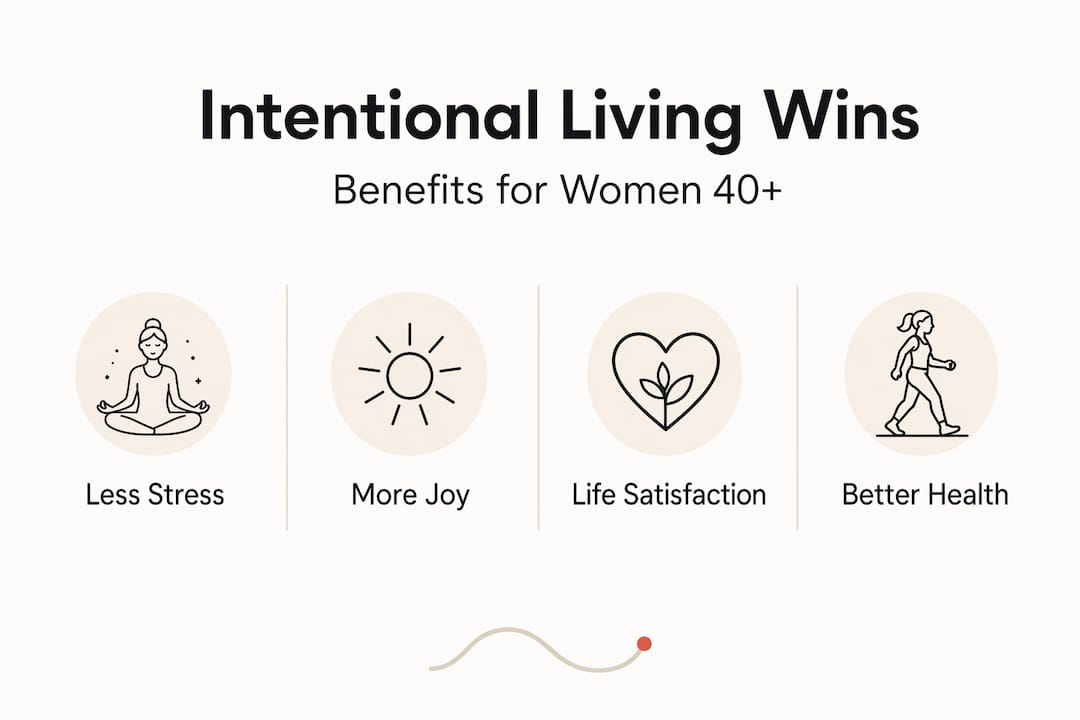
Consistently practicing intentional living is linked to increased life satisfaction, reduced stress, and improved emotional regulation. These are not abstract outcomes. They show up in daily life as the ability to say no without guilt, to be present in conversation, to make a decision without second-guessing it for days afterward.
One of the most underestimated benefits is improved decision-making. When you live intentionally, a pause between impulse and action becomes a habit. You stop making choices from exhaustion or anxiety. You start making them from clarity. Over time, this dramatically reduces regret.
Pro Tip: When you face a decision that feels urgent, give yourself a 24-hour pause before responding. Most “urgent” choices are not. That pause is intentional living in action.
There is also a growing connection between intentional living and what is now being called offline living. Creating boundaries with digital technology is one of the defining wellness trends of 2026, and for good reason. Constant connectivity fragments attention, floods you with others’ priorities, and quietly erodes your sense of self. Women who choose to live more intentionally often report that protecting their attention, especially from screens, is one of the first and most powerful shifts they make.
Living with purpose also offers protection from internal conflict. When your choices align with your values, you feel integrated rather than fractured. That internal coherence is its own form of peace.
The uncomfortable truth about making the shift
Here is what most articles about intentional living skip. The shift to conscious, values-driven living is not just uplifting. It can also be genuinely hard.
When you begin to question unchosen inherited rules and examine the scripts you have been running on, you are doing something psychologists call mentalizing. You are stepping outside your automatic patterns and asking whether they are actually yours. This is rich, meaningful work. It is also disorienting.
Many women describe a quiet grief that surfaces during this process. You may realize that some of your deepest commitments were never freely chosen. That certain relationships have been built on a version of you that no longer fits. That letting go of inherited identities is a real loss, even when it is also a liberation.
This grief is not a sign that something has gone wrong. It is a sign that something real is happening.
The cost of becoming more intentional is that you can no longer pretend you don’t know what you know. That awareness can feel heavy before it feels freeing.”
There is also the matter of friction. Modern life is designed to keep you comfortable and reactive. Notifications, convenience, endless options. Adding useful friction, intentionally slowing down certain habits, forces attention back to your own experience. It is counterintuitive. It is also one of the most practical tools available for reclaiming awareness and ownership of your time.
Normalize the discomfort. It is not an obstacle to intentional living. It is part of the practice.
How to live intentionally starting now
Knowing what intentional living means and actually practicing it are two different things. Here is a grounded approach for women ready to begin.
-
Clarify your values first. Before you change anything, spend time identifying what genuinely matters to you in this season of your life. Not what mattered at 28. Not what you think should matter. Use a journal, a walk, or a guided tool to surface what actually feels alive in you right now.
-
Swap your to-do list for an intention list. Rather than a sprawling list of tasks, a daily intention list limited to 3 to 5 focused items reduces decision fatigue and keeps your energy directed toward what matters. The question shifts from “what do I need to get done?” to “what do I want to move toward today?”
-
Build decision pauses into your day. Before agreeing to something, check in with yourself. Does this align with my values? Does it serve the life I am choosing? A brief pause is enough to shift from reactive to responsive.
-
Set boundaries with technology. Offline living habits protect your mental clarity and attention. This might mean phone-free mornings, a no-scroll rule before bed, or designating certain spaces in your home as screen-free.
-
Create a reflection rhythm. Intentional living requires regular check-ins with yourself. Journaling, meditation, and quiet walks all serve this purpose. The specific form matters less than the consistency.
-
Use analog tools deliberately. A paper journal, a handwritten list, a physical calendar. Slower analog habits create the useful friction that keeps you present rather than reactive.
Pro Tip: Start with one practice only. Choose the one that feels like the smallest possible step, not the most impressive. Consistency with one small shift creates more change than a complete overhaul that lasts three days.
Here is a quick comparison to help you see the difference between autopilot and intentional approaches:
| Autopilot habit | Intentional alternative |
|---|---|
| Checking your phone first thing in the morning | A screen-free first 30 minutes dedicated to reflection or movement |
| Saying yes out of obligation | Pausing and asking whether the commitment aligns with your current values |
| Filling free time with busyness | Treating open time as an invitation to rest, create, or simply be |
| Making decisions under pressure | Building in a waiting period before responding to non-urgent requests |
| Ignoring emotional signals | Treating discomfort or restlessness as information worth paying attention to |
What I’ve learned from actually doing this work
I spent years thinking I was living a purposeful life because I was busy. Busy, productive, checked off every box. What I eventually realized is that I had been living someone else’s version of my life with extraordinary dedication.
The shift toward intentional living started, for me, with a simple and uncomfortable question: which of my choices are actually mine? The answer was not what I expected. And yes, there was grief in that discovery. Real grief.
What surprised me most was how much I had confused motion with direction. I was always moving. But intentional living requires alignment between your actions and your values, and I had never stopped long enough to check whether those two were pointing in the same direction.
What I’ve found, on the other side of that discomfort, is something quieter and more solid than I anticipated. Not perfect days, not a polished morning routine. A clearer sense of what I am saying yes to and why. That clarity, honestly, changes everything.
If you are in the early stages of this, I want to offer this: be patient with the confusion. It is not a sign that you are doing it wrong. It is a sign that you are paying attention, maybe for the first time in a long time. That is not a small thing.
— Theresa
Your next step with Obsessedforlife
If this article has stirred something in you, that is worth paying attention to.
Obsessedforlife was built for exactly this moment. The moment when you have done everything expected of you and a new question starts rising: what do I actually want with my life? Through the Obsession Map, an original guided assessment, you can begin to surface what brings you joy in this season, what values truly drive you, and what experiences you have not yet considered. It is a thoughtful starting point for building a vibrant, fulfilling life after years of showing up for everyone else.
Whether you are 42 or 68, you are not starting over. You are finally beginning. Explore what intentional living looks like for you specifically by visiting Obsessedforlife and taking the first step toward a life that genuinely reflects you. You can also read more about what this kind of living makes possible in the vibrant life after 65 guide from the Obsessedforlife blog.
FAQ
What does living intentionally mean in simple terms?
Living intentionally means making conscious, values-driven choices in your daily life rather than responding to habit, pressure, or expectation on autopilot. It is about structuring your time and energy around what genuinely matters to you.
How is intentional living different from perfectionism?
Intentional living is about awareness and alignment, not flawlessness. Perfectionism seeks control over outcomes; intentional living seeks honesty about values. You can rest, change your mind, and still be living intentionally.
What are the main benefits of living intentionally?
Research links intentional living to greater life satisfaction, reduced stress, and improved emotional regulation. It also strengthens decision-making by creating a pause between impulse and action, which reduces long-term regret.
How do you start living intentionally after 40?
Begin with values clarification, then introduce one small daily practice such as an intention list or a technology boundary. Consistent small shifts create more lasting change than complete lifestyle overhauls.
Is it normal to feel grief when shifting to intentional living?
Yes. Letting go of unchosen inherited roles and identities can involve genuine grief. Psychologists identify this mourning process as a necessary and healthy part of moving toward authentic self-direction.