

Work-life integration for women is defined as the practice of blending professional responsibilities and personal life into a single, fluid rhythm rather than treating them as opposing forces. Unlike traditional work-life balance, which asks you to divide your time equally between work and everything else, integration asks a different question entirely: where is your energy best placed right now? This shift matters because 45% of women workers report burnout, with inflexible scheduling cited as a primary driver. The standard balance model was never designed for women carrying multiple roles at once. Integration offers a more honest framework for how life works.
What is work-life integration for women, and why does it matter?
Work-life integration is the recognized term in organizational psychology for a model that replaces strict role separation with intentional blending. Where balance implies a scale that must stay level, integration treats your life as a whole system. You are not a professional from 9 AM to 5 PM and a person after that. You are both, always.
This matters most for women because the traditional balance model was built around a workforce that did not include caregiving, emotional labor, or the mental load of running a household. Integration measures success by energy alignment rather than time allocation. That single shift changes everything about how you plan your day, set your limits, and define what a good week looks like.
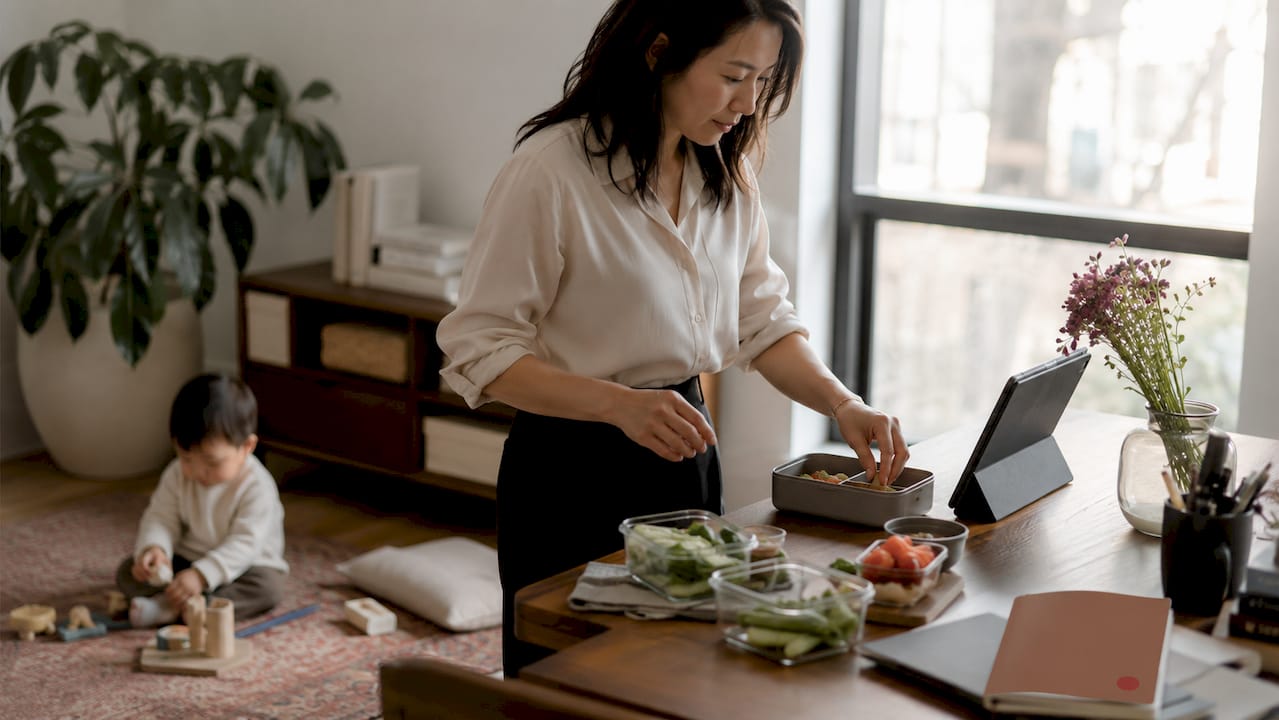
For women in their 40s and 50s, this framework often arrives at exactly the right moment. The roles have multiplied. The expectations have not shrunk. And the old model of “balance” keeps promising an equilibrium that never quite arrives.
How does work-life integration differ from work-life balance?
Work-life balance treats work and personal life as two separate buckets that need equal filling. Integration treats them as one continuous experience that shifts in emphasis depending on what matters most right now.
The practical difference is significant. Balance asks: “Did I spend enough time on each thing today?” Integration asks: “Did I show up with enough energy and intention where it counted?” One is a clock problem. The other is an identity problem, and identity is the more honest measure.
Balance is a faulty metaphor for women leaders because it implies that work and life are equal weights that can be managed symmetrically. Real life does not work that way. A sick child, a deadline, a parent’s health crisis, a creative project that lights you up at midnight: none of these fit neatly into a balanced schedule.
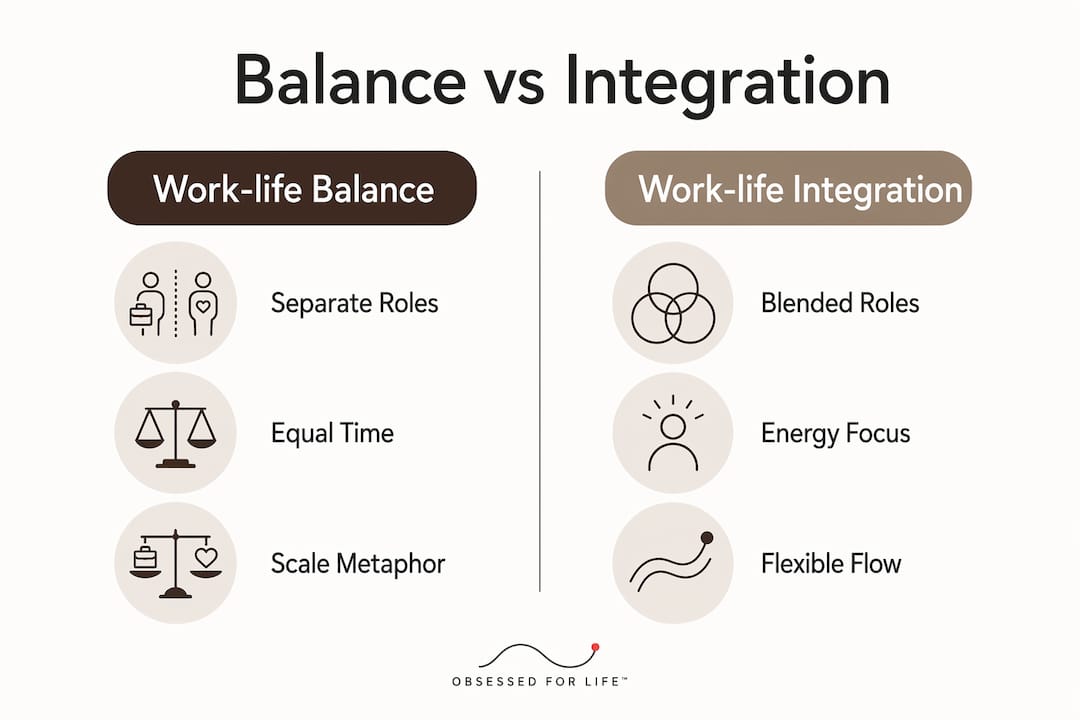
| Principle | Work-life balance | Work-life integration |
|---|---|---|
| Core metaphor | A scale with equal sides | A rhythm that shifts with need |
| Success measure | Time spent in each role | Energy alignment and presence |
| Boundary type | Hard separation between work and personal | Intentional, flexible limits |
| Flexibility | Low; requires strict scheduling | High; adapts to life’s demands |
| Identity focus | Role-based (worker vs. person) | Whole-person identity |
Pro Tip: When you feel guilty for working during a family moment or being present with family during work hours, that guilt is the balance model talking. Integration gives you permission to be fully human instead.
What unique challenges do women face in achieving work-life integration?
The challenges women face are not personal failures. They are structural, social, and deeply documented.
61% of women feel pressure to be perfect in their roles as mothers, partners, and professionals simultaneously. That pressure does not ease when you adopt a new framework. It requires active, ongoing resistance. And 69% of women feel that no matter what they achieve, it is never enough. That statistic describes not a productivity problem but a psychological one rooted in impossible standards.
The boundary between work and family has become structurally blurred for working mothers. 62% of full-time working mothers report difficulty balancing work and family, and 70% perform parenting tasks while actively working. That is not a choice. That is the reality of carrying two full-time responsibilities in a world that still treats them as separate.
The challenges cluster into a few clear patterns:
-
The perfection trap. Society rewards women who appear effortless in every role. Admitting struggle feels like failure.
-
The mental load. Planning, anticipating, and managing household and family logistics falls disproportionately on women, even when both partners work full time.
-
Career penalties. 52% of working mothers say parenting makes career advancement harder. That is not a perception gap. It reflects real structural bias.
-
The always-on expectation. 54% of women struggle to disconnect from work, which keeps the nervous system in a state of low-grade alert even during personal time.
-
Inflexible scheduling. Among women who improved their work-life experience, 57% credited increased flexibility as the leading factor. Flexibility is not a perk. It is a health variable.
Integration is an ongoing, sometimes uncomfortable choice to protect personal anchors, ensuring core identity remains intact despite fluid schedules.”WMN Magazine
Recognizing these challenges as systemic rather than personal is the first honest step toward building something better.
How can women implement effective work-life integration strategies?
Effective integration is built on a few repeatable practices, not a single dramatic overhaul. Start with what you can control and build from there.
-
Identify your personal anchors. A personal anchor is any activity, relationship, or practice that keeps your core identity intact. It might be a morning walk, a weekly call with a close friend, or protected creative time. Active daily decisions to protect these anchors create synergy between your roles and reduce burnout over time. Without anchors, every role competes for the same depleted resource.
-
Manage energy, not just time. A work-life identity balance checklist can help you map where your energy goes versus where you intend it to go. Time management assumes all hours are equal. Energy management recognizes that a focused hour after rest is worth three hours of distracted effort.
-
Build mental transition periods. Mental gear-shifting transitions of 10–15 minutes between work and personal tasks reduce stress and improve your presence in each area. This could be a short walk, five minutes of quiet, or a deliberate ritual that signals a role shift. Skipping transitions is one of the most common and most costly shortcuts women make.
-
Set intentional technology limits. Without technology boundaries, integration becomes an always-on trap. Scheduling emails to send only during business hours is one concrete tactic. It protects your personal time and resets others’ expectations about your availability.
-
Know your role type. Integration is easier in roles measured by output rather than rigid hours. If your job requires physical presence on a fixed schedule, integration looks different than it does for a remote knowledge worker. Realistic expectations prevent the frustration of applying a strategy that does not fit your actual constraints.
-
Reflect and adjust continuously. Integration is not a destination. It requires continuous reflection and the courage to say no, not a one-time solution. A quarterly life audit after 40 can surface what is working, what has shifted, and where your energy needs to be redirected.
Pro Tip: When you feel the pull to respond to a work message during personal time, pause and ask: “Is this urgent, or does it just feel urgent?” Most of the time, it can wait. Training yourself to tell the difference is one of the most protective skills you can build.
What benefits can women expect from work-life integration?
The benefits of work-life integration are not abstract. They show up in your body, your relationships, and your sense of self.
Women who practice intentional integration consistently report:
-
Reduced burnout. When energy is managed rather than depleted, the chronic exhaustion that defines burnout becomes less frequent and less severe.
-
Stronger identity beyond work. Integration protects the parts of you that exist outside your professional role. That protection matters more as you move through your 40s and 50s, when questions about meaning and purpose naturally intensify.
-
Greater satisfaction across life areas. Intentional boundaries based on what matters most enable women to show up more authentically in both professional and personal contexts.
-
Improved mental health. The psychological relief of releasing the perfection standard, even partially, reduces anxiety and the persistent sense of falling short.
-
More presence. When you are not mentally at work while physically with your family, or mentally at home while physically at your desk, both experiences improve. Presence is the quiet dividend of good integration.
The shift from balance to integration is not about doing less. It is about doing what matters with more of yourself intact.
Key Takeaways
Work-life integration for women succeeds when it prioritizes energy and identity over equal time division, replacing the outdated balance model with a flexible, whole-person approach.
| Point | Details |
|---|---|
| Integration vs. balance | Integration measures success by energy alignment, not equal time in each role. |
| Challenges are structural | Burnout, mental load, and inflexible scheduling are systemic issues, not personal failures. |
| Personal anchors matter | Protecting core identity practices daily reduces burnout and sustains fulfillment. |
| Transitions reduce stress | A 10–15 minute mental shift between roles improves presence and lowers carryover stress. |
| Reflection keeps it working | Integration requires ongoing adjustment, not a one-time fix. |
What I have learned about integration that no one tells you
The conversation around work-life integration tends to focus on tactics: the right schedule, the right boundaries, the right tools. What it rarely addresses is the identity work underneath all of it.
In my experience, the women who struggle most with integration are not the ones who lack discipline. They are the ones who have not yet given themselves permission to want something for themselves. They have spent so long being excellent at what others needed that their own preferences have gone quiet. Integration without that self-knowledge is just a more flexible version of the same exhaustion.
The real work is asking: what do I want life to feel like? Not what should it look like. Not what would impress people. What would feel like mine? That question is harder than any scheduling tactic, and it is also the only one that leads somewhere worth going.
Reflection’s role in life design is not a soft skill. It is the foundation. Without it, you are just rearranging the furniture in a house you never chose.
Imperfect progress is still progress. You do not need to have it figured out to begin. You just need to be honest about what is costing you too much and what you are not protecting enough. Start there.
— Theresa Stairs
What Obsessedforlife offers women ready for this work
If this article has stirred something in you, that stirring is worth following. Knowing the theory of work-life integration is one thing. Knowing what you specifically need from this season of life is another.
Obsessedforlife was built for exactly this moment. Through the Obsession Map, an original guided assessment, you can explore what brings you joy right now, what values are driving you, and what this chapter of life is genuinely for. It is not a productivity tool. It is a self-discovery resource designed for women who are ready to stop organizing their lives around everyone else’s needs and start building something that feels like theirs. Whether you are 42 or 62, the question of what you want is not too late. It is right on time.
FAQ
What is work-life integration for women?
Work-life integration for women is the practice of blending professional and personal roles into a flexible, energy-based rhythm rather than dividing time equally between them. It prioritizes identity and presence over strict scheduling.
How is work-life integration different from work-life balance?
Balance treats work and personal life as competing demands requiring equal time. Integration treats them as one continuous experience, measuring success by energy alignment and intentional presence rather than hours spent.
What are the biggest challenges women face with work-life integration?
The most common challenges include societal pressure to be perfect in multiple roles, the mental load of household management, inflexible work schedules, and the difficulty of disconnecting from work. These are structural issues, not personal shortcomings.
What strategies help women achieve work-life integration?
Identifying personal anchors, managing energy rather than time, building 10–15 minute mental transitions between roles, and setting clear technology limits are the most effective starting points for sustainable integration.
Does work-life integration work for women in rigid 9-to-5 jobs?
Integration is more flexible in output-based roles, but women in fixed-hour jobs can still apply energy management, transition rituals, and intentional boundary-setting within the constraints of their schedule.