

Neglecting the inner life is defined as the pattern of prioritizing external accomplishment over emotional awareness, self-reflection, and authentic self-connection. For women who have spent decades excelling at work, parenting, and caregiving, this pattern is not a character flaw. It is a deeply conditioned survival strategy, one that external success replaces authentic emotional engagement so gradually that most women don't notice the gap until their 40s or 50s, when the achievements feel hollow and the question "Is this all there is?" arrives without warning.
Why overachievers neglect inner life: the achievement-fulfillment gap
The gap between outer success and inner fulfillment is the central experience of high-achieving women at midlife. You can have the career, the credentials, the organized household, and the admiration of people around you, and still feel a quiet, persistent emptiness that none of those things touch. High achievers treat success as an external scorecard shaped by societal or parental expectations, which creates a life that looks complete from the outside but feels unfinished from within.

This gap commonly surfaces as a crisis in the second half of life. Psychologists call this a developmental transition, not a breakdown. The midlife experience of "I've done everything right, so why do I feel nothing?" is not a sign that something is wrong with you. It signals that the goals you achieved were never fully yours to begin with.
Achievement also becomes identity. When your sense of worth is tied to what you produce, rest feels like failure and stillness feels like threat. Fulfillment and success are distinct; high achievers excel externally but often lack the internal tools to manage their own experience, which leads to burnout and disconnection. The table below shows how these two dimensions differ in practice.
| Dimension | External success | Inner fulfillment |
|---|---|---|
| Measured by | Titles, income, recognition | Meaning, joy, emotional ease |
| Driven by | Societal or parental expectations | Personal values and authentic desire |
| Feels like | Accomplishment, then emptiness | Satisfaction that persists |
| Risk when neglected | Burnout, disconnection | Loss of identity and purpose |
| Path forward | Redefining what counts as success | Building an inner toolkit alongside ambition |
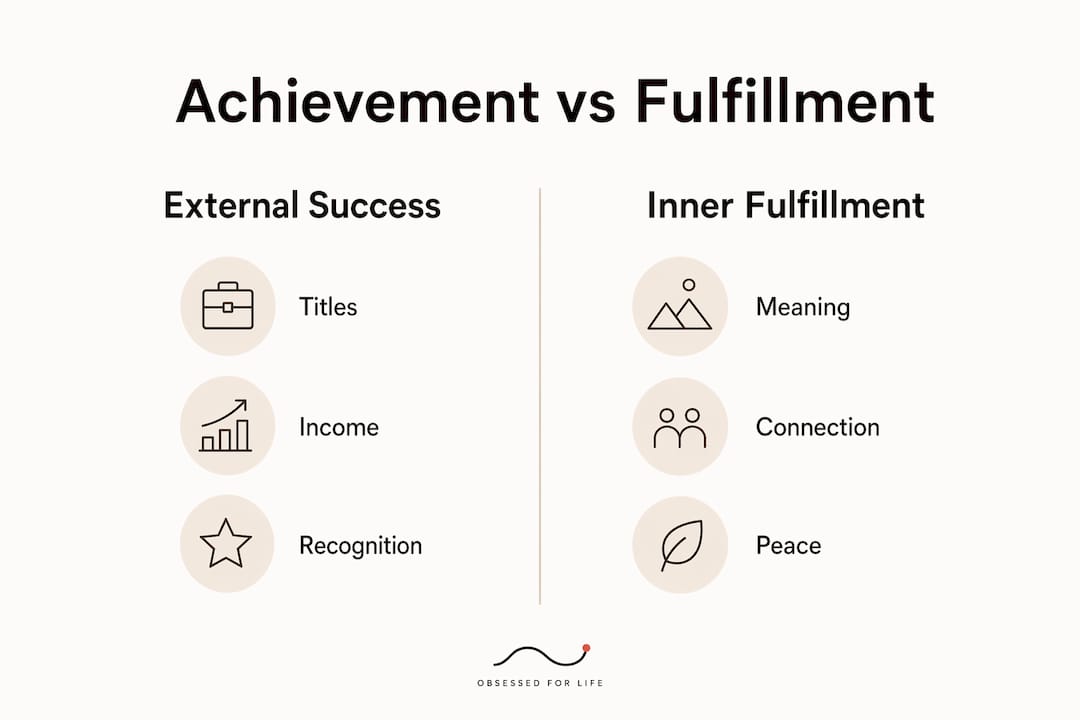
The gap between outer success and inner experience also shows up in relationships. Women describe feeling emotionally flat with people they love, present in body but absent in feeling. Therapy that engages meaning and identity beneath the surface, rather than just managing symptoms, creates the most durable change.
Is overachieving actually a trauma response?
Chronic overachievement functions as a high-functioning trauma response. The nervous system learns early that constant output keeps anxiety at bay. Producing, achieving, and staying busy become the regulation strategy, the way the body manages feelings it was never taught to process.
This pattern often begins in childhood. Conditional love, emotional neglect, or households where worth was tied to performance teach children that stillness is unsafe. The child who learned to earn approval through excellence becomes the adult who cannot stop. She is not ambitious in the way people assume. She is, in many cases, afraid.
The physical signs are telling. When you try to rest, a tight chest arrives. The mind races. An unnamed dread settles in. Overachievers experience paradoxical panic during stillness because their nervous systems interpret quiet as threat, compelling compulsive productivity. That restlessness is not laziness or lack of discipline. It is a nervous system doing exactly what it was trained to do.
Achievement also functions as emotional armor. Achievement can act as armor rather than genuine desire, masking a fear of worthlessness that drives continuous striving despite inner emptiness. Rest alone does not heal this. The nervous system has learned to rely on the dopamine hit of productivity, so stopping without support often worsens distress rather than relieving it.
- Tight chest or racing mind when you stop: Your nervous system is signaling perceived threat, not actual danger.
- Feeling guilty during rest: Guilt is a conditioned response, not evidence that rest is wrong.
- Emotional flatness despite success: This is disconnection, not ingratitude.
- Compulsive planning or list-making in quiet moments: The mind filling silence to avoid feeling.
- Physical exhaustion that sleep doesn't fix: Chronic nervous system activation depletes the body even when hours of rest are present.
Pro Tip: When stillness triggers anxiety, place one hand on your chest and breathe slowly for 60 seconds before reaching for your phone or task list. This simple somatic cue begins to retrain the nervous system's response to quiet.
How does the attention economy make inner life harder to reach?
The modern attention economy compounds what trauma began. Algorithms are designed to fragment attention, and fragmented attention cannot sustain the depth of reflection that inner life requires. Every notification, every scroll, every curated feed pulls you further from the quiet where self-knowledge lives.
Societal values reinforce this. Productivity is celebrated. Stillness is misread as laziness. Youth and external markers of success receive the most cultural applause, while the inner work of midlife, the kind that asks harder questions, receives almost none. The attention economy fragments focus using algorithms, reducing the capacity for interiority required to discover your authentic self.
The ego also plays a role. The ego functions as a protective false self, distancing you from your true essence and making inner work feel threatening. Cultural distractions give that false self endless places to hide. The result is a woman who is highly competent, constantly connected, and quietly lost.
Reclaiming interiority requires deliberate practice. These four approaches create the conditions for inner life to surface:
- Read physical books without a screen nearby. Sustained reading rebuilds the attention span that algorithms erode.
- Write by hand for ten minutes each morning. Handwriting slows the mind enough to hear what it actually thinks.
- Spend ten minutes outside without your phone. Sensory presence without digital input is a direct path to self-awareness.
- Practice one meal without multitasking. Eating in silence or simple conversation reintroduces you to your own rhythm.
Pro Tip: Treat one hour of screen-free time each evening as a non-negotiable appointment. Write it into your calendar the way you would a meeting. Your inner life deserves the same protected space.
How do you reconnect with your inner life without abandoning ambition?
Reconnecting with your inner life does not mean giving up your drive. It means learning the difference between survival-driven achievement and authentic ambition. Survival-driven achievement asks, "What do I need to do to be safe, loved, or worthy?" Authentic ambition asks, "What do I genuinely want to create or experience?" The first is fear. The second is freedom.
Transitioning from fear-based achievement to authentic ambition involves integrating rest and joy alongside goals, not replacing goals with rest. This is a crucial distinction. You are not being asked to stop achieving. You are being asked to achieve from a different place inside yourself.
Practical steps that support this shift:
- Seek trauma-informed therapy or somatic coaching. These approaches address the nervous system patterns beneath the behavior, not just the behavior itself.
- Practice emotional literacy daily. Name what you feel three times a day, morning, midday, and evening. Naming emotion builds the inner toolkit that achievement never required.
- Set one boundary each week that protects your time. Boundaries are not walls. They are the structure that makes inner life possible.
- Redefine what success means to you now. Write a personal definition that includes joy, connection, and ease alongside accomplishment.
- Allow yourself one unscheduled hour each week. Not rest as reward. Rest as nervous system regulation, which is a function, not a luxury.
Life beyond professional goals looks different for every woman, but it always involves turning toward what you actually feel, not just what you have accomplished. The women who make this shift describe it not as loss but as arrival. They were always heading here. They just needed permission to stop and look.
Authentic living after 40 is not a retreat from the world. It is a return to yourself within it. That return is available to you, and it begins with the willingness to sit with what you find when the doing stops.
Key Takeaways
Neglecting the inner life is not a personal failure. It is a conditioned pattern that can be recognized, understood, and gently reversed.
| Point | Details |
|---|---|
| Achievement masks inner emptiness | External success built on societal expectations creates a gap that midlife makes impossible to ignore. |
| Overachieving is often trauma-driven | Constant productivity regulates a nervous system conditioned to treat stillness as threat. |
| The attention economy deepens the gap | Algorithmic distraction erodes the sustained attention that inner life and self-reflection require. |
| Rest is a function, not a reward | Healing requires treating rest as nervous system regulation, not something earned through output. |
| Authentic ambition replaces fear-driven striving | Shifting from survival-based achievement to values-based goals is the path to lasting fulfillment. |
What I've learned from watching women arrive at this question
I have watched women in their 40s, 50s, and 60s describe the same moment with almost identical words. "I did everything I was supposed to do. I don't know who I am." What strikes me every time is not the sadness in that statement. It is the courage. Saying it out loud is the first act of inner life they have allowed themselves in years.
What our culture does not say clearly enough is that overachievement is often celebrated in women precisely because it is so useful to everyone around them. The woman who never stops, never complains, and always delivers is rewarded at work, praised at home, and admired in her community. Nobody asks what it costs her. She rarely asks either.
The discomfort that arrives when you slow down is not a sign that something is wrong. It is the feeling of a nervous system learning a new language. That discomfort is growth, not danger. The women I have seen do this work do not become less ambitious. They become more themselves. And that, in my experience, is the most powerful thing a woman can be.
Community matters enormously here. Healing from decades of conditioned overachievement is not a solo project. Finding other women who are asking the same questions, who understand the particular exhaustion of having excelled at everything except knowing themselves, changes the pace and the depth of the work. You do not have to figure this out alone.
— Theresa Stairs
What Obsessedforlife offers women ready to look inward
If any part of this article felt like a mirror, you are not alone, and you are not starting from scratch.

Obsessedforlife is a self-discovery platform built specifically for women 40 and beyond who have spent years showing up for everyone else. The Obsession Map, an original guided assessment, helps you identify what brings you genuine joy in this season, what values actually drive you, and what experiences belong to this chapter of your life. It is not a productivity tool. It is an invitation to find your joy after 40 and follow where it leads. Whether you are 42 or 68, the question of what you truly want is not too late to ask. It is, in fact, exactly on time.
FAQ
Why do overachievers struggle with inner peace?
Overachievers struggle with inner peace because their nervous systems are conditioned to treat stillness as threat. Constant productivity becomes a regulation strategy that crowds out the reflection inner peace requires.
What causes overachiever burnout?
Overachiever burnout is caused by the gap between fear-driven striving and authentic desire. When achievement is armor rather than genuine motivation, the nervous system depletes without the emotional replenishment that meaning and rest provide.
Is neglecting emotional well-being common among high-achieving women?
Neglecting emotional well-being is a recognized pattern among high-achieving women, particularly at midlife, when external accomplishments no longer provide the fulfillment they once did. Depth-oriented therapy and self-exploration are the most effective paths forward.
How does midlife change the relationship with achievement?
Midlife is a developmental transition where the external scorecard loses its power. Women in their 40s and beyond often confront the gap between what they have accomplished and what they have actually felt, making it a natural window for midlife self-discovery.
Can you be ambitious and still have a rich inner life?
Authentic ambition and a rich inner life are fully compatible. The shift required is from fear-driven achievement to values-based goals, integrating rest, emotional awareness, and joy alongside accomplishment rather than treating them as opposites.