

Authentic living is defined as the consistent alignment of your daily choices and behaviors with your core values and true self, rather than with external expectations or inherited roles. Psychologists call this congruence between self-concept and lived experience, and they identify it as a cornerstone of mental health. Carl Rogers built his entire therapeutic framework around this idea. Self-Determination Theory, developed by Edward Deci and Richard Ryan, places autonomy and purpose at the center of human well-being. When your life reflects who you are, rather than who you were told to be, research shows that life satisfaction, self-esteem, and purpose all rise.
What does authentic living mean according to psychology and philosophy?
Authentic living, in psychological terms, means that your outer life matches your inner world. When those two are out of sync, the result is not just vague dissatisfaction. Misalignment causes defensiveness and a persistent sense that something is off, even when everything looks fine from the outside. Rogers called this gap “incongruence,” and he believed it was the root of most psychological suffering.
Self-Determination Theory adds another layer. It identifies autonomy, competence, and relatedness as the three core psychological needs. When you live by someone else’s script, autonomy collapses. The result is a life that functions but does not feel like yours.

Philosophy offers a sharper edge. Martin Heidegger argued that most people live in what he called “das Man,” the anonymous “they-self,” drifting through life according to social norms without ever truly owning their choices. Authentic existence, for Heidegger, means confronting your own mortality and the reality of your situation, and then choosing deliberately anyway. It is uncomfortable work. That discomfort is the point.
One distinction worth holding onto: authenticity is not the same as honesty. Authenticity differs from honesty in a specific way. Honesty is about external truthfulness. Authenticity is about internal alignment. You can be scrupulously honest and still be living someone else’s life. Conversely, a small act of social kindness, telling a friend her haircut looks great when you are indifferent, can be a fully authentic expression of your core value of compassion.
Authenticity is less about finding a hidden self and more about reclaiming parts of yourself that were suppressed by societal or familial expectations.” — Psychologies
Pro Tip: When you feel a flicker of resentment or quiet dread about a commitment, treat it as data. That feeling is often the first signal that your behavior has drifted from your values.
One more thing to release: the idea that inauthenticity is a failure. Psychologists confirm that oscillating between authentic and inauthentic states is the normal human condition, not a sign that you are doing it wrong. Stress, grief, and social pressure all pull us toward the default. Recognizing that pull, and gently returning to yourself, is the actual practice.
Why authentic living matters especially after 40
Midlife is not a crisis. It is an invitation. Midlife offers an optimal opportunity to shift from external achievement goals toward values-centered, emotionally meaningful living. That shift does not happen automatically. It requires you to look honestly at the roles you have been playing and ask which ones you chose.
Many women at this stage feel stuck inside identities like “caregiver,” “superwoman,” or “the responsible one.” These roles feel authentic because they have been worn so long. But many of these identities are survival adaptations, not expressions of the true self. They were built to manage difficult circumstances, not to reflect genuine values. Recognizing that distinction is both liberating and, at first, disorienting.
Societal pressure compounds the challenge. Women over 40 often carry a dense layer of “shoulds” accumulated from family, culture, and decades of performing competence for others. Peeling those back requires a specific kind of courage. It also requires a life outside the caretaking role to even become visible as a possibility.
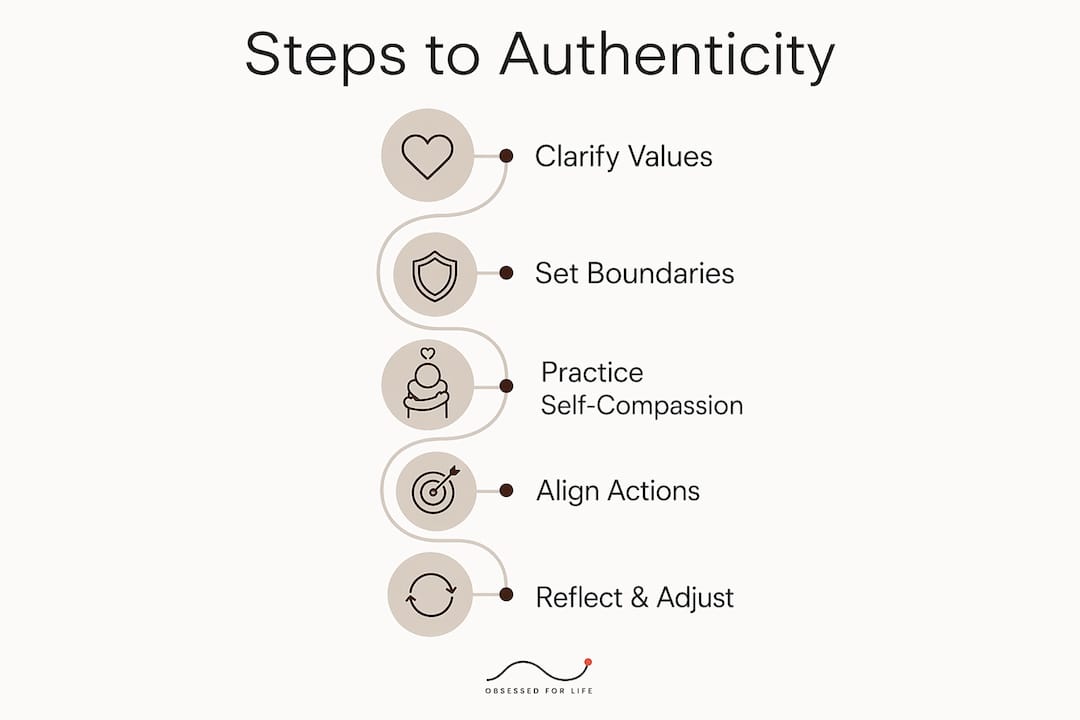
Research points to three evidence-based steps for women navigating this transition:
-
Self-compassion. Self-compassion is vital for overcoming the shame and anxiety that surface when you begin disentangling from inherited standards. Without it, the process feels like self-criticism rather than self-discovery.
-
Values clarification. Identifying what you care about, separate from what you were taught to care about, gives you a compass. Without that compass, change feels random.
-
Boundary-setting. Healthy boundaries increase self-esteem and reduce stress. They are also the most concrete way to practice authenticity in daily life.
Pro Tip: Set new goals after 40 that reflect your current values, not the ambitions you had in your twenties. The season has changed. Your goals can too.
What practical steps help you align with your authentic self?
The path toward authentic living is not a single revelation. It is a series of small, deliberate choices made over time. Here is where to begin.
-
Conduct a narrative review. Write out the major chapters of your life and the roles you played in each. Ask yourself: which of these did I choose, and which were assigned to me? A narrative review of your life story is one of the most effective tools for separating your authentic self from the adaptations you built around it.
-
Do a values clarification exercise. List ten things you genuinely care about, then cut the list to five. The cutting is the exercise. What you cannot let go of is your actual value system.
-
Practice saying no in low-stakes situations. Setting boundaries in low-stakes situations builds the confidence needed for larger life changes. Start with small refusals and notice how your body responds.
-
Journal as a dialogue with yourself. Not a record of events, but a conversation. Ask yourself: “What did I want today that I did not allow myself to have?” Then answer honestly.
-
Seek professional support when trauma is a barrier. Therapeutic interventions like EMDR can help process the experiences that made inauthenticity feel necessary in the first place. The journey requires safe environments and genuine determination. A skilled therapist provides both.
| Practice | What it builds |
|---|---|
| Narrative review | Clarity about which roles were chosen versus assigned |
| Values clarification | A personal compass for decision-making |
| Boundary practice | Self-esteem and reduced anxiety over time |
| Reflective journaling | Ongoing dialogue between your current and emerging self |
| Therapeutic support | Safe processing of trauma that blocks authentic expression |
A life audit is another structured way to assess where your time, energy, and attention are going versus where you want them to go. Think of it as a financial audit, but for your life.
How does authentic living impact well-being, relationships, and purpose?
The benefits of authentic living are not abstract. Authentic individuals experience greater vitality, purpose, and resilience, along with measurably reduced depression and anxiety. That is not a small return on investment.
Relationships shift too, and in ways that feel both better and more demanding. When you stop performing a version of yourself designed to manage others’ expectations, some relationships deepen significantly. Others reveal themselves as built entirely on that performance. That second category is painful to recognize. It is also clarifying.
Purpose becomes more accessible when you are living authentically. Career alignment, creative pursuits, and community involvement all feel more natural when they grow from genuine values rather than obligation. The career clarity that comes from values-based decision-making is one of the most practical benefits of this work, especially for women considering pivots or second chapters after 40.
The fears are real too. Many women worry that living authentically means disappointing people, losing relationships, or appearing selfish. Those fears deserve acknowledgment, not dismissal. Research consistently shows that the discomfort of transition is temporary. The cost of continued inauthenticity, measured in chronic stress, resentment, and a quiet sense of wasted time, compounds over years.
Living intentionally and living authentically are closely related. Both require you to make choices from the inside out rather than the outside in. The difference is that authenticity is the foundation. Intentionality is what you build on top of it.
Key takeaways
Authentic living is a practice of returning to your values, not a permanent state you achieve once and maintain effortlessly.
| Point | Details |
|---|---|
| Core definition | Authentic living means aligning daily behavior with core values, not external expectations. |
| Normal oscillation | Drifting into inauthenticity under stress is normal; the practice is in returning, not in never leaving. |
| Midlife as opportunity | Women 40+ are uniquely positioned to shift from inherited roles toward values-centered living. |
| Three starting steps | Self-compassion, values clarification, and boundary setting are evidence-based entry points. |
| Measurable benefits | Authentic living correlates with higher vitality, reduced anxiety, deeper relationships, and a stronger sense of purpose. |
What I have learned about authenticity that no one tells you
By Theresa Stairs
The version of authenticity sold in popular culture is a little too clean. Find yourself, be yourself, live your truth. It sounds like a single afternoon of journaling followed by a permanent glow. That is not what the research shows, and it is not what I have seen in practice.
What happens is messier and more interesting. You catch yourself performing. You feel the gap between what you said yes to and what you wanted. You notice the resentment that follows. And then, if you are paying attention, you use that information. That is the practice. Not the arrival. The noticing and returning.
The women I find most inspiring in this work are not the ones who have it figured out. They are the ones who have stopped pretending that the life they built in their thirties still fits in their fifties. That kind of honesty takes more courage than most people realize. It also requires self-compassion as a daily practice, not a concept.
One thing I wish more women knew: authenticity is not about becoming someone new. It is about reclaiming parts of yourself that got quiet under the weight of responsibility, expectation, and survival. Those parts did not disappear. They are waiting. And this season of life, with all its disruption and possibility, is exactly the right time to go looking.
— Theresa Stairs
Ready to find what lights you up?
If this article has stirred something in you, that stirring is worth following. Obsessedforlife exists for exactly this moment: when the question “what do I want?” finally feels urgent enough to answer.
The Obsession Map is Obsessedforlife’s original guided assessment, designed to help women 40 and beyond identify what brings them genuine joy in this season, clarify the values driving their choices, and see a picture of the life that is waiting for them. It is not a quiz. It is a conversation with yourself, held in a thoughtfully designed space. If you are ready to stop guessing and start listening to what you want, begin here.
FAQ
What is the simplest definition of authentic living?
Authentic living means consistently choosing behaviors that align with your core values rather than conforming to external expectations or inherited roles. Psychologists describe this alignment as congruence, and it is strongly linked to life satisfaction and well-being.
Is authentic living the same as always being honest?
No. Authenticity is about internal alignment between your values and actions, while honesty refers to external truthfulness. You can be honest but still live inauthentically, and small acts of social kindness can be fully authentic expressions of values like compassion.
Why is midlife a good time to pursue authentic living?
Midlife offers a natural inflection point at which external achievements are often reached, and the deeper question of personal meaning becomes harder to ignore. Research confirms that this life stage is optimal for shifting from goal-driven living to values-centered, emotionally meaningful choices.
How do I start living more authentically?
The three evidence-based starting points are self-compassion, values clarification, and boundary-setting. Begin by identifying what you genuinely care about, then practice small refusals in low-stakes situations to build the confidence needed for larger changes.
Can authentic living improve mental health?
Yes. Research links authentic living to measurably reduced depression and anxiety, along with greater vitality, resilience, and sense of purpose. The key mechanism is reducing the chronic stress that comes from sustained misalignment between your values and your daily life.