

You don't need to wait until everything feels perfectly aligned. The clearest truth about pursuing bucket list dreams as a senior is this: the best time to begin is now, with whatever you have, wherever you are.
Retirement opens a calendar that finally belongs to you. That's not a small thing. It's an invitation most people spend decades waiting for, and then hesitate to accept. The hesitation is understandable. But goal-setting research by Locke & Latham shows that specific, written goals are directly linked to higher motivation, self-esteem, and a sense of personal control. Vague wishes stay wishes. Named goals become plans.
Here's what starting today actually looks like:
- Write down three experiences you've thought about for years but never scheduled
- Choose one that excites you most and ask: What is the single next step?
- Tell one person about it this week, someone who will ask you about it later
- Put a date on your calendar, even a tentative one, before you close this page
- Accept that seasonal timing and physical energy matter, so front-load the more demanding adventures while your body is willing
Pro Tip: Say yes before you feel fully ready. Readiness is overrated — confidence arrives after the doing, not before it.
Table of Contents
- How do you create a bucket list that you'll actually complete?
- What mindset shifts help you move from "someday" to actually going?
- Budgeting and timing strategies that make adventures actually happen
- How Obsessedforlife and the Obsession Map deepen your sense of purpose
- Key Takeaways
How do you create a bucket list that you'll actually complete?
Start with a brainstorm, not a plan. Give yourself an hour with no filter and write down every experience that surfaces: places, skills, relationships, creative projects, physical challenges, quiet pleasures. Aim for 10–20 items across different categories. A focused list prevents overwhelm and raises your completion rate far more than an endless scroll of ideas.
Once you have your raw list, score each item across three factors: physical demand (how much stamina or mobility does it require?), seasonal timing (is there a window when this works best?), and budget tier (what will it realistically cost?). Adventures that require physical fitness belong near the top of your timeline, not the bottom. A hike through a national park is better planned for this year than in five years.
Writing your goals down converts a wish into a commitment. Only a fraction of retirees have a written bucket list, yet written goals produce dramatically higher completion rates. Share your list with a family member or close friend. Accountability doubles follow-through.
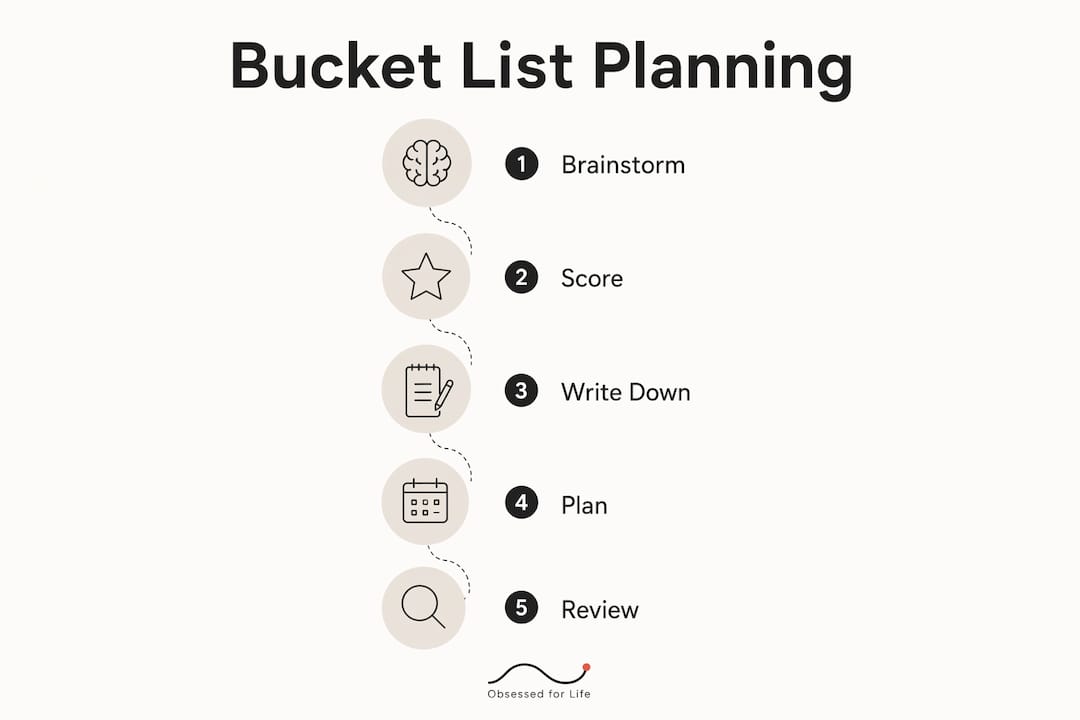
Use a budgeting app like EveryDollar or Mint to assign a rough cost to each item and track progress. Knowing a river cruise costs $4,000 makes it plannable. Not knowing keeps it abstract.
| Bucket List Item | Physical Demand | Budget Tier | Best Season | Timeframe |
|---|---|---|---|---|
| Local botanical garden day trip | — | Low (under $100) | Spring | This month |
| Domestic train journey | — | Medium (hundreds) | Fall | This quarter |
| National park hiking trip | — | Medium | Summer | This year |
| International river cruise | 4 | High ($—,000–$—,000) | Spring/Fall | Within — years |
| Safari or wildlife expedition | — | High ($—,000+) | Dry season | Within — years |
- Organize items by timeframe: this month, this quarter, this year, within five years
- Review and update your list every quarter, replacing completed goals with new ones
- Celebrate each completed item, no matter how small it seems
What mindset shifts help you move from "someday" to actually going?
The "someday" trap is seductive because it feels responsible. You're not saying no. You're just saying not yet. But "not yet" has a way of becoming never, quietly and without announcement. The shift that breaks the pattern is a single question: What would it take to start planning now?

That question does something specific. It moves you from passive dreaming to active problem-solving. Suddenly the obstacle isn't your age or your health or your readiness. It's a logistics question with a real answer.
Physical hesitation is one of the most common barriers, and one of the most honest. Your body has changed. That's true. But physical readiness is often overestimated as a prerequisite. Seniors who travel full-time in their 70s describe accepting some discomfort and building in recovery days as the actual strategy, not a workaround. One traveler writing at sixty-nine put it plainly: it hurts, and it's worth it.
Flexibility matters as much as ambition. Your interests will shift. Your health may change. A bucket list that becomes a rigid obligation stops being a source of joy and starts feeling like pressure. Build in permission to adapt without guilt.
Pro Tip: Take baby steps to build real confidence. Book a short domestic flight before planning international travel. Sign up for one class before committing to a full program. Each small yes makes the next one easier.
Budgeting and timing strategies that make adventures actually happen
The single most practical move you can make is creating a dedicated bucket list fund, separate from your everyday retirement income. This one decision transforms vague dreams into budgeted plans with real timelines. When the money has a name and a purpose, spending it feels intentional rather than indulgent.
Timing your adventures by physical demand is equally important. Front-load the experiences that require stamina, mobility, or altitude. A trek, a long-haul flight, or an active safari belongs earlier in your retirement years, not later. Local and low-demand experiences can fill any season and any year.
| Goal Type | Timeframe | Budget Allocation | Examples |
|---|---|---|---|
| Quick wins and local adventures | This month | 20–30% of annual bucket list budget | Day trips, cultural events, free experiences |
| Regional travel and new skills | This year | Around 40% | Domestic flights, workshops, group tours |
| Big dreams and legacy experiences | Within — years | 30–Around 40% | International travel, major creative projects |
A few practical principles for keeping plans on track:
- Build recovery days into every physically demanding trip, not as a luxury but as a requirement
- Use seasonal timing to reduce costs: shoulder seasons (May, September, October) offer lower prices and smaller crowds at most destinations
- When life changes unexpectedly, shift the goal forward rather than dropping it entirely
- Pack light when traveling. One experienced traveler at 75 fits everything into a 27-pound backpack, which keeps mobility high and logistics simple without specifying the exact weight
- Review your budget quarterly alongside your list, adjusting allocations as goals evolve
How Obsessedforlife and the Obsession Map deepen your sense of purpose
Knowing what you want to do is only part of the picture. Knowing why it matters to you is what sustains the momentum when life gets complicated. That's where Obsessedforlife's Obsession Map comes in. It's a guided assessment designed to surface your core joys, values, and the experiences that genuinely light you up in this season of life. Not what you think you should want. What actually resonates with who you are right now.
Theresa Stairs and the Obsessedforlife platform exist specifically for women who have spent years showing up for everyone else and are now ready to ask a different question: What do I want? That question, taken seriously, changes everything about how you approach a bucket list. It stops being a checklist and becomes a meaningful life redesign.
Documenting your experiences keeps the joy alive long after the adventure ends. Some ways to do that well:
- Keep a dedicated bucket list journal, writing a few honest lines after each experience
- Take photographs with intention, not just for social media but for your own memory
- Share stories with friends, family, or an online community. Social connection through shared goals boosts motivation and longevity
- Schedule a monthly check-in with yourself: What did I do? What's next? What still excites me?
- Join a group, a travel club, a class cohort, or an online forum, where others are actively pursuing their own goals
Regular review and adjustment of your goals keeps the list alive and authentic. A bucket list that grows with you is one you'll actually return to. The goal isn't to finish the list. It's to keep the sense of possibility open, and to live fully in later years with intention and genuine joy.

The Obsession Map at Obsessedforlife is where that clarity begins. If you're ready to stop wondering what this chapter is for and start building it with purpose, this is the place to start.
Key Takeaways
Pursuing bucket list dreams as a senior works best when specific goals replace vague wishes, adventures are sequenced by physical demand and budget, and joy remains the compass throughout.
| Point | Details |
|---|---|
| Write goals down immediately | Written goals convert wishes into commitments and produce dramatically higher completion rates. |
| Front-load physical adventures | Schedule demanding activities earlier in retirement while stamina and mobility support them. |
| Create a dedicated fund | A separate bucket list fund turns abstract dreams into budgeted plans with real timelines. |
| Say yes before feeling ready | Confidence follows action, not the other way around. Book the trip, then prepare. |
| Review and adapt quarterly | A bucket list that grows with your changing interests stays a source of joy, not obligation. |