

Life review therapy is defined as a structured, guided process that helps older adults integrate both positive and negative life experiences, including regrets, to find meaning, acceptance, and peace. Unlike casual storytelling or nostalgia, it is a clinically recognized intervention with measurable effects on mental health. The role of life review in senior wellness extends well beyond symptom relief. It touches identity, legacy, and the quiet but urgent question so many women in their later years are finally ready to ask: What has my life meant, and what do I still want from it?
What are the mental health benefits of life review therapy for seniors?
Life review therapy produces measurable, research-backed improvements in mental health for older adults, particularly those experiencing depression and anxiety. A 2026 narrative review published in Neuropsychopharmacology confirmed that life review therapy is more beneficial than simple reminiscence for depressed older adults. That distinction matters enormously. It means the structured process of revisiting difficult memories, not just the pleasant ones, is what drives healing.
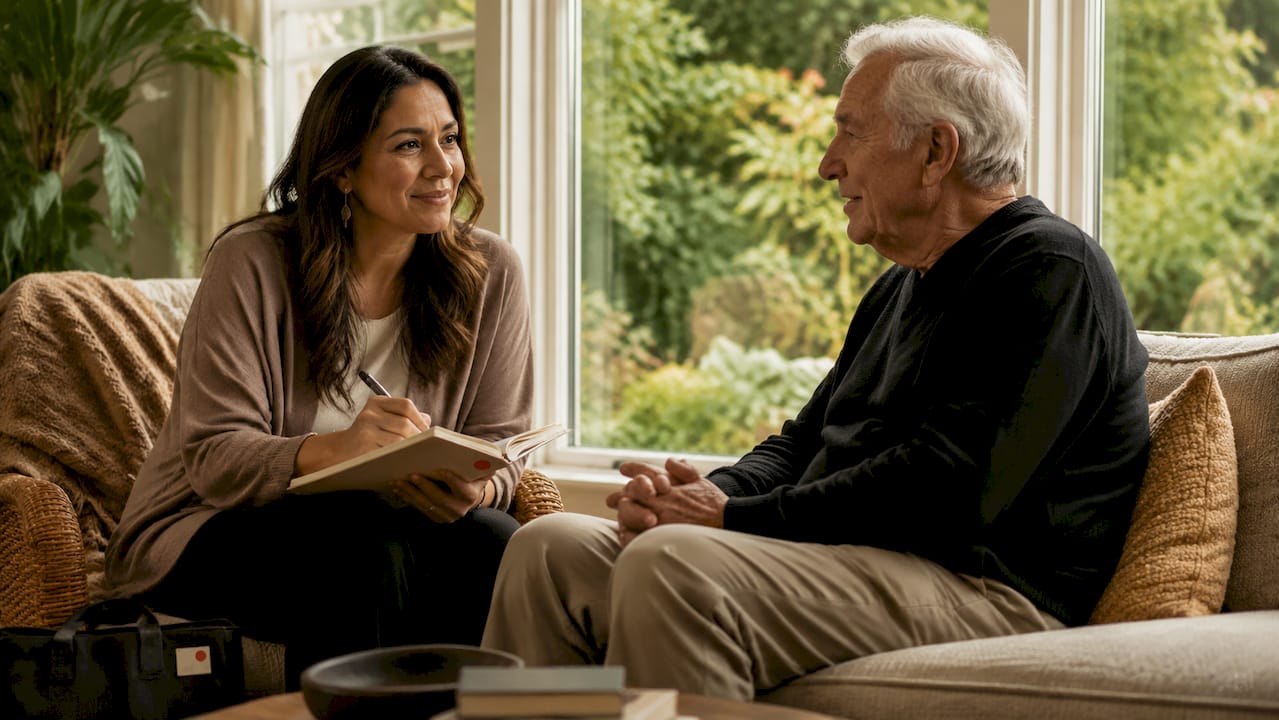
A meta-analysis of 195 randomized controlled trials found that life review therapy produces stronger effects on depressive symptom reduction and well-being improvement than simpler reminiscence approaches. That is a large evidence base, and it points to one clear conclusion: depth of reflection, not just frequency, is what creates change.
The core benefits include:
- Reduced depressive symptoms and anxiety, particularly in adults 65 and older who carry unresolved grief or regret
- Improved life satisfaction, as seniors move from a sense of despair toward what psychologist Erik Erikson called ego integrity, the acceptance of one's life as meaningful and complete
- Greater self-acceptance, including the ability to hold both pride and regret without being consumed by either
- Stronger sense of personal coherence, the feeling that your life story makes sense and belongs to you
"Life review therapy guides seniors from despair and regret to ego integrity, improving life satisfaction and self-acceptance." — Sailor Health, summarizing decades of psychological research
These outcomes are not abstract. When a woman in her late sixties finally processes a career she abandoned, a relationship she ended, or a dream she deferred, she is not just remembering. She is reorganizing her sense of self. That reorganization is the therapeutic work, and it has real consequences for how she feels, functions, and engages with the life still ahead of her.
How does life review therapy differ from reminiscence and other senior wellness techniques?
The difference between life review therapy and casual reminiscence is not just a matter of degree. It is a matter of purpose and clinical structure.
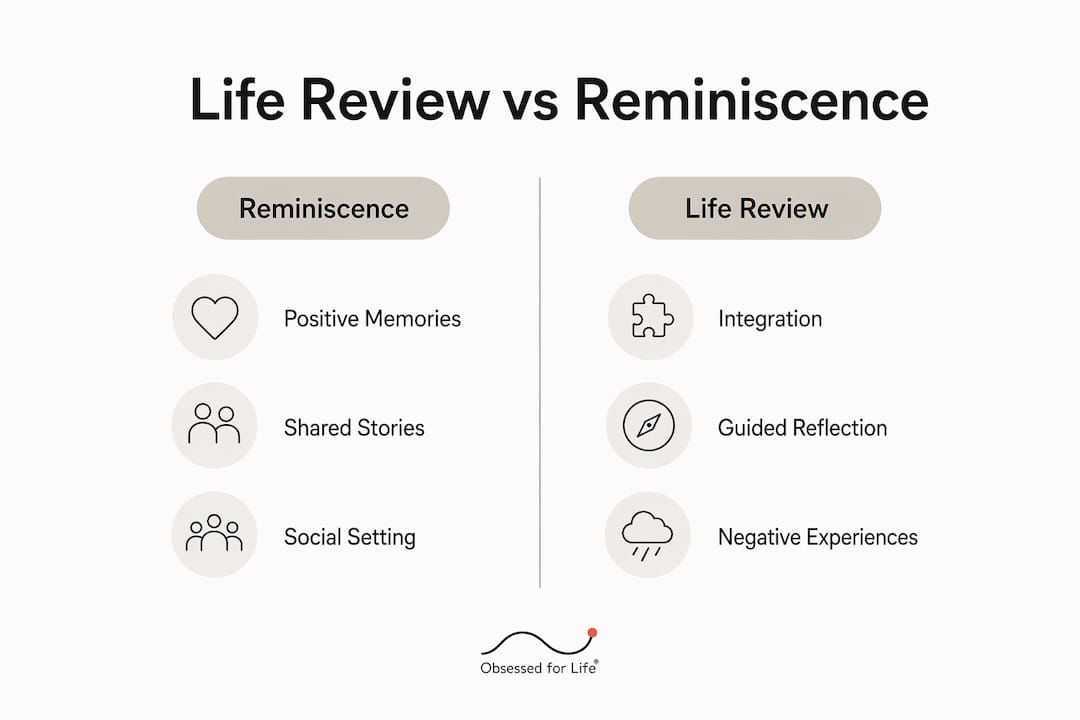
| Feature | Reminiscence | Life review therapy |
|---|---|---|
| Focus | Positive memories, shared stories | Integration of both positive and negative experiences |
| Setting | Social, informal (e.g., group conversations) | Clinical or structured therapeutic sessions |
| Goal | Enjoyment, social connection | Meaning-making, acceptance, symptom reduction |
| Facilitation | Minimal or peer-led | Trained therapist or skilled facilitator |
| Suitable for | General senior populations | Seniors with depression, anxiety, or end-of-life distress |
Life review therapy is guided reflection that deliberately integrates negative experiences and regrets, which is what separates it from casual reminiscence focused on positive memories. Reminiscence has its place. It builds social bonds and lifts mood in group settings. But for a senior carrying genuine psychological distress, it is not enough.
Life review therapy also complements other evidence-based approaches. Cognitive behavioral therapy (CBT) addresses distorted thinking patterns in the present. Acceptance and commitment therapy (ACT) builds psychological flexibility. Life review adds a third dimension: the past. Together, these approaches address the full arc of a person's psychological experience.
Pro Tip: If you are a caregiver supporting a loved one through this process, look for facilitators who have specific training in both gerontology and psychotherapy. The quality of facilitation shapes the outcome more than any workbook or question list.
What are practical life review applications in senior and end-of-life care?
Life review therapy takes several concrete forms in clinical and community settings. Each has a distinct structure, population, and set of goals.
-
Individual structured life review. A therapist guides a senior through a series of sessions, typically organized chronologically or thematically, covering childhood, adulthood, relationships, work, and loss. The therapist helps the client find meaning in difficult chapters rather than avoiding them.
-
Dignity Therapy. Developed for palliative care settings, Dignity Therapy uses a framework of nine questions to help patients near the end of life find meaning, reduce distress, and create a lasting document for loved ones. UCLA Health describes it as a form of grief psychotherapy that preserves the patient's sense of dignity and legacy. The questions invite reflection on what has mattered most, what the person is most proud of, and what they want remembered. The result is often a recorded or written narrative that becomes a gift to family.
-
VISION-AGE online group program. The VISION-AGE protocol delivers enriched life review therapy through weekly manual-guided online group sessions plus individual meetings for adults aged 68 and older with depression and anxiety. Published as a randomized controlled trial protocol in BMC Psychiatry in 2026, it represents the growing recognition that telehealth can deliver structured life review to seniors who cannot access in-person care. The program runs for 20 weekly sessions, ensuring consistent, evidence-based delivery across a meaningful timeframe.
-
Caregiver-supported home review. Family members and professional caregivers can support informal life review exercises, such as guided journaling, photo-based reflection, or structured conversation prompts, as long as they understand the emotional risks. Unstructured narration without skilled support can sometimes deepen distress rather than relieve it.
-
Group-based community programs. Senior centers and wellness communities increasingly offer facilitated life review groups. These blend the social benefits of reminiscence with the structured depth of therapeutic review, making them accessible entry points for seniors who are not yet ready for clinical intervention.
The facilitator's clinical skill is critical in all of these formats. Life review is not a passive exercise. It asks people to sit with difficult truths, and that requires a guide who knows when to press forward and when to pause.
Why is life review therapy vital for comprehensive senior wellness?
Senior wellness is not simply the absence of illness. Psychosocial factors like depressive symptoms, anxiety, loneliness, and self-efficacy explain more variance in quality of life for seniors than clinical measures alone. That finding, from a 2026 multicenter observational cohort study in BMC Geriatrics, reframes what good care actually looks like. Treating a physical condition while leaving loneliness and lost purpose unaddressed is incomplete care.
Life review directly targets these psychosocial factors. It builds self-efficacy by helping seniors recognize their own resilience across decades of challenge. It reduces loneliness by creating shared narrative in group formats. It addresses the kind of meaning and acceptance that no medication can provide.
| Psychosocial factor | How life review addresses it |
|---|---|
| Depressive symptoms | Structured integration of regret and loss reduces rumination |
| Loneliness | Group formats create shared narrative and connection |
| Self-efficacy | Recognizing past resilience builds confidence in present challenges |
| Meaning and purpose | Identifying life themes fosters a coherent, valued identity |
| Legacy and dignity | Dignity Therapy preserves a person's story for loved ones |
For women navigating the later chapters of life, this work is especially resonant. Many have spent decades prioritizing others. Life review offers something rare: a structured invitation to look at your own story with curiosity and care. It is not self-indulgence. It is senior life redesign at its most fundamental level.
Pro Tip: Life review does not require a therapist to begin. Start with a single question: "What is the chapter of my life I have never fully made peace with?" Write for ten minutes without editing. That is the first step.
Key takeaways
Life review therapy is the most evidence-supported structured approach for improving mental health, meaning, and quality of life in older adults, outperforming casual reminiscence across 195 randomized controlled trials.
| Point | Details |
|---|---|
| Life review vs. reminiscence | Life review integrates negative experiences and regrets; reminiscence focuses on positive memories only. |
| Mental health outcomes | Research across 195 RCTs confirms stronger effects on depression and well-being than simpler approaches. |
| Practical formats | Dignity Therapy, VISION-AGE, and individual structured sessions each serve different needs and settings. |
| Psychosocial impact | Life review addresses loneliness, self-efficacy, and meaning, factors that predict quality of life more than clinical measures alone. |
| Facilitation matters | Skilled facilitation is not optional. Unstructured life review can deepen distress without proper guidance. |
What I have learned from watching women do this work
By Theresa
Most people assume life review is something that happens naturally as you age. You get older, you look back, you make peace. That is not how it works. Left unstructured, looking back can become a loop of regret rather than a path toward acceptance. The difference between rumination and integration is not the memories themselves. It is the presence of a skilled guide and a clear framework.
What I have observed, both in research and in the women I encounter through Obsessedforlife, is that the most transformative life review does not begin with the big questions. It begins with permission. Permission to say: this chapter was hard, and I am allowed to name that. Permission to hold both pride and grief in the same hand without needing to resolve the tension immediately.
I also want to say something that most clinical articles skip over: life review is not only for people in crisis. It is for any woman who senses that her story deserves more attention than she has given it. The woman who built a vibrant life after 65 and still wonders what it all added up to. The woman who is healthy, curious, and ready to understand herself more fully. For her, life review is not therapy. It is an act of self-respect.
Caregivers: your role here is not to fix or redirect. It is to witness. Ask the question, then be quiet. The silence that follows is often where the real work begins.
— Theresa
Start your own reflection with Obsessedforlife

If this article has stirred something in you, that is not an accident. Obsessedforlife was built for exactly this moment. The Obsession Map is an original guided assessment that helps women 40 and beyond explore what brings them joy in this season, what values still drive them, and what experiences are waiting in the chapters ahead. It is not a clinical tool. It is something warmer: a mirror that reflects your own story back to you with clarity and care. If you are ready to stop deferring the question of what you want, begin here and let the reflection start.
FAQ
What is life review therapy?
Life review therapy is a structured, clinically guided process that helps older adults integrate both positive and negative life experiences, including regrets, to find meaning and acceptance. It is more effective than casual reminiscence for seniors experiencing depression, according to a 2026 Neuropsychopharmacology review.
How does life review therapy differ from reminiscence therapy?
Reminiscence therapy focuses on recalling positive memories in social settings, while life review therapy deliberately works through negative experiences and regrets in a structured clinical format. The goal of life review is psychological integration and symptom reduction, not just enjoyment or social connection.
What is Dignity Therapy and who is it for?
Dignity Therapy is a palliative care form of life review that uses nine guided questions to help patients near the end of life find meaning, reduce distress, and leave a lasting narrative for loved ones. UCLA Health describes it as a grief psychotherapy requiring skilled facilitation to manage emotional complexity safely.
Can caregivers support life review at home?
Caregivers can support informal life review through guided journaling or structured conversation prompts, but unstructured narration without skilled oversight can sometimes deepen distress. Starting with a single reflective question and monitoring emotional responses carefully is the safest approach.
How long does a structured life review program typically take?
Evidence-based programs like VISION-AGE run for 20 weekly sessions plus individual meetings, providing consistent delivery over approximately five months. Shorter formats exist, but programs with clear session frequency and follow-up assessments produce the most reliable outcomes.