

Senior identity beyond age is the purposeful reconstruction of self that moves past chronological labels to embrace ongoing growth, values, and self-chosen meaning. Gerontological research frames this as a natural and necessary process, not a crisis. The concept of elderhood, a distinct developmental stage beyond adulthood, gives this shift a name and a framework. For women 40 and older, understanding how age affects identity is the first step toward reclaiming it. The unease you feel when roles fall away is not a sign something is wrong. It is a signal that something new is ready to begin.
What is senior identity beyond age, and why does it matter?
Senior identity beyond age is defined as the active, self-chosen process of building a coherent sense of self that is not dependent on job titles, parenting roles, or chronological age. Psychologists identify three layers of identity that shift simultaneously in midlife and beyond: the achievement self, the relational self, and the body and time self. When all three shift at once, the disorientation feels enormous. That disorientation is not a breakdown. It is identity reshaping.
The importance of senior identity goes well beyond self-esteem. Self-image directly affects emotional and physical health in aging. A strong, self-defined identity reduces the risk of social isolation and depression. It also supports resilience during illness or physical change. Identity is not a luxury. It is a health resource.

Research confirms that identity work in your 50s and 60s is a process, not a problem to solve. The unease signals healthy self-reshaping, not failure. Naming that process is the first act of reclaiming it.
How does aging affect identity, and where do traditional labels fall short?
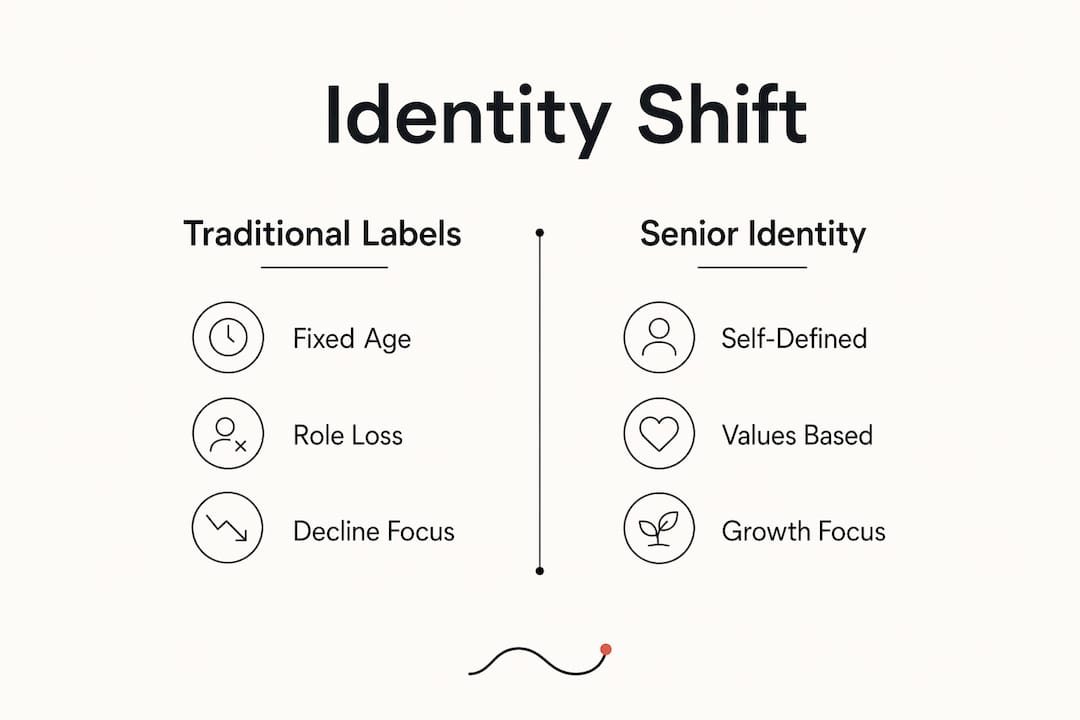
Traditional age labels create what researchers call an "identity gap." After 60, words like "retired," "senior," or "elder" become the dominant cultural vocabulary for who you are. The problem is that none of those words describe what you do, what you value, or what you are still becoming.
The three-layer identity model makes this concrete:
- Achievement identity is built from career titles, credentials, and professional accomplishments. Retirement removes this layer almost overnight.
- Relational identity is built from roles like mother, partner, or caregiver. As children grow and relationships shift, this layer thins.
- Body and time identity is shaped by how you experience your physical self and your sense of time. Aging changes both in ways that culture rarely frames positively.
When these three layers shift at the same time, the result is grief. Clients experience real grief over letting go of former selves. That grief is legitimate and worth honoring. The mistake is treating it as a permanent state rather than a passage.
Societal labels accelerate the damage. The word "senior" carries cultural weight that shrinks possibility rather than expanding it. The lack of cultural vocabulary for active later life contributes directly to identity loss and diminished self-perception. When language contracts, self-concept contracts with it.
What is elderhood, and how does it reframe later life?
Elderhood is defined as a distinct developmental life stage characterized by autonomy, dignity, and multidimensional growth. It is not a softer word for "old." It is a framework that positions later life as a period of active becoming rather than gradual decline.
The contrast with existing terms is meaningful:
| Term | What it implies | What it misses |
|---|---|---|
| Retirement | Withdrawal from active life | Ongoing contribution and growth |
| Senior | Age-based category | Values, purpose, and agency |
| Older adult | Neutral but passive | The active developmental work of this stage |
| Elderhood | Active growth and wisdom | Nothing. This is the fuller picture. |
Elderhood as a developmental stage is backed by research showing that strong identity in this phase reduces social isolation and depression risk. The framework matters because it gives women permission to see this chapter as generative, not terminal.
Ageism complicates this. Self-directed ageism discourages women from acknowledging aging at all, which paradoxically deepens negative identity perceptions. Rejecting ageist narratives is not denial. It is an act of accurate self-perception.
Pro Tip: Try replacing the word "retired" with a phrase that describes what you are moving toward, not what you have left. "I'm in a season of creative work" or "I'm building something new" are more accurate and more energizing.
How can women 40+ reshape identity beyond age and roles?
Identity reconstruction after major role transitions is not passive. It requires deliberate practice. Preparing for identity transition is most effective when started five to ten years before major role endings by cultivating new interests and social ties. That means the work is available to you right now, wherever you are in the process.
Here are seven practices that support intentional identity rebuilding:
- Write an identity paragraph without job titles. Describe your values, your skills, and what others seek from you. This exercise reveals which parts of your identity were outsourced to roles and now need direct articulation.
- Name what you are moving toward, not just what you are leaving. Grief over former roles is real. Naming a new direction gives grief somewhere to go.
- Build social connections outside former roles. New relationships formed around shared interests rather than shared workplaces reflect who you are becoming, not who you were.
- Shift from achievement-focused identity to contribution-focused identity. Ask not "what have I accomplished?" but "what am I still offering?"
- Experiment with self-defined language. Some women use terms like "Legacent" (a blend of legacy and ascent) to describe this phase. The specific word matters less than the act of choosing your own.
- Reconnect with interests that predate your career. What did you love before professional success became the organizing principle of your life? Those interests hold identity clues.
- Use reflection as a design tool rather than a backward glance. Reflection is most powerful when it informs what comes next.
Pro Tip: Set aside 20 minutes to write freely about what you would do if no one needed anything from you. Not what you should do. What you actually want. That answer is identity data.
Life beyond professional goals is not a void. It is a canvas. The women who navigate this transition most successfully treat it as a design project, not a loss.
How do cultural narratives shape the way women see themselves after 40?
Cultural narratives about aging are not neutral. They actively shape self-perception, often in ways women absorb without noticing. Ageism operates at the societal level through media, language, and institutional structures. It also operates internally, through the stories women tell themselves about what is still possible.
The most damaging narratives share a common structure:
- "You've had your time" frames later life as aftermath rather than chapter.
- "Act your age" polices ambition, curiosity, and reinvention.
- "You're too old to start over" treats identity as fixed rather than living.
- "Enjoy your retirement" assumes withdrawal is the goal.
Each of these narratives functions as an identity ceiling. Changing cultural narratives around elderhood counters stigma and opens real possibilities for ongoing growth and self-definition. The shift begins with noticing which narratives you have internalized and choosing different ones.
Digital platforms now serve as active arenas for older adults to reconstruct identity and seek social affirmation beyond traditional roles. Online communities, creative platforms, and self-expression tools give women concrete spaces to practice and share who they are becoming. Identity reconstruction increasingly involves digital engagement as part of psychological growth. That is not a trend. It is a resource.
Values-based living offers a direct counter to cultural age narratives. When your identity is anchored in what you value rather than what you have achieved or how old you are, external labels lose their grip.
Key Takeaways
Senior identity beyond age is built through intentional practice, self-defined language, and a shift from achievement-based to values-based self-definition.
| Point | Details |
|---|---|
| Identity shifts are normal | The three-layer identity model shows that achievement, relational, and body-self all shift in midlife. This is reshaping, not crisis. |
| Labels limit self-perception | Words like "retired" and "senior" shrink possibility. Choosing your own language is an act of identity reclamation. |
| Elderhood is a growth stage | Research frames elderhood as a distinct developmental phase marked by autonomy, dignity, and ongoing contribution. |
| Practical steps work | Writing a title-free identity paragraph and building new social ties are proven methods for rebuilding authentic self-definition. |
| Culture shapes identity quietly | Ageist narratives operate internally. Naming them is the first step toward choosing a different story. |
What I've learned about identity after 40 that most articles won't tell you
The conversation around identity in later life tends to focus on loss. Lost titles, lost roles, lost certainty. What gets far less attention is the grief that comes before the loss, the quiet erosion that happens when you are still in the role but already sensing it won't define you forever.
I've watched women in their 40s and 50s dismiss this feeling as ingratitude. They still have the career, the family, the structure. Why does something feel off? The answer is that identity work doesn't wait for the role to end. It begins the moment you start asking whether the role is the whole story.
The most common misperception I encounter is that rebuilding identity is something you do after the transition. It isn't. The women who move through this most gracefully are the ones who started cultivating new interests, new language, and new relationships while the old structure was still in place. They didn't wait for the floor to disappear before they built a new one.
The other thing worth saying plainly: this process takes longer than anyone tells you. A year is not enough. Two years is not unusual. Patience with the process is not passivity. It is the work itself. Uncertainty in this season is not a sign you are doing it wrong. It is a sign you are doing it honestly.
Community matters more than most identity frameworks acknowledge. You cannot think your way into a new self in isolation. You need people who see who you are becoming, not just who you were.
— Theresa Stairs
What Obsessedforlife offers women redefining who they are
Obsessedforlife was built for exactly this moment. The platform exists for women 40 and beyond who have spent years showing up for everyone else and are now ready to ask a different question: what do I want with my life?
The Obsession Map is an original guided assessment that helps women identify what brings them joy in this season, what values drive them, and what experiences belong to this chapter. It listens to who you are and reflects back a picture of what lights you up. Whether you are 42 or 68, the work of meaningful life pivots is available to you right now. Obsessedforlife is where that work begins.
FAQ
What does "senior identity beyond age" mean?
Senior identity beyond age is the active process of defining yourself through values, contributions, and self-chosen meaning rather than chronological age or former roles. It draws on the concept of elderhood as a distinct developmental stage marked by autonomy and ongoing growth.
Why do women feel lost after retirement or when children leave home?
The loss of major roles removes the achievement and relational layers of identity simultaneously. Research shows this triggers real grief over former selves, which is a normal part of identity reshaping rather than a permanent condition.
How does ageism affect self-perception in women over 40?
Ageism, including self-directed ageism, actively shrinks self-perception by framing later life as decline rather than development. Changing the language you use about this season is one of the most direct ways to counter its effects.
What is the fastest way to start rebuilding identity after a major role transition?
Writing a short paragraph about your values and skills without using any job titles or role labels is a research-backed starting point. This exercise clarifies which parts of your identity were outsourced to roles and need direct, personal articulation.
Does identity reconstruction get easier with time?
Identity work in the 50s and 60s is a process, not a single event. Research confirms the unease is a signal of healthy reshaping. Building new social connections and interests outside former roles accelerates the process meaningfully.