

Homemaker life redesign is the intentional redefinition of your home environment, routines, and self-concept to reflect who you truly are in midlife and beyond. It is not a productivity overhaul or a decluttering project. It is a deeper shift: moving from managing your home like a logistical puzzle to living in it as a sanctuary that fits the woman you are right now. For women 40 and older, especially empty nesters, this redesign is less about doing more and more about finally doing what matters. Frameworks like The Homemaker’s Path and practices like the 15-minute daily reset give that shift real structure.
What mindset shifts define homemaker life redesign?
The most significant barrier to redesigning your homemaker life is not your schedule. It is your mindset. Specifically, most women over 40 are stuck in what experts call Management Mode: treating the home as a project to be controlled rather than a place to be inhabited. Transitioning to Dwelling Mode reduces cognitive overload and allows the home to become a genuine sanctuary.

Women aged 42 and older who shift from productivity to presence report reduced sensory overload and greater peace at home. That finding matters because it names the real cost of staying in Management Mode: not just tiredness, but a kind of chronic low-grade stress that never fully lifts.
Three mindset shifts make the biggest difference:
-
Decouple self-worth from productivity. Your value as a person is not measured by how clean the kitchen is.
-
Resist the comparison trap. Many women feel they must earn permission to love their lives before they allow themselves to enjoy homemaking. Abandoning that comparison enables real contentment.
-
Take your thoughts captive. Replacing discouraging internal narratives with truthful, encouraging ones builds lasting confidence and a positive home environment.
A fourth shift is often overlooked: stepping away from the default project manager role. Resisting the urge to hover over every household task allows family members to share responsibility and reduces burnout significantly.
Pro Tip: When a negative thought about your home or your homemaking arises, pause and ask: “Is this true, or is this a habit?” Most of the time, it is just a habit.
How does the “You-Now Home” concept guide homemaker lifestyle changes?
Most women live in homes configured for a past version of themselves. The You-Now Home concept addresses this directly: your home should reflect your current needs, capacity, and life stage, not the one you had ten years ago.
The framework rests on three pillars.
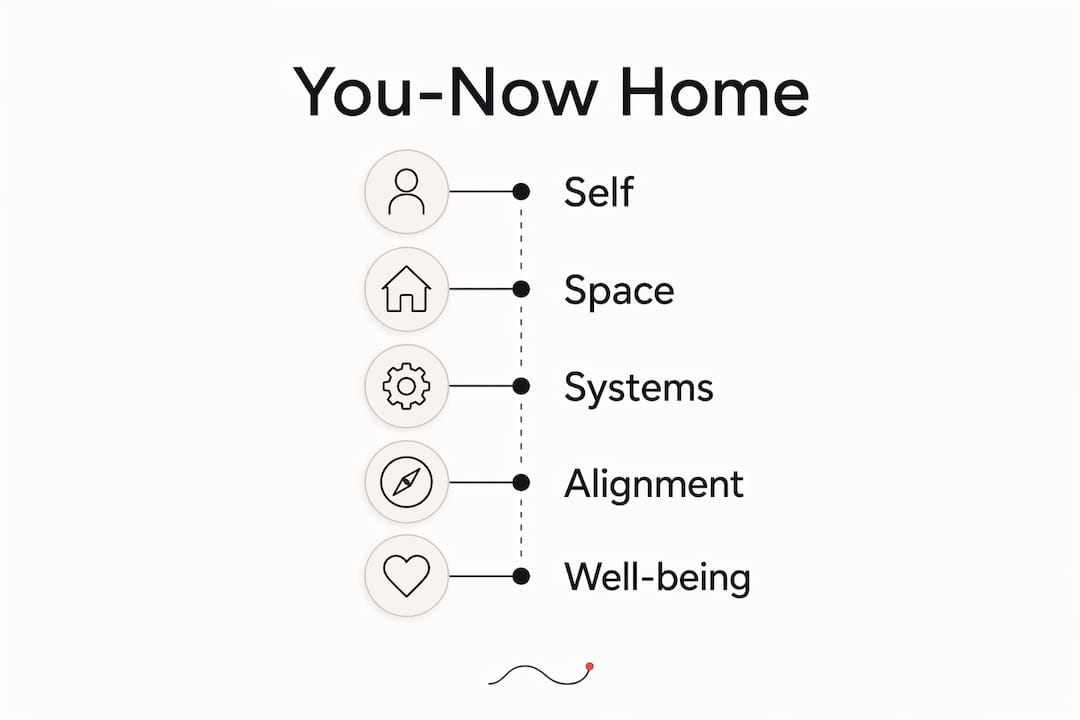
Self covers your current energy levels, physical needs, and emotional bandwidth. If you used to host large family dinners every week but no longer want to, your kitchen setup, your pantry stock, and your weekly rhythm should reflect that reality now.
Space covers the contents and layout of your home. A guest room that no longer hosts guests is an invitation to ask what that room could become for you. A living room arranged for children who have left home can be rearranged for the life you live.
Systems covers your daily routines and how the home runs. Systems built for a household of five do not serve a household of two. Updating them is not laziness. It is accurate.
| Traditional home setup | You-Now Home |
|---|---|
| Organized around past family needs | Organized around current life stage |
| Systems built for maximum capacity | Systems sized for present reality |
| Spaces defined by old roles | Spaces redesigned for current identity |
| Routines inherited from busier seasons | Routines chosen with intention |
Aligning your home with your current life improves daily function and emotional well-being. The You-Now Home is not a one-time project. It adapts as you do.
What practical routines support sustainable improvements in homemaker life?
Sustainable homemaking does not come from marathon cleaning sessions or rigid schedules. It comes from small, consistent actions that fit your actual life. The 15-minute daily reset focuses on tidying shared spaces and running one load of laundry. That single practice reduces mental load and prevents the physical burnout that comes from letting things pile up.
Slow homemaking builds on the same principle. Introducing five high-impact foundations gradually over several weeks allows your nervous system to adjust. Rushing the process creates the same overwhelm you were trying to leave behind.
Practical tips for building routines that last:
-
Anchor new habits to existing ones. If you already make coffee every morning, add a five-minute tidy to that same window.
-
Start with one room or one system. Trying to redesign everything at once is the fastest route back to burnout.
-
Invite family participation without hovering. Assign tasks clearly, then step back.
-
Treat disruptions as normal. A sick week, a holiday, a hard month: these do not erase your progress.
-
Measure success by rhythm, not perfection. Did you return to your baseline? That counts.
Pro Tip: Practice what researchers call “messy mindfulness.” When your routine falls apart, return to your baseline without self-judgment. Consistency over time matters far more than any single perfect day.
Habit stacking and anchored rhythms work because they reduce the number of decisions you make each day. Fewer decisions mean less fatigue. Less fatigue means more presence. More presence is the whole point of this redesign.
What is The Homemaker’s Path and how does it structure life redesign?
The Homemaker’s Path is a five-stage framework that moves women from chaos to calling in a sequential, flexible process. Each stage builds on the one before it, so skipping ahead tends to create gaps that surface later.
| Stage | Focus area | Expected outcome |
|---|---|---|
| Reset | Clearing mental and physical clutter | A calmer, more manageable starting point |
| Rhythm | Establishing daily and weekly routines | Predictable flow that reduces decision fatigue |
| Order | Organizing spaces and systems | A home that functions with less effort |
| Abundance | Cultivating gratitude and contentment | Deeper satisfaction with the home you have |
| Calling | Embracing homemaking as meaningful vocation | A sense of purpose rooted in daily life |
The framework includes specialty tracks and allows flexible pacing, which matters for women whose lives do not follow a straight line. An empty nester redesigning her home after children leave will move through these stages differently than a woman managing a chronic health condition. Both paths are valid.
What makes The Homemaker’s Path useful for life redesign at midlife is that it treats homemaking as a practice with depth, not a checklist with an end. The Calling stage, in particular, reframes the entire endeavor. When homemaking becomes a vocation rather than a burden, the daily work of it carries a different weight.
The framework also supports the mindset shifts described earlier. You cannot reach Abundance while still in Management Mode. The stages are designed to move you through the psychological work alongside the practical work.
Key Takeaways
Homemaker life redesign is a sustainable process of aligning your mindset, routines, and home environment with who you are right now, not who you used to be.
| Point | Details |
|---|---|
| Mindset precedes method | Shifting from Management Mode to Dwelling Mode is the foundation of every practical change. |
| The You-Now Home principle | Redesign your space, systems, and self-concept around your current life stage, not a past one. |
| Small routines compound | A 15-minute daily reset reduces mental load more reliably than occasional deep overhauls. |
| The Homemaker’s Path provides structure | Five sequential stages guide women from overwhelm to a sense of calling in their home life. |
| Messy mindfulness sustains progress | Returning to your baseline after disruption, without self-judgment, is the real skill to build. |
What I have learned from watching women redesign their home lives
By Theresa Stairs
The women I have seen struggle most with homemaker life redesign are not the ones with the messiest homes. They are the most competent. They have spent decades being excellent at what everyone else needed, and that competence has become a kind of trap. They know how to manage. They do not yet know how to dwell.
The comparison trap is real, and it is relentless. Social media offers an endless stream of homes that look like they were styled for a magazine, and it is easy to measure your Tuesday morning against someone else’s curated Sunday afternoon. The women who make the most lasting progress are the ones who find contentment internally rather than chasing an external standard that keeps moving.
What I find most encouraging is how little it takes to shift the feeling of a home. Not a renovation. Not a complete overhaul. A 15-minute reset done consistently. One room rearranged to serve the life you live. One habit dropped because it belonged to a season that has passed. These small acts of alignment add up to something that feels, over time, like freedom.
The You-Now Home concept gave me language for something I had observed but could not name: the quiet exhaustion of living in a home built for someone you no longer are. When you finally give yourself permission to update that home, to let it reflect your current reality, something loosens. That loosening is the beginning of the redesign.
Be patient with yourself. This is not a project with a deadline. It is a practice with a direction.
— Theresa Stairs
What Obsessedforlife offers women ready to go deeper
If this article has stirred something in you, that is worth paying attention to. The question of what you want your life to look like now, after years of showing up for everyone else, is one of the most meaningful questions a woman can ask.

Obsessedforlife is built for exactly this moment. Through the Obsession Map, an original guided assessment, you can explore what brings you joy in this season, what values drive you, and what experiences belong to this chapter of your life. It is a thoughtfully designed tool for women 40 and beyond who are ready to stop managing and start living. Whether you are 42 or 68, the path forward is yours to shape. Obsessedforlife is where that personal redesign begins.
FAQ
What is homemaker life redesign?
Homemaker life redesign is the intentional process of aligning your home environment, daily routines, and self-concept with who you are at your current life stage. It involves both mindset shifts and practical changes to create a home that supports your present needs.
How do I start redesigning my homemaker life?
Start with the mindset shift from Management Mode to Dwelling Mode, then apply the You-Now Home framework by evaluating your Self, Space, and Systems. Small consistent actions, like a 15-minute daily reset, build momentum without creating overwhelm.
What is The Homemaker’s Path?
The Homemaker’s Path is a five-stage framework covering Reset, Rhythm, Order, Abundance, and Calling. Each stage builds sequentially to guide women from a place of chaos toward a sense of purpose and calling in their home life.
How does the “You-Now Home” concept work?
The You-Now Home concept holds that most women live in homes configured for a past version of themselves. Redesigning around your current Self, Space, and Systems creates a home that functions with less effort and greater emotional ease.
What is messy mindfulness in homemaking?
Messy mindfulness is the practice of returning to your baseline routines after a disruption, without self-judgment or an all-or-nothing reset. It is the habit that keeps long-term progress intact when life inevitably gets in the way.