

Life outside the caretaking role is a process of identity reconstruction, where you reclaim a sense of self that caregiving gradually reshaped over months or years. Researchers Karl Kosloski and Rhonda Montgomery developed caregiving identity theory to explain exactly this: the disorienting gap between who you were before caregiving and who you became inside it. That gap does not close on its own. It requires deliberate, compassionate work. If you have recently stepped back from a caregiving role, or you are beginning to sense that the role has consumed more of you than you realized, this is your invitation to understand what comes next and how to move toward it.
What is life outside the caretaking role, really?
Life outside the caretaking role is not simply the absence of caregiving duties. It is the active, ongoing work of identity reconstruction after a role that structured your time, relationships, and sense of purpose has ended or shifted. Annie Wright, a psychotherapist writing in 2026, describes post-caregiving disorientation as a distinct psychological experience, separate from grief and separate from the empty nest feeling many women also know. This distinction matters because it means the tools you need are specific to identity work, not just emotional processing.
The caregiving role creates what you might call an architecture for daily life. It tells you when to wake up, what to prioritize, how to measure a good day. When that architecture dissolves, the disorientation is not a sign that something is wrong with you. It is a predictable response to a genuine structural loss.
“The question is not who you were before caregiving. The question is who you are becoming now, with everything that role taught you.”
Three distinct losses tend to surface during this transition:
-
Structural loss: The daily rhythm and decision-making patterns that caregiving provided are suddenly gone.
-
Relational loss: Relationships built around the caregiving context, with medical teams, support networks, or even the person you cared for, shift or disappear.
-
Purpose loss: The clear sense of being needed, which caregiving delivers reliably, no longer arrives each morning.
Naming these losses is not pessimistic. It is precise. And precision is where recovery begins.
How caregiver identity theory explains the transition
Caregiving identity theory describes the confusing identity shift caregivers face as their previous roles no longer align with their caregiving self. The mismatch creates what researchers call existential pain: a felt gap between the old self and the caregiver self that requires active identity work to bridge. This is not a metaphor. It is a documented psychological process with recognizable phases.

Caregiving rarely announces itself as an identity takeover. It begins with small adjustments, a few hours a week, a reorganized schedule. Over time, those adjustments compound until the caregiver role occupies the center of your identity, and the roles you held before- professional, creative, social, intimate- move to the edges. By the time caregiving ends, many women find those earlier roles feel distant or even foreign.
Pro Tip: Try drawing a simple pie chart of how you spent your time during peak caregiving. Then draw a second pie chart of how you want to spend your time now. The gap between the two charts is your identity work. It shows you exactly where to begin.
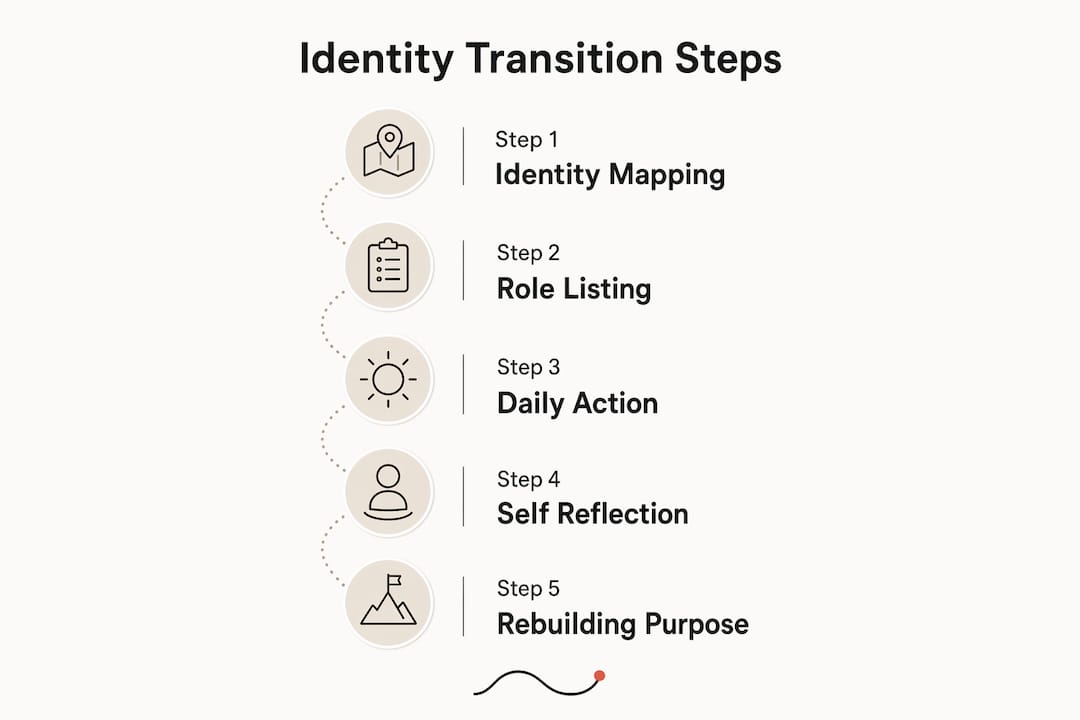
Two practical techniques from identity theory support this transition. The first is identity mapping: listing the roles and qualities that defined you before caregiving and noting which ones still feel alive. The second is identity bridging: finding the values that ran through both your pre-caregiving self and your caregiving self, because those values are the continuity thread you can carry forward.
| Identity work technique | What it does |
|---|---|
| Identity mapping | Reveals which pre-caregiving roles still resonate and which need to be rebuilt |
| Identity bridging | Connects past and present self through shared values, reducing the sense of rupture |
| Pie chart visualization | Makes the scale of caregiving’s time investment visible and identifies reclaimable hours |
| Naming the caregiver self | Reduces shame and confusion by treating caregiving as a legitimate identity phase |
Owning the caregiver identity, rather than rushing past it, is itself a form of healing. Recognizing how caregiving changes you is the first step toward finding support and moving forward with clarity.
What measurable changes happen after caregiving ends?
The research on life after caregiving is more encouraging than most women expect. A 2026 study published in the European Journal of Health Economics found that exiting caregiving roles results in improved mental health, emotional wellbeing, social functioning, and higher employment rates. These are not small or temporary gains. Women who provided at least 10 hours per week of care see both immediate and sustained benefits once caregiving ends.
That threshold of 10 hours per week matters because it captures the point at which caregiving begins to function as a second job, reshaping your schedule, your social life, and your sense of self. Using hours per week rather than vague role labels gives you a more honest picture of what you carried and what you are now free to reclaim.
The benefits of transitioning out of caregiving include:
-
Measurable reductions in anxiety and depressive symptoms
-
Greater capacity for social connection and friendship maintenance
-
Increased likelihood of returning to or advancing in paid work
-
More time available for personal growth after 40 and new goal-setting
-
Improved physical health outcomes linked to reduced chronic stress
Planning your transition with this evidence in mind changes the experience. When you know that the disorientation is temporary and that wellbeing genuinely improves, you can treat the difficult early weeks as a phase to move through rather than a permanent state to fear.
How to intentionally rebuild identity and find purpose beyond caregiving
Finding purpose outside caretaking is not a single decision. It is a series of small, deliberate choices that accumulate into a new life pattern. The research is clear that simply regaining free time is insufficient. Cognitive and emotional frameworks must be realigned for genuine healing to occur.
Here is a sequence that works:
-
Map your identity. Write down every role you held before and during caregiving. Note which ones feel like yours and which feel borrowed or lost. This is your starting inventory.
-
Set one compassionate boundary per week. Boundaries after caregiving are not about pushing people away. They are about practicing the experience of prioritizing yourself, which may feel unfamiliar at first.
-
Choose one micro-action daily. Micro-actions and meaningful activities build confidence and create new life patterns that honor past roles while fostering autonomy. A micro-action might be a 20-minute walk, a single page of a book you chose for yourself, or one phone call to a friend you have been meaning to reconnect with.
-
Experiment without committing. Rediscovering hobbies after caregiving works best when you treat new activities as experiments rather than auditions. You are not looking for your permanent passion. You are gathering information about what still lights you up.
-
Seek community deliberately. Support groups, therapy, coaching, and women’s purpose communities all reduce the isolation that post-caregiving identity work can produce. Connection is not a luxury in this process. It is a structural requirement.
Pro Tip: Keep a simple weekly log with two columns: “What I did for others” and “What I did for myself.” Most women are startled by the imbalance in the first few weeks. The log makes the shift visible and gives you something concrete to adjust.
Your existing routines, the ones that persisted even through caregiving, are anchors of continuity. Morning coffee, a weekly walk, a favorite playlist. These small rhythms carry your identity through the transition and give you a stable foundation to build on.
What role does meaning-making play in sustaining identity post-caregiving?
Caregiver identity can extend beyond active care, requiring ongoing meaning-making even after caregiving duties end. A 2026 qualitative study of spousal caregivers of people living with dementia found that caregivers develop resilience by adapting to shifting roles and sustaining identity through engagement and shared history. The caregiving experience does not disappear when the role ends. It becomes part of the story you carry forward.
Meaning-making in this context is the practice of integrating what caregiving taught you- about patience, about presence, about what genuinely matters- into the identity you are building now. This is not about romanticizing a difficult experience. It is about refusing to let it be only a loss.
Three practices support ongoing meaning-making:
-
Values continuity: Identify the values that caregiving expressed- compassion, loyalty, attentiveness- and find new contexts where those values can live. Living intentionally after 40 means choosing activities and relationships that reflect what you care about.
-
Shared history as resource: If the person you cared for is still in your life, the relationship continues to evolve. If they are not, the shared history remains a source of meaning rather than only a source of grief.
-
Embracing non-linear progress: Women recovering identity post-caregiving must navigate ambiguity and incremental progress rather than expecting instant clarity. Some weeks will feel like forward movement. Others will feel like standing still. Both are part of the process.
Identity accrual, the gradual accumulation of a new self, is not a project with a completion date. It is a lifelong orientation toward growth, curiosity, and honest self-knowledge.
Key takeaways
Life outside the caretaking role is an identity reconstruction process, not a passive return to who you were before. It requires named techniques, community support, and patient, incremental work.
| Point | Details |
|---|---|
| Identity reconstruction is the core work | Post-caregiving life requires active identity work, not just the passage of time. |
| Disorientation is predictable and temporary | Structural, relational, and purpose losses are normal responses to role exit, not personal failures. |
| Measurable wellbeing improves after caregiving | Women who provided 10+ hours per week of care see sustained mental health and social gains after the role ends. |
| Micro-actions build new patterns | Small daily choices accumulate into a new identity more reliably than large, dramatic reinventions. |
| Meaning-making sustains long-term identity | Integrating caregiving’s lessons into your evolving self creates continuity rather than rupture. |
What I have learned about the other side of caregiving
By Theresa
I have sat with women who describe the end of caregiving as a strange kind of grief nobody warned them about. They expected relief. They got relief, yes, but also a silence that felt louder than the caregiving ever did. The schedule that had once felt suffocating suddenly felt like the only thing holding them together.
What I have come to believe is that the disorientation is not a problem to be solved quickly. It is information. It is your self, asking to be heard after years of being set aside. The women I have seen move through this most gracefully are not the ones who immediately fill the calendar with new activities. They are the ones who sit with the question long enough to hear an honest answer.
Patience with yourself in this season is not passivity. It is a form of respect for the scale of what you carried. Celebrate the small wins: the first morning you woke up and thought about what you wanted, the first time you said no without apologizing, the first hobby you tried just because it sounded interesting. Those moments are the foundation.
Seek support without waiting until you feel ready. Therapy, coaching, community, these are not signs of struggle. They are signs of someone who takes her own becoming seriously. And that's exactly the kind of woman this season is for.
— Theresa Stairs
Ready to explore what comes next for you?
You have spent years being excellent at what others needed. Now the question that belongs entirely to you is rising. What do you want with this chapter?

Obsessedforlife was built for exactly this moment. Through the Obsession Map, an original guided assessment, you can explore what brings you joy in this season, what values drive you, and what experiences are genuinely waiting for you. It's a mirror, designed to reflect back a picture of what lights you up so the path forward feels like yours. Because it is. Whether you are 42 or 68, you are finally beginning. Visit Obsessedforlife and let the next chapter start on your terms.
FAQ
What is life outside the caretaking role?
Life outside the caretaking role involves reconstructing your identity after caregiving has ended or been significantly reduced. It involves reclaiming personal purpose, rebuilding social connections, and integrating the caregiving experience into an evolving sense of self.
How long does post-caregiving disorientation last?
Post-caregiving disorientation varies by individual and by the intensity of the caregiving role, measured in hours per week. Research shows that wellbeing improves meaningfully after role exit, but the identity work involved is gradual and non-linear rather than resolved on a fixed timeline.
What are the first steps to rediscovering yourself after caregiving?
Identity mapping, listing your pre-caregiving roles and values, and choosing one small daily action for yourself are the most practical starting points. Support and community also reduce isolation and help normalize the identity changes you are experiencing.
Does caregiving identity disappear when the role ends?
Caregiving identity does not simply disappear. Research from a 2026 qualitative study of dementia caregivers shows that caregiver identity persists in adapted forms, requiring ongoing meaning-making rather than an abrupt ending.
Can former caregivers return to work or pursue new goals after caregiving?
A 2026 study found that women who exited caregiving roles showed higher employment rates and improved social functioning. Pursuing new experiences after 40 is not only possible but supported by measurable improvements in wellbeing once the caregiving role ends.