

If you've outgrown YourCareerHomecoming.com or simply want to compare your options before committing, five platforms stand out as credible alternatives for mid-to-late career professionals seeking meaningful transitions: NueCareer, CareerNav Pro, CaseY AI, Leapr, and Pivot Wings. Each takes a different angle on what career change actually requires at this stage of life, whether that's deep personal discovery, data-driven job matching, AI-powered efficiency, executive network access, or mission-aligned coaching.
Here's a quick orientation before you go deeper:
- NueCareer: Personalized coaching built around purpose-led frameworks for mid-to-late career professionals. Pricing is not publicly listed; contact for consultation.
- CareerNav Pro: Assessment-based career guidance with job matching tools for professionals who want data behind their decisions. Tiered plans available; pricing not publicly listed.
- CaseY AI: AI-powered resume tailoring and job board matching for tech-comfortable professionals who want speed and efficiency. Subscription-based; pricing not publicly listed.
- Leapr: Executive-level platform focused on hidden job markets, private equity intel, and proprietary networking. Premium pricing; contact for details.
- Pivot Wings: Niche coach network for professionals pivoting toward mission-driven work in sectors like B-corps and nonprofits. Pricing not publicly listed.
None of these are a perfect replica of YourCareerHomecoming.com's WHOLE Method, which founder Laura Simms built specifically around the idea that career change requires identity work, not just tactical pivots. But each alternative addresses a real need that high achievers at midlife often carry into a coaching relationship.
Which YourCareerHomecoming.com alternatives best fit your career stage?
The five platforms differ enough that choosing between them is less about quality and more about fit. A side-by-side look at their core dimensions makes the contrast clear.

| Platform | Core features | Key differentiator | Pros | Cons | Who it's for | Pricing |
|---|---|---|---|---|---|---|
| NueCareer | Personalized coaching, purpose frameworks, one-on-one sessions | WHOLE Method-inspired integration of purpose and career goals | Deep personal alignment focus; structured for mid-career complexity | Less emphasis on job board tools or AI efficiency | Mid-to-late career professionals wanting holistic coaching | Not publicly listed |
| CareerNav Pro | Career assessments, strategic job matching, guided navigation | Assessment-first approach with actionable job search tools | Strong data foundation; clear next steps from assessments | Less emphasis on emotional or identity work | Professionals who want evidence behind their direction | Tiered plans; not publicly listed |
| CaseY AI | AI resume tailoring, job board scraping, match scoring | AI-driven application process across multiple boards | Fast, efficient, reduces manual application time | Tactical rather than strategic; limited coaching depth | Tech-comfortable professionals prioritizing speed | Subscription-based; not publicly listed |
| Leapr | Hidden job market access, executive networking, private equity intel | Proprietary network and unadvertised role database | Access to roles never posted publicly | Premium cost; less suited for non-executive transitions | Senior professionals and executives | Premium; contact for details |
| Pivot Wings | Mission-driven coach network, values alignment, sector-specific coaching | Niche focus on B-corps, nonprofits, and purpose-led organizations | Coaches who genuinely understand mission-driven sectors | Narrower scope; less useful if sector isn't values-driven | Career changers moving toward meaningful work | Not publicly listed |
NueCareer
NueCareer positions itself closest to the YourCareerHomecoming.com philosophy. Its coaching frameworks draw from purpose-led thinking, treating career change as a question of identity and values, not just job titles. For professionals who feel the pull of something more meaningful but can't yet name it, this kind of structured exploration tends to produce clarity that a job board never will. The platform focuses on one-on-one coaching, which means the experience is shaped around your specific situation rather than a generic program.

CareerNav Pro
CareerNav Pro takes a more analytical path. It leads with career assessments, the kind that surface patterns in your strengths, values, and work style, and then connects those results to job matching tools. This works well for professionals who feel paralyzed by too many options and want a framework to narrow the field. The limitation is that assessments can tell you what you're good at without fully addressing why you've been feeling stuck, which is often the deeper question at midlife.
CaseY AI
AI tools increase efficiency in job searching, but they work best as a complement to strategic thinking, not a replacement for it. CaseY AI understands this distinction reasonably well. Its core strength is automating the mechanical parts of a job search: tailoring resumes to specific postings, scoring match percentages, and scanning multiple job boards at once. For a senior professional who already knows what they want and simply needs to move faster, CaseY AI removes real friction. For someone still working out what they want, it's the wrong starting point.
Leapr
Executive-level opportunities are often hidden, sitting inside private equity networks and recruiter conversations that never reach a public job board. Leapr is built around that reality. Its proprietary database and network access give senior professionals a view of the market that general platforms simply don't offer. If you're at the VP level or above and targeting roles that require a warm introduction rather than an online application, Leapr addresses a genuine gap. The investment reflects the exclusivity of the access.
Pivot Wings
Pivot Wings fills a specific and underserved space: coaching for professionals who want their next chapter to mean something beyond compensation. Its coach network specializes in sectors like B-corps, nonprofits, and social enterprises, which means the coaches understand the trade-offs involved in moving from a high-earning corporate role toward mission-driven work. Niche coaching platforms focused on mission-driven sectors consistently show better alignment outcomes for mid-career transitioners with values-led priorities. Pivot Wings is the clearest expression of that principle among the five alternatives here.
How to choose the right career coaching platform at midlife
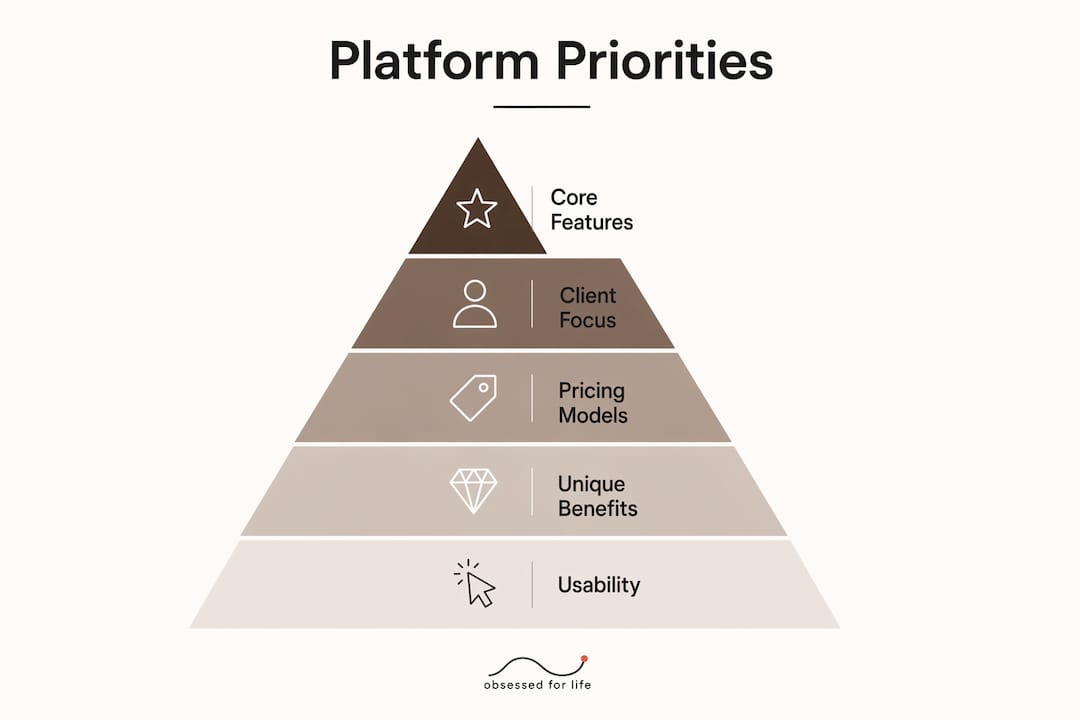
Choosing a career coaching platform when you're 15 or 20 years into a successful career is a different exercise than choosing one at 28. The stakes are higher, the identity questions are more complex, and the tolerance for generic advice is lower. A few criteria separate the platforms worth your time from the ones that will leave you exactly where you started.
Start with the coaching method, not the features list. A platform that leads with resume templates or job board access is solving a surface problem. At midlife, the harder work is figuring out what you actually want, which requires a coach trained in deep-discovery frameworks rather than someone who can polish a LinkedIn profile. Ask directly: what methodology does this platform use, and how does it address career identity, not just career tactics?
Check coach credentials specifically. Certification matters, but the type of certification matters more. A coach certified in career strategy is different from one trained in emotional intelligence, identity work, or sector-specific transitions. The Muse's Coach Connect platform offers hundreds of certified coaches across specializations, which illustrates how wide the credential range can be. Know what you need before you evaluate who has it.
Watch for red flags:
- Promises of rapid results without a discovery process
- No certified coaches or vague credentials
- A program that looks identical for every client
- Pricing that's entirely hidden with no explanation of what you're buying
Trust signals worth looking for:
- Published coaching philosophy with a named methodology
- Real client outcomes described in specific, not generic, terms
- A free consultation or assessment before any financial commitment
- Transparent pricing tiers or at least a clear explanation of how pricing works
Match the platform's focus to your actual priority. If you want access to unadvertised executive roles, Leapr is the right tool. If you're moving toward nonprofit or B-corp work, Pivot Wings has the sector knowledge. If you need to understand your own values before you can choose a direction, NueCareer or a platform modeled on deep-discovery coaching will serve you better than an AI job matcher. Networking and niche job boards consistently outperform general platforms for high-level transitions, but only when the platform's niche matches yours.
The U.S. Department of Labor's CareerOneStop also offers free career assessment tools and exploration resources, which can be a useful starting point for clarifying direction before investing in a paid coaching platform.
Pro Tip: Before you pay for any coaching platform, ask to speak with a coach for 20–30 minutes at no cost. How that conversation feels, whether the coach listens more than they pitch, tells you more than any feature comparison.
Why emotional intelligence matters more than tactics at this career stage
Tactical career advice, the resume tips, the interview scripts, the LinkedIn optimization, is widely available and largely interchangeable. What separates a genuinely useful coaching platform for mid-to-late career professionals is something harder to package: the capacity to work with the emotional and psychological weight that high achievers carry into a career transition.
Burnout is one part of it. So are what coaches sometimes call "golden handcuffs," the combination of financial security, status, and identity investment that makes it genuinely difficult to leave a role that no longer fits, even when you know it doesn't. Career transitions that incorporate emotional intelligence and address these psychological restraints tend to produce more durable outcomes than those built purely on tactical approaches. The reason is straightforward: if you haven't worked through why you stayed so long in the wrong place, you're likely to recreate the same pattern somewhere new.
Mission-driven coaching addresses this at a structural level. When a platform is built around values alignment rather than job placement, the coaching conversation naturally moves toward questions of meaning, identity, and what you actually want your work to do in the world. That's a different conversation than "here are three companies hiring in your field."
The benefits of emotionally intelligent, mission-focused coaching for mid-career professionals include:
- Clearer sense of personal values and how they translate to career choices
- Reduced risk of repeating the same dissatisfying patterns in a new role
- Greater confidence in making a transition that involves real financial or status trade-offs
- Better ability to articulate your own story during interviews and networking conversations
- Stronger long-term satisfaction with the direction chosen
For women navigating this territory, the questions often run deeper than career strategy alone. Career peaks frequently trigger broader life questions that no amount of job board access will answer. Understanding that connection is the first step toward finding the right kind of support.
A note on analytical skills: The ability to assess your own patterns, strengths, and blind spots is itself a career asset. Platforms that build this capacity into their coaching process, rather than simply delivering a report, tend to produce more lasting results. A good guide to analytical career change skills can help you approach this kind of self-assessment with more structure.
The emotional dimension of career change is also where managing emotions effectively becomes a practical skill, not just a personal development concept. Coaches who integrate this work into their methodology are offering something qualitatively different from those who don't.
Obsessedforlife offers a different kind of starting point
The platforms compared above are all built around career coaching in the traditional sense: they help you find a new role, a new direction, or a new professional identity. Obsessedforlife starts somewhere else entirely.

If you're a woman at 40, 50, or beyond who has spent years being excellent at what others needed, and who is now sitting with a quieter, more personal question, what do I actually want with my life, Obsessedforlife was built for exactly that moment. It's not a job placement platform or a resume service. It's a self-discovery space for women 40+ who are ready to stop performing a version of success that no longer fits.
The Obsession Map, Obsessedforlife's original guided assessment, helps you explore what brings you joy in this season, what values are driving you now, and what experiences you genuinely want in this chapter. It listens to who you are and reflects back a picture of what lights you up. That clarity, knowing what you're actually moving toward rather than just away from, is often the missing piece before any career coaching can really land.
For women who want to understand life beyond professional goals before choosing a new direction, Obsessedforlife is a thoughtful first step.
Key Takeaways
The most effective career coaching platform for mid-to-late career professionals is the one that matches your actual need, whether that's identity work, executive network access, mission alignment, or AI-driven efficiency.
| Point | Details |
|---|---|
| Match platform to your real need | NueCareer suits identity-focused transitions; Leapr suits executives targeting hidden roles; Pivot Wings suits mission-driven pivots. |
| Credentials vary widely | Ask specifically what methodology a coach uses, not just whether they are certified. |
| Emotional intelligence matters | Coaching that addresses burnout and values alignment produces more durable career outcomes than purely tactical approaches. |
| AI tools complement, not replace, strategy | CaseY AI and similar platforms work best when you already know your direction and need execution speed. |
| Obsessedforlife | For women 40+ asking what they truly want, the Obsession Map offers a self-discovery foundation before formal career coaching begins. |